Doctor Who episode 877: The Timeless Children (1/3/2020)
‘It’s all lies. None of this is the truth.’ The Deadly Assassin of the 21st Century, with a showdown between the Doctor and the Master on Gallifrey, a lengthy sequence in the Matrix, and a similar emetic reaction from a subset of fans. Whether it proves as influentially iconoclastic as Robert Holmes’ story only time will tell. And around the edges, it also acts as a series climax, wrapping up Asahd’s plans for the ascension of the Cybermen, revealing the truth about Ruth and Brendan, and explaining the Master’s Time Lord plan.
Considered as the finale, this is a lot stronger than Chibnall’s previous form in either Torchwood or Doctor Who. The stakes are suitably high and personal, with the Doctor face to face with her best enemy like Jack coming up against Gray in Exit Wounds, and a Death Particle threatening all life in the universe. True, it would have been helpful to have at least heard about this particle before it’s suddenly relevant to the plot, and true, Ashad’s plan to make the Cybermen into robots is a bit crap – but both of these are turned into sort-of strengths as rubbish robots give the Master an “in” to the Cyber plan, while the Death Particle lets us glimpse his nihilism in the face of the revelations about his own existence. In the end, though, it’s the Doctor who presumably exterminates anyone beyond the capitol when she arranges to unleash the particle upon Gallifrey. Wiping out the Morris-dancing Shobogans and their enemies alike left a previous incarnation with a hefty dose of survivor’s guilt, but this version has more personal issues to deal with.
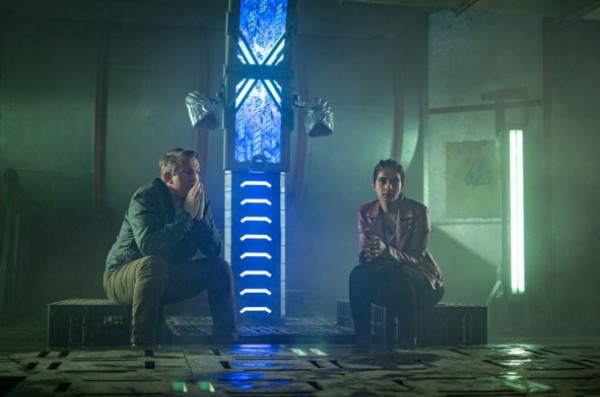
Elsewhere, Graham and Yaz get a lovely scene together as they stare into the abyss. It’s probably Chibnall’s strongest attempt at this sort of moment. There’s a tense, Shaun of the Dead sequence of humans having to pretend to be Cybermen to escape detection, with the lovely release of them popping their heads out of storage units in a very un-Cyberman way. Ko Sharmus gets to be Obi Wan on the Death Star as he destroys the Cyber mothership, and later steps in to to save the day so the hero can escape. Ryan, again, has nothing to do – but he’s been the biggest casualty of the extended Fam this year.
As a conclusion to the series arc, it’s not quite as effective. The warning of the lone Cyberman is addressed, but it’s less clear what any of it has to do with Jack. Ashad turns out to be very dull as soon as soon as the Master turns up. The climactic return of the Judoon promises another chance to tie up these loose ends – which is fine, but we didn’t really need a 10-month wait for these administrative questions. Instead, it’s the big stuff that all gets resolved here: the fall of Gallifrey, the Master’s destructive madness, Ruth and Brendan’s identities (sort of) and the ‘lie of the Timeless Child’.
This remains Chibnall’s second most divisive decision, and I might as well admit I don’t like it. But I don’t like any attempts to “reintroduce mystery” to the Doctor’s character because they all, inevitably, lead to fairly tiresome answers. I’m sceptical that The Timeless Children will have any long-term implications for a character who’s successively been a refugee from the 49th Century, a runaway god of Time, a half-human hybrid, a creation of the Untempered Schism and an insignificant Outsider living in a barn, before you even take into account tie-in media that say she’s a reincarnation of one of the Gallifreyan Founding Fathers or a crystal man from the end of time.
Chibnall’s reinvention of the Doctor as the most important being in Gallifreyan history smacks of modish superhero origin stories, even as it hews to Andrew Cartmel’s concept of the Doctor being ‘far more than just another Time Lord.’ It’s also irrelevant, which the story even points out – ‘Have you ever been limited by who you were before?’ Unless the series is going to fundamentally change, nothing we learn about the Doctor’s past alters who she is or what she does. Discovering that a benevolent time-travelling alien is actually a slightly different benevolent time-travelling alien is hardly up there with “Luke, I am your father” – an insight that fundamentally shifts the relationship between the hero and villain and provides new storytelling possibilities. It’s just information.
Worse: information delivered in a way that interrupts the flow of the episode, extracting the Doctor from the story for an extended piece of artless exposition, instead of being something that she discovers for herself. Plus, by jumping straight from a couple of hints and the tease of Ruth, which the Doctor hasn’t shown much further interest in pursuing, to this makes the whole arc pay-off feel unearned. She, like us, is reduced to having to listen to a fan expound his personal theories about how the Shobogans and Rassilon fit together, like she’s been cornered at the Fitzroy Tavern circa 1998. And because Chibnall retains some responsibility as showrunner, he even builds in multiple trapdoors (the Timeless Child is called a lie by both the Doctor and the Master, and there’s a whole sub-plot about false memories). The end result is both a damp squib, and eminently ignorable should you wish it.
The best bits of The Timeless Children are pretty good. Dhawan’s return improves over Spyfall, as he makes the Master genuinely hateable in a way that, barring Simm in The Doctor Falls, none of the previous ones has been, and Whittaker plays the Doctor’s visible contempt something like Tom Baker’s in Logopolis. The Cyberman action scenes feel like they have the scale and horror Eric Saward was reaching for. The Cyber Lords look a bit ridiculous with their fancy engravings, but there’s a solid idea there that might have been profitably explored had Chibnall not been diverted by his About Time essay. The cliffhanger into the 2021 New Year special is great.
Next Time: Lockdown Adventures
 Next Time...
One comment