Sideways in Time: An Unearthly Child / Pathfinders…
‘Bringing science fiction into reality, Britain has launched two manned space rockets to the Moon.’ Doctor Who didn’t spring from nowhere. The aim of these entries is to look sideways from each Doctor Who serial at other media, seeking out influences and inspirations, and boldly viewing what no Matt has viewed before. Starting with the Pathfinders… serials from the early 1960s. There were four (the first, Target Luna, is lost) written by Malcolm Hulke and Eric Paice, and produced by Sydney Newman. They focus on Professor Norman Wedgewood’s British rocket programme as it succeeds (albeit with a safety record as bad as Quatermass’s – invariably journalists, children and rodents find their way on board) first in sending humans into space, then to the Moon, Mars and finally Venus.
The influences are obvious. Pathfinders… is a series of serials, each between six and eight episodes, each about 25 minutes long, and each ending on a dramatic cliffhanger. Beyond that, it involves a mix of scientific boffins and adventurous kids who get into scrapes as they discover the mysterious hidden history of the Solar System. Doctor Who is very much Newman’s refinement of this concept for the BBC, but the essentials are mostly present here – particularly from the third serial, Pathfinders to Mars, which slims down the main cast and introduces Harcourt Brown (George “Arbitan” Colouris), a crank scientist with wild theories about life on Mars, and a cavalier attitude towards the lives of his fellow travellers.
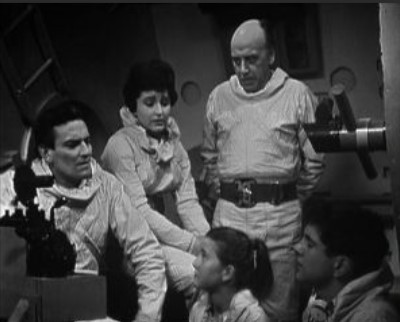
By the final serial, Pathfinders to Venus, Brown is faking emergencies to force the travellers’ rocket ship to land on Venus so he is able to go exploring a city he’s glimpsed from orbit. With Brown, Gerald “Kamelion” Flood’s square-jawed pilot Conway Henderson (it even sounds like Ian Chesterton), kind-but-stern scientist Mary Meadows (Pamela Barney) and the juvenile leads encountering cavemen and prehistoric monsters in an alien jungle, and battling malfunctions inside the spaceship, the template for the first 13 episodes of Doctor Who barely needs spelling out.
Beyond plot similarities, there’s a philosophical link between Pathfinders… and Doctor Who (at least Newman’s original, “no BEMs” concept). There’s a light but clear focus on scientific education (with attempts to simulate zero gravity in Pathfinders in Space and a long sequence about degaussing to avoid a magnetic meteor strike in Pathfinders to Venus). Pathfinders in Space leads to a slightly hoary reveal that ancient spacecraft discovered on the Moon belonged to the original Earth people, who were wiped out aeons ago in nuclear war – the kind of anti-war morality that runs through both An Unearthly Child and (more blatantly) The Daleks.
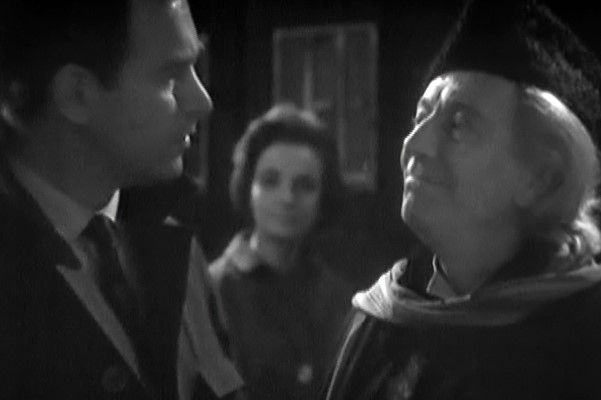
I’d never seen Pathfinders… before, and it’s quite cute, if clearly not as polished as Doctor Who. It’s pitched towards a younger audience, with three kids in the first extant serial and a lot of tiresome business with a guinea pig. But some of the ideas are great. Pathfinders in Space’s first mysterious spaceship, floating in orbit, slightly reminded me of the discovery of Liberator in Blake’s 7, and the discovery of a second, buried spacecraft recalls both Quatermass and the Pit and Journey into Space. It’s a shame Target Luna doesn’t survive because Michael Craze played the juvenile lead.
Next Time: The Daleks / The Time Machine
Sources: Pathfinders in Space (Network DVD, 2011); The Pathfinders in Space Series Guide (Andrew Pixley, 2011).
 Next Time...
One comment