Sideways in Time: The Daleks / The Time Machine
‘That box has three dimensions: length, breadth and height… But what is the fourth dimension?’ Clearly H.G. Well’s 1895 novel is an obvious cornerstone for subsequent time-travel science fiction: Sydney Newman recalled, ‘I’d read H.G. Wells, of course, and I recalled his book The Time Machine. That inspired me to dream up the time-space machine for Doctor Who’ I’m focusing specifically on George Pal’s 1960 movie starring Rod Taylor as a young, athletic and idealistic time traveller (rather like C.E. Webber’s original notion of the male companion “Cliff”) voyaging into the distant future where he eventually encounters the descendants of 20th Century humankind – the passive, childlike Eloi and the degenerate, monstrous Morlocks.
The early parts of the film have some passing similarities to Doctor Who, with George’s sceptical friends rejecting the idea that they might find free movement in time in a Victorian parlour, but it would be a stretch to spot much beyond the bones of the concept here (Waterfield and Maxtible’s experiments in The Evil of the Daleks come closer). As George travels forward in time, meeting the son of his friend Filby and realising that the Boer War, underway at the beginning of his travels, is only replaced by new and increasingly horrifying conflicts – the two World Wars, and then, in 1966, a terrible glimpse of an atomic holocaust to come as ‘the mushrooms will be sprouting’ and London is consumed by lava in scenes that might well have inspired the end of the world in Inferno.
But it’s not until George arrives 800,000 years hence that there are some very obvious moments mined for Hartnell stories. The Morlock-headed sphinx in whose shadow the time machine arrives is a close match for the Monoid-headed statue on The Ark, and the shaggy-haired Morlocks might well have inspired the Monoids both visually, and in the way they stalk the futuristic jungles and prey upon the hapless, tunic-wearing Eloi.
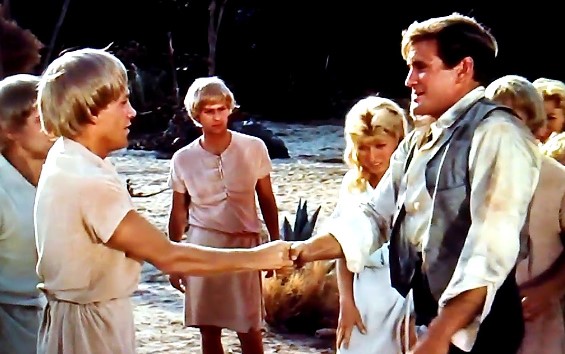
However, it’s Terry Nation’s original Dalek story that has the clearest overlap with this. Consider George, youthful and heroic, diving into a river to save Weena from drowning while her fellow Eloi barely notice her pathetic mewls of distress. The Eloi are beautiful people, within a narrow ethnic range, ideal specimens of humankind. But they are entirely passive, blissed out as they wander through the forests of future Earth and preyed upon by the Morlocks, just as the Thals, in theory the inheritors of Skaro, are helpless in the face of the Daleks’ superior gumption and determination. And just as in The Daleks, the young hero, Ian, can only defeat the monsters (and escape back to his own time) by inspiring the Thals to abandon their meekness and fight back, so here George must teach the Eloi to rebel.
The parallels are also evident in the history of both Skaro and 800,000 Earth. The Thals have their tablets recording their history, the Eloi have talking rings, but the story is the same. On both planets, devastating war meant ‘the labour of centuries, gone in an instant.’ Of the desperate survivors, some took refuge beneath the earth, the others took their chances on the surface. The Earth-dwellers became the Morlocks, safe from the poison air inside their city. The surface-dwellers became the Eloi. There are other small parallels – the promise of free food brings the Eloi under Morlock control, flashes of Morlocks moving in the dark jungle echoes scenes of Alydon stalking Susan through the petrified forest, and both stories climax with a battle inside the monsters’ city.
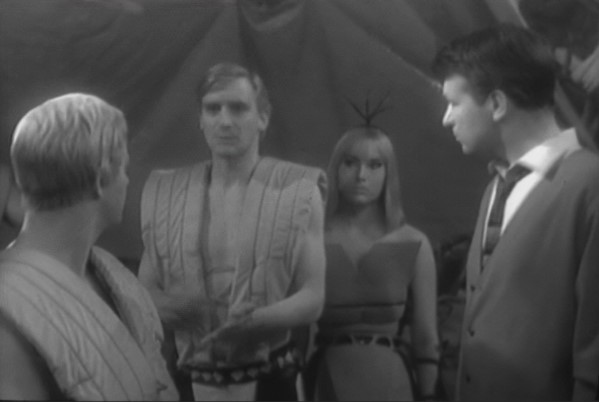
The Daleks is not a slavish rehash of The Time Machine: Nation spends much more time exploring Skaro; the Thals are never quite as useless as the Eloi, and the horror of nuclear war and bodily mutation are much more present in his scripts (just as they’re naturally more present in Pal’s movie than Wells’ book). In the film, George fulfils the role of both the Doctor (the inventor of the time machine) and Ian (the hero), and there’s no equivalent of Barbara or Susan (Weena is more like Dyoni) – which works in the film’s favour given how little Nation finds for the Doctor and Susan to do in the back half of The Daleks. I rather like Pal’s movie, which is brisk and effective, with a great performance from Taylor (his silent disgust when he learns of World War One is outstanding). But then, I rather like The Daleks.
Next Time: The Edge of Destruction / Out of the Unknown
Sources: The Time Machine (George Pal, 1960); Sydney Newman Interview (Doctor Who Magazine, 1986); Doctor Who (before the TARDIS) (BBC News website, 2008)
 Next Time...
One comment