Sideways in Time: The Edge of Destruction / Out of the Unknown
‘The Machine stops.’ I’m not a huge fan of The Edge of Destruction, which, during the Pilgrimage, I sniffily opined, “feels like hard work for little reward.” I largely stand by that, but a couple of things I picked up on in the review, which I’m revisiting here, are the ideas that, “it looks stagier than any other Doctor Who episode I can think of” and “the AI was better than the first Dalek episode, so it can’t have been that badly received.” It seems to me now that I brushed past the essence of the episodes, which represent the show tapping into a contemporary vein of single, science fiction plays that largely no longer exist.
TV used to be full of Plays of the Week – I have several DVDs and Blu-Rays full of them – and Sydney Newman was a keen supporter, overseeing the famous Armchair Theatre anthology while at ABC in the late 1950s and early 1960s, and offering Irene Shubik the role of script editor. In 1961, Shubik proposed to Newman an Armchair Theatre spin-off focusing on literary science fiction. This became Out of This World, featuring adaptations of stories by authors such as Philip K Dick and Clifford Simak, adapted by scriptwriters including Terry Nation (an Asimov adaptation, Little Lost Robot, is the sole extant episode).
In 1962, Newman was poached to join the BBC and quickly headhunted Shubik. Both were keen to import the Out of This World idea, but the complexities of clearing suitable source material and creating new science fiction environments meant the BBC version, Out of the Unknown, didn’t debut until 1965 – by which time Doctor Who was in its third season. The episode I’m focusing on, The Machine Stops, an adaptation by Kenneth Cavander and Clive Donner of a story by EM Forster, launched the second season in 1966 – weeks before William Hartnell bowed out of Doctor Who (the special effects designer Michaeljohn Harris went on to do uncredited effects work on The Tenth Planet).
Clearly, The Machine Stops didn’t influence The Edge of Destruction (unless David Whitaker was particularly thinking of the Forster’s story, which I doubt). It may have been inspired by it, but I think that’s equally unlikely given the long gap between productions. The parallels are more in the style of production, and the kind of storytelling both employ. Because The Edge of Destruction, with its consciously weird and unsettling effects and script, as human beings start to break down in sympathy with the machine that provides their every life support, shares thematic concerns with this.
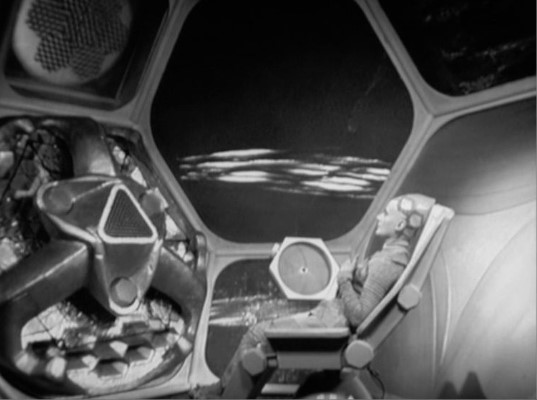
The Machine Stops is set in Earth’s future when humankind has become entirely dependent on a great machine that runs everything for them. They are connected not intimately, but via screens, like a 1960s Zoom, each individual living their own private lockdown. They barely even move without the machine orchestrating it: chairs roll them around their living quarters (which reminded me of Dennis Potter’s sci-fi play Cold Lazarus), if an item is dropped, the floor lifts it back up. Walking is a half-forgotten habit. Travel is permitted but is frowned on. Illness is treated by a horrible, twitching, probing device that descends from the ceiling, or by euthanasia when pain or age become mildly tedious. In short: a dystopian utopia, where humanity has been eliminated along with want.
One of the inhabitants of this machine world, Kuno, rejects the tyranny of the machine, struggling out of his habitat to find his way to Earth’s surface where the air is less poisonous than he has been led to believe, and free people live. He’s like a Morlock (or a Dalek) discovering the Eloi. His mother, Vashti, strongly disapproves of such sensualism, and of Kuno’s ‘new’ ideas (all dully recycled). One day, though, Kuno comes to a genuinely new and terrible idea: the Machine stops. When it does, the knowledge to repair it has been lost, and the machine people are doomed.
There are visual similarities to The Edge of Destruction: strange camera moves as Vashti is troubled by her son and the camera swoops into quivering dials and oddly twitching membranes. There are BBC science fiction design choices, too: hexagons, everywhere, very like Brachacki’s TARDIS. Hexagonal corridors that seem to prefigure the entrance to Blake’s 7 ‘s Liberator flight deck. Hair is largely shaven or shed, to be replaced by odd hats – a world Madeleine Issigri would fit right in. The root of the horror is not that machines will replace people, it’s that people will lose the knowledge to live without the machines. Barbara’s human instinct and intuition trump the Doctor’s logic and save the day in Doctor Who. Out of the Unknown is less comforting – although Kuno and Vashti repeat some of Barbara and the Doctor’s conflict, they can’t escape their system, and perish with it. Audiences of the 1960s were tuned into this kind of consciously weird, almost confrontational drama in a way we are, perhaps, no longer. Out of the Unknown helps me to appreciate The Edge of Destruction more, even if it doesn’t make me like it any better. Discounting the historicals, it’s the start and end of Sydney Newman’s wish for Doctor Who to be science fiction with “no BEMs”.
Next Time: Marco Polo / Alexander the Great
Sources: Out of the Unknown (BFI DVD, 2014); Out of the Unknown (Mark Ward, 2004)
 Next Time...
One comment