Sideways in Time: The Aztecs / The Feathered Serpent
‘Blood. Blood. There shall be more blood.’ The Discontinuity Guide states The Royal Hunt of the Sun, Peter Shaffer’s 1964 play of the fatal encounter between Spanish conquistadors and the Inca, as a key influence on The Aztecs. About Time is less confident, suggesting the dates of the first performance don’t quite stack up with when we know John Lucarotti proposed an Aztec story. Other than the Mexican setting and possibly the theme of Atahualpa’s baptism, which has some slight parallels to Autloc’s own spiritual awakening, I don’t perceive significant influences, and am more inclined to the About Time view. Instead, I speculated in the Marco Polo / Farewell, Great Macedon entry, that perhaps Lucarotti was working from the same prompt as Moris Farhi – the notion of the TARDIS crew interfering in history, for philanthropic purposes but against the customs and consent of the locals – weaving this (David Whitaker?) idea into his Aztec setting.
Interestingly, The Feathered Serpent, a 1976 Thames TV series set in a Mexican civilisation caught between a benevolent old god, Quala and a bloodthirsty new one, Teshcata, feels much closer in both content and execution to The Aztecs than The Royal Hunt of the Sun. It stars Patrick Troughton as Nasca, the equivalent of Tlotoxl, conniving to ensure the sacrifices to Teshcata continue, and Emperor Kukulkhan’s people do not revert to Quala. The emperor himself describes the sacrifices as ‘barbaric’ and seeks to minimise them, which makes him a spiritual descendant of Yetaxa. Like the Temple of Yetaxa, the great pyramid of Teshcata is full of secret passages and traps, which are key to the resolution of the story. It also features, in the rivalry between Jaguar Knight Mahoutec (who becomes an ally of Nasca’s) and the Toltec Prince Heumec, a similar vibe to Ian’s antagonistic relationship with Ixta. And the whole tone of the piece has the same, studio-bound theatrical style (rather cruelly called out as “cod-Shakespearean” in some reviews of Network’s 2009 DVD release) as The Aztecs.
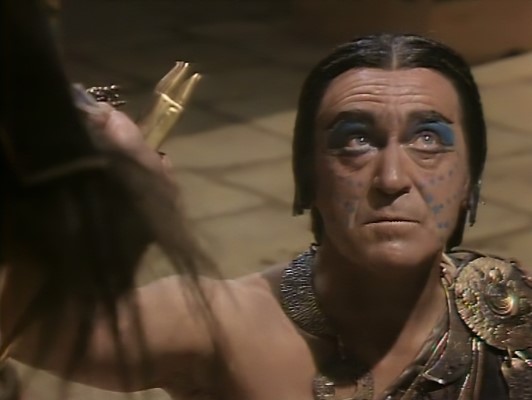
Despite these overlaps, I’d be surprised if John Kane was specifically thinking about a Doctor Who story broadcast once, a dozen years earlier, when writing The Feathered Serpent. Any research into pre-conquest Mexican civilisations is likely to suggest similar plot points – the unimaginable cruelty of human sacrifice alongside an otherwise fairly sophisticated culture, the warrior/priest classes, the monumental architecture. And, to me, the “cod-Shakesperean” approach is typical of much contemporary TV, particularly historical dramas (see also The Six Wives of Henry VIII and its spin-offs or I, Claudius). It’s not even especially noteworthy to find these elements in a 1970s children’s TV drama. The first series is gripping, with plenty of mildly gruesome incident and mostly strong performances. If The Aztecs is preferable, it’s mostly because the additional clash of 1960s liberal values with the 15th Century adds an extra level of incident.
Next Time: The Sensorites / Yesterday’s Enemy
Sources: The Feathered Serpent (Network DVD, 2009); The Royal Hunt of the Sun (Irving Lerner, 1969); BFI Screen Online – The Feathered Serpent
 Next Time...
One comment