Sideways in Time: The Reign of Terror / The Avengers – Girl on the Trapeze
‘I hope we get this settled quickly, I’m beginning to think it’s turning into flu.’ The Reign of Terror is a milestone story not only because it closes Doctor Who’s first season and features its first location filming, but mostly because it’s the writing debut of the show’s second story editor, Dennis Spooner, (succeeding David Whitaker from The Rescue). It’s the first significant change in production personnel, and one of the most influential, because Spooner’s particular style – quirky humour, oddball characters and a delight in juxtaposing the uncanny and the everyday – had as much or more impact than Whitaker’s scientific romance approach.
Spooner’s Wikipedia entry notes he was ‘known primarily for his programmes about fictional spies and his work in children’s television.’ It’s a description that fits The Reign of Terror like a glove. The earlier historicals had been written by John Lucarotti, and tended towards the show’s original, “educational” brief. The Reign of Terror does include some real history, but, as in Spooner’s later The Romans and The Time Meddler, it’s almost incidental to the story which is a French Revolution spy thriller in the vein of A Tale of Two Cities or The Scarlet Pimpernel, revolving around Ian’s unwitting involvement in the adventures of the secret agent James Stirling. There’s nothing like the map detailing Marco Polo’s stately progress towards Peking, or Susan being tutored in Aztec culture. It’s less Reith, more Steed.
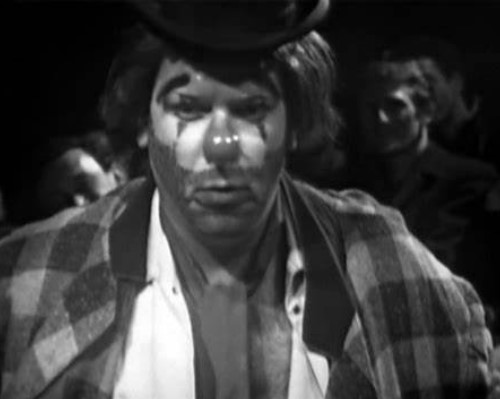
Broadcast on 11th February 1961, Girl on the Trapeze was Spooner’s first script for The Avengers, Sydney Newman’s other great 1960s telefantasy invention. It’s also the earliest extant Avengers episode, and one of the few not to feature Patrick Macnee. It focuses on Dr. Keel, Steed’s unwilling partner in crime, stumbling across an apparent bridge suicide which ultimately leads to him discovering a plot to smuggle a woman out of Britain and back to the Eastern Bloc under the cover of a troupe of circus performers. It’s a great episode, with an unusual setting, a convincing “heavy” in the shape of Kenneth J Warren’s Zibbo the Clown, and an idiosyncratic police superintendent lugubriously convinced he’s going down with the flu. Ian Hendry is a charismatic lead, in the very Ian Chesterton role of Dr Keel – a man caught up in, and secretly rather thrilled by, Steed’s world.
Spooner would specialise in these kind of light espionage stories, both as jobbing writer on The Avengers and The New Avengers (for which he wrote 12 more episodes), Thunderbirds and The Baron, and later as the co-creator of shows like Department S (and sequel Jason King), Randall and Hopkirk (Deceased) and The Champions – that is, series which presented science fiction or supernatural elements within real-world settings in a way that Doctor Who increasingly embraced from the late 1960s. The Time Meddler is a perfect example of the approach Spooner took for shows like Department S – seemingly baffling events (like the assassination of a dummy) gradually explained, with much wit.
The Reign of Terror contains less of that, and only marginally qualifies as spy-fi (given the presence of time travellers), but the inclusion of several comedy sequences and characters (the Doctor and the works foreman, the Conciergerie jailer) are blatant Spoonerisms, as is the appropriation of history as an exotic backdrop, like the Radeck State Circus in Girl on the Trapeze, and the focus on drinking (Keel is off for a knees-up at the start of the episode; Ian is desperate to get the Doctor to a pub at the start of The Reign of Terror, and The Romans is positively bibulous).
Temperamentally, it points the way to the lighter tone of most of Season Two, and overt comedies like The Romans, The Space Museum and The Chase. While it’s hard to credit Spooner with the show’s skyrocketing success through 1965 – Dalekmania and the first Cushing movie were bigger influences – the subtle adjustments to the show, focusing less on the original brief and more on witty adventuring point the way towards later Doctor Who much more reliably than The Sensorites or Marco Polo. Dennis Spooner was responsible for some of my favourite TV programmes, and is a bit of an unsung hero of Doctor Who. He’s the Douglas Adams of the 1960s.
Next Time: Crisis / The Urge to Live
Sources: The Avengers Forever website; Girl on the Trapeze (Studio Canal DVD, 2009)
 Next Time...
One comment