Sideways in Time: The Dalek Invasion of Earth / The War of the Worlds
‘It was plain the Martians appreciated the strategic significance of the British Isles. The people of Britain met the invaders magnificently, but it was unavailing.’ There’s something cinematic about Terry Nation’s Doctor Who scripts. Perhaps he just had a complete disregard for the limitations of Lime Grove, or, after The Daleks, an utter faith that the BBC could execute whatever he threw their way. But there’s a reason why Dr. Who and the Daleks and The Keys of Marinus were considered suitable for feature film treatments and, say, The Sensorites and Planet of Giants weren’t.
I wonder whether part of it is that Nation’s inspirations are cinematic – the Flash Gordon movie serials he saw as a kid, and the big-budget H.G. Wells adaptations that played in the 1960s and 60s. When I looked sideways at The Daleks, I compared it to the 1960 film of The Time Machine. This time, I’m looking at George Pal’s 1953 version of The War of the Worlds, which is clearly both a direct influence on The Dalek Invasion of Earth, and draws on the same historical inspiration as Nation: the experience of the Second World War.
The War of the Worlds begins, like Wells’ novel, with the dying Martians, having rejected all other possibilities, turning their attention to the lebensraum of their neighbouring planet and plotting the extermination of humankind. The film transposes the action from Victorian England to post-war California, with the local community at first intrigued by the mysterious meteorite that arrives on the outskirts of town. It’s charming, in a hokey sort of way, but this quickly turns to horror when the meteorite opens up to disgorge a death ray that roasts some of the folksy townspeople, reducing them to Hiroshima-style outlines in the dirt. It’s first blood in an invasion that quickly extends across the entire planet, with cities levelled and the defenceless survivors retreating into the countryside or huddling in ruined cellars and subways to escape the invaders.
There are some visual parallels – the sequence of Martian flying saucers destroying fleeing vehicles is repeated in Barbara and Jenny’s desperate escape from London in an old dust cart, while the Martian war machines in general are an influence on the Daleks (as they contain relatively feeble creatures that cannot survive in Earth’s biosphere, and which have spindly claws like the one we glimpse in The Daleks). Later Dalek stories imitate the effect of the death rays on humans – an x-ray glow revealing the skeleton (The Dalek Invasion of Earth has to settle for turning the screen negative).
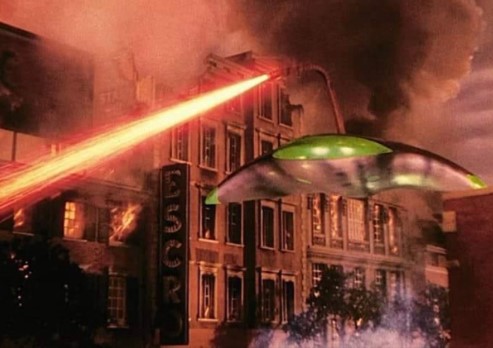
But the real overlap between the film and The Dalek Invasion of Earth is the focus on Second World War imagery. The military mobilisation looks like newsreel footage; the ruined cities look Blitzed out. Eight years after the war, the suffering in Europe was still fresh, and the importance of the British alliance still undimmed by Suez. Thought mostly noises off, the script specifies the significance of stubborn British resistance in the face of the Martian onslaught, and the importance of the information they are providing to the last bastion of the free world in the USA. Scenes of survivors huddling around radios or picking their way through devastated streets appear in both film and TV serial.
In the end, I think it’s this shared source that provides the added oomph to both – it’s one thing to imagine a devastating existential struggle against an implacable enemy, quite another to live through it (George Pal himself fled Berlin when the Nazis took power, and eventually emigrated from France to the United States just at the beginning of the war; scriptwriter Barré Lyndon was a British expat who emigrated in 1940. Terry Nation was born in 1930, and as a child lived through the regular bombing of the Cardiff docks). The War of the Worlds and The Dalek Invasion of Earth are both Second World War stories.
Next Time: Doctor Who and the Daleks
 Next Time...
One comment