Doctor Who And… 1: The Daleks (2/5/1973)
Beginning my Pilgrimage through the Target novelisations in publication order with story editor David Whitaker’s novelisation of Terry Nation’s original 1963/64 Dalek serial…
The first three Target Books, released in May 1973, were actually reprints of novelisations published in the mid Sixties, and so the style of the subsequent novelisations of the early 1970s came from books already a decade old.
Doctor Who and the Daleks sets that style very well, although it’s much longer than the later norm (150 pages of small print against the usual 120 pages), and much less dialogue heavy and script based than the Target novels proper. Although clearly written for children, it has the same kind of feel as, say, Susan Cooper’s writing for Puffin: that is, it’s pretty dark in places. It begins with a car crash, there’s a dead body on the third page, the Doctor is initially presented as a malevolent alien (mellowing gradually as the book goes on), and the Thal death scenes are rather horrible.
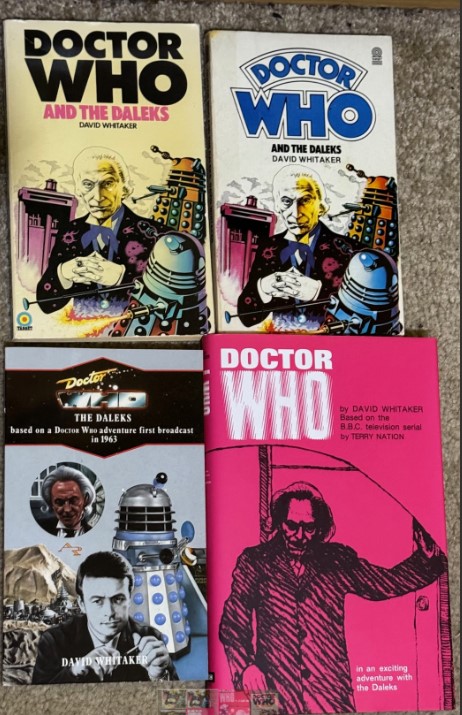
This is certainly more graphic than on TV: for instance, we only saw the claw of a Dalek mutant whereas here, Whitaker describes them as evil imps covered in slime with a single, alien eye. There are very few laughs (except unintentionally: Ian’s obsession with the TARDIS’s toilet facilities provoking one). In some ways it’s less subtle – Ian and Barbara’s budding relationship unfolds as a major sub-plot – but mostly this condenses 170 minutes of TV action into a crisply effective and very readable book. It probably helps that it was written by the programme’s original script editor, who must have been used to reshaping other people’s scripts for time or effect.
And there are some expedient changes from the broadcast version (Susan Foreman is re-christened Susan English to emphasise that she’s an alien posing as a British schoolgirl; Barbara’s relationship with Ganatus is excised because she’s now all a-flutter for Ian). The most significant is to give the Daleks a leader, a glass Dalek, which hints at Whitaker’s later creation of the Dalek Emperor, and has no onscreen precedent (although it obviously did inspire the makers of Revelation of the Daleks 20 years on). Ian’s confrontation with this very specific Dalek adds a bit of weight to the book’s climax which makes it preferable to the relatively weak TV version. For the most part, though, it’s a faithful adaptation, with Whitaker taking the opportunity to make cosmetic tweaks and streamline some of the baggy midsections of Terry Nation’s scripts to the overall benefit of the story.
Interestingly, the 1964 edition of Doctor Who and the Daleks was titled “Doctor Who” – the reference to “an exciting adventure with the Daleks” was merely a tagline. That helps to make sense of the opening, which re-imagines the TV pilot episode into a brutal, terse and gripping encounter on Barnes Common. Therefore, this isn’t just a novelisation of The Daleks, it’s Doctor Who’s original script editor setting out the series’ premise (and in so doing making me wonder quite how much he input to Anthony Coburn’s scripts for An Unearthly Child). It’s essentially a synthesis of the first three TV serials, charting the Doctor’s journey from Ian’s sinister antagonist to his friend.
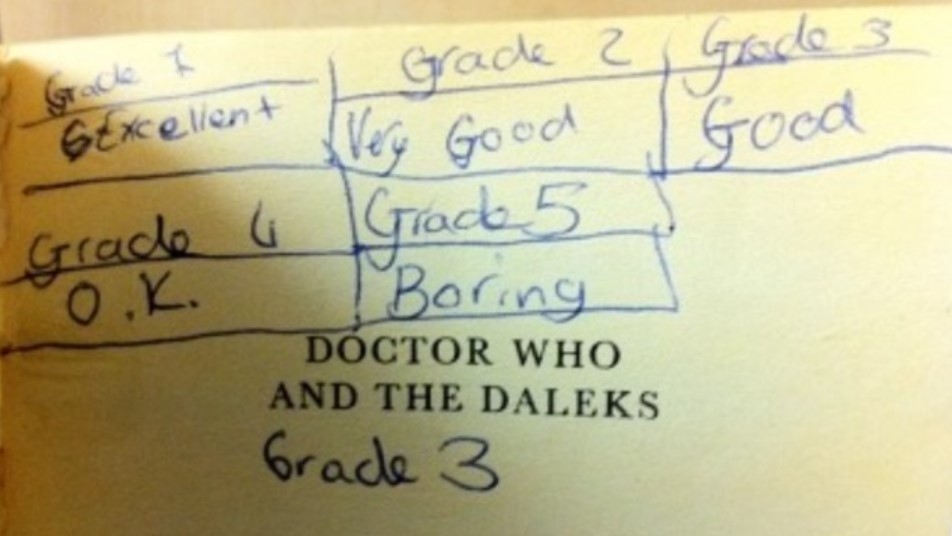
When I first read these novelisations, probably aged about six, I gave them a Grade from 1 (“excellent”) to 5 (“boring”). Doctor Who and the Daleks rated a Grade 3 (“good”). I stand by that.
 Next Time...
One comment