Doctor Who And… 8: The Dæmons (17/10/1974)
Written by Barry Letts, based on the “Guy Leopold” (i.e., Barry Letts and Robert Sloman’s) scripts for the 1971 TV serial.

Another scene-setting prologue faithfully recreates the teaser sequence from TV, leading into an equally-faithful adaptation. Letts largely sticks to the script, but derives a great deal of amusement describing the characters and their reactions (particularly Professor Horner’s short-tempered, over-confident middle aged man and his ongoing petty feud with the BBC3 people).
Just as on TV, the regulars benefit greatly from this focus, particularly in the early pages when they’re settling in for a quiet night. The Brigadier “has gone on somewhere” after his regimental dinner, and is out of contact with UNIT HQ until 4 a.m. Mike is rather more spirited and independent than on TV, and Benton has to consciously avoid being foul-mouthed. The Master is able to almost hypnotise Miss Hawthorne with an endless babble of meaningless Church of England homilies, and has a pang of regret when he believes he’s finally finished off the Doctor (prompting fond reminiscences about Gallifreyan perigosto sticks). His lack of self-control is repeatedly his downfall as he loses the support of the villagers and enrages Azal. Even Osgood gets a little bit of backstory as he wishes he could focus on his pigeon fancying rather than building the Doctor’s baffling gizmo.
The best thing about the book is its genuine sense of a community torn apart by the Master’s plan, as the awakening evil under the village prompts numerous small resentments and weaknesses to overwhelm the villagers, like Squire Winstanley’s craven reliance on the bottle, and Stan seeking a piece of Azal’s power to help him get a better job so his mother can give up charing. It’s all very Blood on Satan’s Claw. Miss Hawthorne is the standout one-off, with Letts having fun with her girlish crush on Benton, and her permanently unruly hair means she’s continually dropping “handfuls of hairpins”. There’s a great scene at the climax where she excitedly plans to test the truth of her witchy powers by challenging Bok – only to be denied the satisfaction of knowing because Azal’s meltdown intervenes.
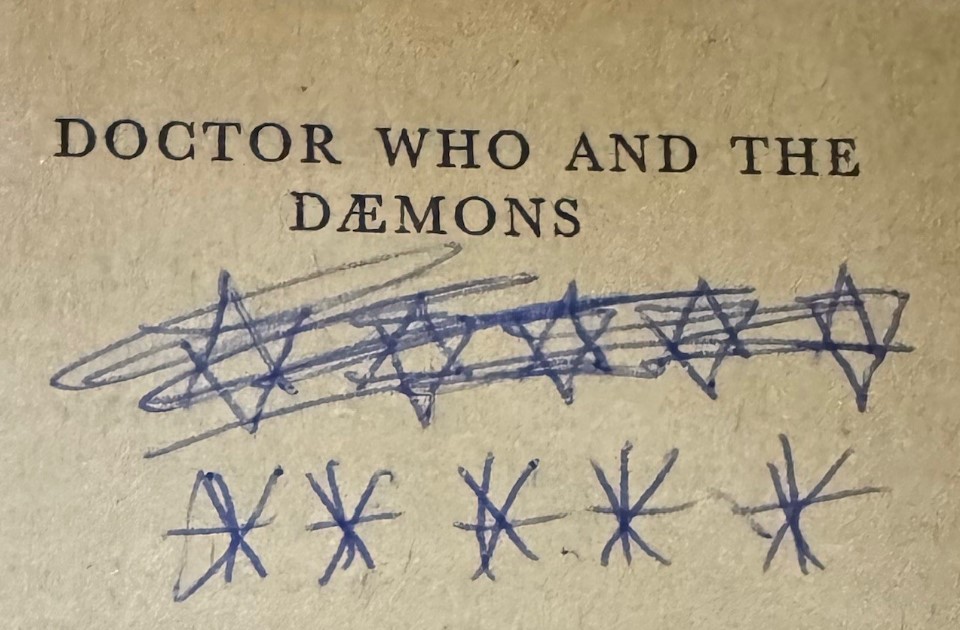
This all makes up for a plot that is, as on TV, largely an exercise in treading water (Azal’s weight yoyos; the Brigadier waits by the heat barrier while the Doctor describes a science thing) until the plot is solved not by the Doctor’s scientific know-how, but by Jo’s decidedly non-scientific intervention. Everything is rather more vivid, the horror more genuinely scary, the funny lines a bit sharper in print. This was a particular favourite of mine as a child (as the star ratings in my battered paperback attest), and I think it holds up well. Grade 1
Next Time: Doctor Who And… The Sea-Devils
 Next Time...
One comment