Doctor Who And… 26: The Planet of the Daleks (21/10/1976)
Written by Terrance Dicks, based on Terry Nation’s scripts for the 1973 TV serial.
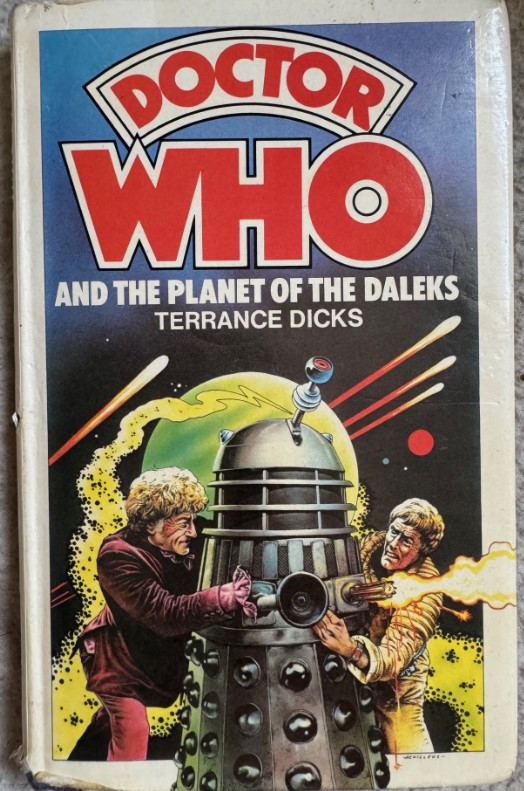
In a rare move for Target Books, this novelisation is the continuation of the previous month’s Doctor Who and the Space War, providing the back half of the waggishly-nicknamed The Master’s Dalek Plan. Except, there’s no indication in the text that Dicks and Malcolm Hulke collaborated at all: the Doctor and Jo leave The Space War in fine fettle, but begin The Planet of the Daleks in a sorry state, with the Doctor, like Steven in The Daleks’ Master Plan, threatening to succumb to injuries sustained during his previous adventure and forced to send a desperate message to the Time Lords.
None of this bothered me when I first read the book in the 1980s (long before I’d even glimpsed a copy of The Space War), and on balance it’s probably a sensible choice. I suppose the alternative would have been to follow the example of Doctor Who and the Revenge of the Cybermen, with a little asterisk at the end of The Space War and a footnote telling readers they could follow the conclusion to the story in this novel.
I loved this one as a kid: it’s fast moving, with some very vivid scenes of the deadly jungles of Spiridon with their spitting fungi and watchful eye plants. I was always particularly struck by the scene of Jo hiding in a closet while an invisible enemy hunts through a spaceship. Read now, these sequences are over in the blink of an eye and it’s hard to recapture the suspense I felt aged six, but back then I wouldn’t have had the patience for pages of mounting tension, and it’s foolishness to expect a kid’s book to imitate the pace of an adult thriller. There’s none of the mounting dread of Doctor Who and the Genesis of the Daleks – but, in fairness to Dicks, neither is there in the TV episodes. Instead, this jumps from set piece to set piece; every chapter ends on a cliffhanger (a favourite is the one where the Daleks burst into Level Zero guns blazing while the Doctor and Thals desperately hope for an updraft to kick in and lift them to safety).
A better line of criticism, because it’s such a contrast to the previous novel, is Dicks’ characterisation of the Thals, none of whom emerges as a particularly notable character. We do get a sense of Taron’s grim caution, Codal’s scientific curiosity and Latep’s “cheerful open face”, but there’s nothing here to rival the Earth President’s romantic entanglements or the Master’s capricious cruelty in The Space War.
Astonishingly, the Daleks themselves are practically the most distinctive characters. The put-upon Expedition Commander gives its subordinates a telling off: “‘Supreme Command are gravely displeased with the progress of this operation.’ No one replied, or attempted excuses.” The Supreme Dalek, second in command to the Emperor, feels like the Dalek Darth Vader, passing the Emperor’s justice on Dalek and inferior life form alike, and refusing to accept defeat.
This one takes me right back to my childhood. It’s not Dicks’ greatest novel, nor even his greatest Dalek novel, but it’s still good fun. Grade 3.

Next Time: Doctor Who and the Pyramids of Mars.
 Next Time...
One comment