All the Poirots – ranked Part One: The C Listers
In 2023-24, I read Dame Agatha Christie’s complete Hercule Poirot canon, including all 34 novels, 63 short stories and the novelisation of a stage play. Here’s my Top 40 countdown…
Not Ranked
Orphaned Poirot short stories and novellas (in Problem At Pollensa Bay, While The Light Lasts, Secret Notebooks, The Regatta Mystery, Hercule Poirot and the Greenshore Folly): Mostly inferior early versions of more developed longer stories and novels. Most interesting are in John Curran’s Secret Notebooks including alternative, bonkers Labour of Hercules which ponders “What if Hitler turned good?”
The C-List
40. Black Coffee (novelised in 1998 by Charles Osborne from the 1930 Christie stage play): The prose style is a fairly rudimentary “he said, she said, stage direction” job lacking any of the shrewd observational comedy of Christie. That said, the source material is pretty thin: the plot is like one of the weaker stories in Poirot Investigates (stolen formulas and national security), all set in one room to make it cheap to stage in provincial rep. The clueing is fairly half-hearted as well: most of the suspense comes from sleight of hand stage directions, plus a blatant re-use of a plot point from The Mysterious Affair at Styles. None of the characters really comes to life. Hastings is superfluous, and even Poirot seems to be going through the motions. It’s mildly disappointing that the Suchet series didn’t get round to adapting this one, but it’s hard to imagine them stretching it beyond 45 minutes.
39. Elephants Can Remember (1972): A bizarre, rambling novel that meanders towards a conclusion that is so obvious that I was expecting it to be a red herring. Everything is vague: vague conversations; vague memories, vague prose. The editor should be reprimanded for a bad job – in one paragraph a death jumps from three weeks earlier to “some months” earlier. Scenes descend into tangential streams of consciousness. “How many pages?” The end result, amazingly, isn’t entirely displeasing but it’s so much weaker even than Christie’s lower tier Poirot novels. Interesting that key elements of child murder and taking the law into one’s own hands loom in many of her late Sixties and Seventies books.
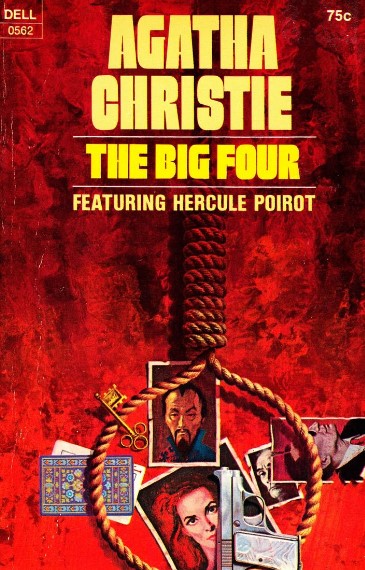
38. The Big Four (1927): A novel stitched together haphazardly from a series of short stories in Christie’s breathless “adventure” style. Four diabolical masterminds plot to take over the world from a secret underground base (no, really) and Poirot is pledged to stop them. In several lightweight cases in the manner of Poirot Investigates Poirot foils a Big Four plot, but as Number Four is a master of disguise (Christie always over-rates actors’ ability to alter appearance) he continually escapes. This tends to make both criminal and detective look rubbish. There is an of-its-time “Yellow Peril” aspect (and some racist Chinese dialogue), but nothing else very offensive about this. If it were a Tommy and Tuppence, it would probably be their best novel. It’s certainly a lot more fun than some of her later ‘thrillers’. However, it is by no means a Poirot novel, and is markedly inferior to the sophisticated and convincing Murder of Roger Ackroyd. Christie’s Poirot novels are generally her strongest. This is one of her weaker efforts overall, and bears no comparison to the rest of the Poirot canon.
37. Hickory Dickory Dock (1955): The first half in a student hostel is quite fun (if very of-its-time) and very different from Christie’s usual settings, with a diverse cast. Descends into a fanciful thriller in the second half. Poirot is basically redundant. At the weak end.
36. The Mystery of the Blue Train (1928): One of Christie’s least favourite of her own books, as she struggled to get back into writing after her divorce. Suffers from a slightly forced and stodgy opening – Christie admitted that this one didn’t flow as easily as normal. However, once it warms up the characterisation is sharper than before. Katherine Grey is the most rounded, crisply written and absolutely believable of her heroines yet. This can sometimes get in the way of Christie’s normally sharp clueing – for the first time the murder plot really seems secondary to the characterisation and Katherine’s rags to riches story. And the denouement is especially weakly done: a confusing half-reconstruction of the crime. Throughout the book there is a very cynical view of human nature – the money-grabbing French floozy Mirelle; the spiteful old ladies in St Mary Mead; the easily-manipulated men. Possibly her experience of marital problems gave her writing more depth and bite. Some of the prose is gauche and melodramatic, (e.g., the breathless description of Ruth’s emotional turmoil), and there is an overuse of favourite adjectives such as people remarking things ‘drily’ (Poirot does three times on a page). But in general there is a lot of shrewdness and wit. Overall, it’s still a clear development of Christie’s style, and if she hasn’t quite managed to get the psychological depth and clueing in the right balance it’s still a much better novel than she gave it credit for.
35. The Man Who Was Number Four (1924 short stories anthologised in 2017): Very silly, more in the vein of Christie’s 20s thrillers than a Poirot mystery, but it has enthusiasm and gawky charm and the short story format works much better than Christie’s 1927 The Big Four novelisation.
34. Poirot Investigates (1924 anthology): This is the very first Christie book I read, probably in 1989, so I have fond memories of it. Several of the stories are fairly weak pastiches of Sherlock Holmes (Christie’s strength was rarely in the clinical observation of minutiae). However, her relentless undercutting of Hastings (he continually points out Poirot’s conceit whilst over-estimating his own deductive prowess) is very unlike Conan Doyle’s treatment of Watson, and suggests Christie had already seen that Poirot could operate outside of the double act in a way Holmes couldn’t. Christie’s grasp of the short story is shaky in this early collection. Some of the mysteries are so cursory, the clues so basic, that the solution is revealed as soon as the guilty party is introduced (e.g., Million-Dollar Bond Robbery). Plus there are too many implausible disguises. This is also Poirot at his most Marple-ish, solving some of the cases through a single question and intuition (dressed up as his “little grey cells”) rather than investigation. “Oh so and so must have been so and so’s secret heir, I saw it at wernce.” There are also one or two more of the spy adventures and international intrigues that Christie loved to write and her audience rather less enthusiastically read. Plus Hasting’s constant harping that Poirot has lost it becomes tiresome given he always solves the case. There are some fun stories – The Italian Nobleman, The Hunter’s Lodge and The Missing Will. But this is still clearly the work of a novice, and although I don’t think Christie ever mastered the short story she got a lot better at them than these.
33. Poirot’s Early Cases (1974 anthology): Mop up of the uncollected 1920s Poirot stories with Hastings’ presence a useful reminder ahead of Curtain. Some are middling Conan Doyle pastiches but there are gems like Double Sin and Tale of the Unexpected style Wasp’s Nest.
32. Murder in the Mews (1937 anthology): The long story format works rather better for Poirot than the inconsequential short stories. Even so, Murder in the Mews and The Incredible Theft feel like Early Cases despite Poirot frequently being described as “elderly”. Dead Man’s Mirror is better: you sense with a bit more character development it could have made a novel. Triangle at Rhodes is the shortest and most interesting, with the tragic inevitability of some of Christie’s mature works. One feels it could just as effectively have been a Marple.
31. Murder in Mesopotamia (1936): Quite good local colour and a great Hastings substitute in Nurse Leatheran, but this one strains credulity beyond breaking point with the increasingly risible final revelations.
30. The Murder on the Links (1923): It opens with Hastings and a mysterious young woman on a train, which is a promisingly typical Christie gambit. Hastings’ usual tastelessness emerges when he is excited by the fee on offer from a rich émigré. Poirot is more interested in the sport of a case. Poirot is now disdainful of forensic investigation and is championing the “true psychology of the case”, saying he can solve mysteries from his armchair rather than crawling round on damp grass. He also makes lots of continuity references to Styles and the short stories. This is one of Christie’s charming habits – creating a fictional universe where Superintendent Battle can encounter Poirot, Mrs Oliver, Parker Pyne and so forth (they may never meet, but Marple and Poirot absolutely inhabit the same world). But for all his protestations about crawling round on grass, Poirot then implausibly races to climb up a tree at the climax. Generally, this is one of Christie’s most prosaically-clued books: scraps of paper under hearth rugs; a strand of woman’s hair; lead piping… Ingenious, then, but a bit excitable and lacking the discipline and taut efficiency of her best works. Getting rid of Hastings was a wise move though: Poirot is more interestingly drawn directly through his creator’s voice rather than filtered via a PG Wodehouse pastiche.
29. The Clocks (1963): Interesting setting, with a mostly offscreen (but delightfully garrulous) Poirot playing armchair detective. Contains obfuscating overtones of her beloved espionage capers: the One Two Buckle My Shoe of the 1960s.
28. Cat Among the Pigeons (1959): Breathless, spy-infested jewel caper more like one of Christie’s thrillers or an early short story than a mature Poirot novel. Shot through with moments of poignant insight but on the whole a bit daft.
27. Mrs. McGinty’s Dead (1952): Compelling premise but the suspects are a bit flavourless and the plotting seems looser than usual. The inclusion of Ariadne Oliver feels like an attempt to give it a bit of colour. Very mid table.
26. Appointment With Death (1938): Supremely grotesque victim gives everyone a motive. Sadly, the back end of the book is endless, boring convolutions about a syringe, and – for all the “psychological” angle, it’s sadly lacking Christie’s usual insights into human nature. You can tell it’s not a classic because no-one has managed to make a decent film of it (although by all accounts Christie’s stage adaptation a great improvement).
Next Time: The B-Listers
 Next Time...
3 comments