All the Poirots – ranked Part Two: The B Listers
Yesterday I covered my bottom 15 Poirots. Today: the second instalment in my Top 40 countdown of all of Dame Agatha Christie’s Poirot novels and stories…
The B-List
25. Hallowe’en Party (1969): As the shadows lengthened over Christie’s life she created some of her most haunting work. This one has the creepy quality of a Marple, with sleeping murders and the expression on a face when someone is glimpsed over a shoulder. There is perhaps less detection and clueing than before, but this is disturbing stuff with narcissism, sexual obsession and child murder on display. The first Poirot novel I read and a strong final showing for his 1960s.
24. One, Two, Buckle My Shoe (1940): One of Christie’s most inelegant plots, which veers towards Big Four territory (Poirot fondly recalls Countess Vera Rosakoff) with spies on hush hush missions and assassination attempts against the British PM. This is all tosh. By contrast, there are two scenes in the book (Poirot meets an arrested man; Poirot’s final discussion with the killer) which are among Christie’s most powerful studies of Poirot and his morality, and I think among the best and most mature things she ever wrote. There’s a gruesome murder, in keeping with Christie’s desire to make her crimes less genteel. At one point a woman goes missing and another says, “I feel sure that it must be loss of memory.” Poirot politely agrees – while the reader thinks “no he doesn’t, and neither does Agatha.”
23. Third Girl (1966): There’s a line of criticism that Christie got a bit vague in her old age, and her plots meandering. There is a hint of that here, with long conversations, streams of consciousness, and repetition of words and phrases (“garden”, “exotic”, “peacock”). But Third Girl deserves re-evaluation. As in most of her post-war novels, the puzzle mystery elements of the book are less interesting than the characterisation and sociological fascination of a woman in her late 70s actively engaging with contemporary youth culture. That aid, the central mystery – Was there a murder? Who is the victim? – is as compelling as anything she wrote. There is a suggestion too of an autobiographical element. A marriage that falls apart when the husband leaves his wife and daughter for a younger woman and the consequences for the child; traumatic memory loss; a character called Neele. 1926 looms large. This is the best novel for Poirot in years. He is insulted at the start and is terrible on the rebound, putting in far more legwork than usual. His scenes with Mrs Oliver are very funny. The pervasive atmosphere of evil hangs about the book as in many of her increasingly horror influenced later books. But this is a fascinating contemporary novel of the 1960s, and a surprise highlight on this read through. I thoroughly recommend it.
22. Death in the Clouds (1935): My experience of this one is inevitably clouded by the fact that, for once, I not only correctly identified the killer, but I did so by spotting a very early clue. The rest of it is fine, but rather too much pottering around on the ground rather than in “the air”. Shame Christie didn’t write it in the 1960s when Poirot could have solved the whole thing on a Transatlantic flight.
21. Three Act Tragedy (1935): Treads some similar ground to Lord Edgware Dies but has plenty of its own charm including Mr Satterthwaite playing love detective and an almost incidental role for Poirot, an idea Christie returns to a lot in the later novels.
20. The Mysterious Affair at Styles (1921): For a first book it’s very solid. The murder happens quite early so the characters are sketched more lightly than she will later. The victim barely appears, and the killer barely gets two pages before the main event. Hastings is an amusing narrator – in this first appearance he seems even more conceited than Poirot, ready to write off his old friend as a funny foreign has-been at every opportunity despite his own deductions being repeatedly disproved. It makes Poirot seem even more likeable. That’s key: while Sherlock Holmes is a fairly cold fish, Poirot is introduced throwing his arms round Hastings and kissing him. Throughout, he’s presented as adorably odd, constantly absorbing every detail. He is as wrapped up in helping individuals to find love as he seems to be in solving the murder, which is a charming aspect to his character. He calls himself “Papa Poirot” as he plays the love detective. And he makes mistakes (e.g., not hiding a document case containing a fresh will). He’s hyperactive, obsessively rearranging ornaments. That’s reflective of the book where the clueing is more hyperactive than usual with a clue introduced on one page and explained the next. Christie gets more confident in this later, more comfortable just leaving things to mull over. The denouement does rely on a very contrived untidiness on the part of an organised killer, but it is a clever twist that prefigures a lot of her later work. On the whole, it’s is too crammed with incident, including a German spy plot that goes nowhere, to stand alongside her classics. Not one of the first rank, then, but a pretty remarkable first stab. In later books she gets more adept at weaving in clues and integrating the psychology of the characters, but all of that is here in an early form, and it still stands up pretty well.
19. Lord Edgware Dies (1933): As Christie matures as a writer, her books get wittier. This one has some joyously catty exchanges between Poirot, Hastings and Japp. Poirot at this point just repeatedly insults Hastings for being an idiot, suggesting that Christie has nailed male “bants” perfectly. This largely makes up for the fact that the characterisation elsewhere is patchy, with many film stars and minor nobles none of whom gets much in the way of development. The clueing is good, but the twist is hidden too plainly in sight, and no amount of vamping can hide it. The book’s weakness is that its built around the kind of switch that Christie had already trialled in short stories, and beyond it there isn’t really much plot as such. A third murder late on and Poirot faffing around with specs feel like a cursory attempts to delay the reveal. Ending with a chillingly matter-of-fact confessional letter from the killer – a recurring idea in Christie – the book has a real confidence in its cleverness and a joy in the telling that make up for the lack of much actual incident (Chapter 16 is aptly called “Mainly Discussion”).
18. Dumb Witness (1937): Everyone talks about the dog bits but they aren’t especially prominent. I think Christie immensely enjoyed writing this one: it’s longer than usual, and very dryly funny (Poirot and Hastings are both exceptionally wry). At one point a woman goes AWOL in a “highly nervous, overwrought condition” which suggests Christie was exploring certain possibilities linked to the events of 1926. This is a joy, strongly recommended.
17. The Adventure of the Christmas Pudding (1960 anthology): Delightful selection showing Poirot at his best, scampering about playing the funny foreigner while astutely nailing the details of the crimes, or pulling a thread in his mind to uncover murder. There’s little Sixties-ness in most of the stories, which are throwbacks to the golden age, although Four and Twenty Blackbirds has a seedy Fifties undercurrent. My favourite: The Under Dog, for its characterisation and Poirot setting out to be as vexing as possible. Joyous.
16. Evil Under the Sun (1941): Budget holiday variant of Death on the Nile (which is acknowledged in a brief cameo from Hastings). You can see why they filmed this one as the sequel. It’s a lesser piece in every respect, very implausible but quite fun.
15. Dead Man’s Folly (1956): Very readable with lots of autobiographical detail (Mrs Oliver and Nasse are Christie and Greenways). Some of the tricks are reused, but work well. The conclusion puzzlingly lacks the antagonist. Solid and good use of Poirot.
14. Taken at the Flood (1948): Feels like an attempt to repeat The Hollow with a dysfunctional family and late murder. However, the Cloades are a less vivid bunch and the solution perhaps a little too signposted the moment a certain clue is revealed. Not first rate then, but a solid second rate Christie.
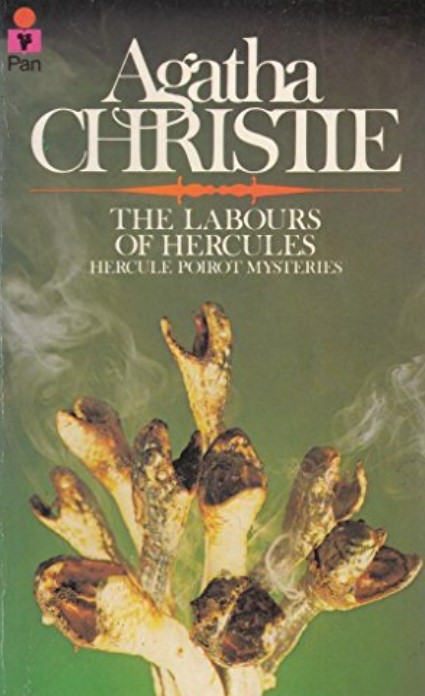
13. The Labours of Hercules (1947 anthology): 12 stories purporting to cover Poirot’s final 12 cases. It does have the sense of a swan song with old friends like Japp and Countess Vera reappearing (Hastings kept back for the already-written Curtain), and even a nod to brother Achille. As with most Christie short stories, the individual mysteries are slight and variable (highlights the creepy Stymphalean Birds and bonkers Flock of Geryon) but the cumulative effect is a great, fun collection that celebrates not sidelines Poirot. A win.
12. Hercule Poirot’s Christmas (1938): After the grotesque Mrs Boynton manipulating her family in the same year’s Appointment With Death, we now get the grotesque Simeon Lee doing the same. This is a far superior variation, though, with an effectively wintry feel and some great clueing. The resolution (and motive) slightly strains credibility, but not absurdly so. Having Poirot hover at the margins is very effective.
11. Peril at End House (1932): The first Poirot novel after a four-year gap. And Hastings (and first person narration) is back. It’s easily Hastings’ best appearance to date. Poirot, presumably speaking for Christie, points out his potential for “imagination” and light relief unlike the stolid valet Georges. Given that she’s recognised what Hastings can bring to the novels, Christie sets about making him stiffer, denser and more amusing than ever. The first chapter has a hilarious exchange where he incredulously reads out a letter that Poirot has already read. The would-be victim Nick and her circle of diffident young friends are well sketched – very Wodehousian, but as suspects none is very convincing, and there’s a bit too much faffing about with wills and poisoned chocolates. The identity of the murderer is quite clever, but the reveal is of the acme of the faintly ludicrous “gathered you all together” type ruthlessly satirised by Mitchell and Webb, with far too many irrelevancies thrown in to obfuscate a simple conceit. Overall it’s not A-list, but definitely feels like Christie rediscovering the joy in writing Poirot: the book sparkles even if it doesn’t shine. In Chapter Nine Poirot muses on the method of a killer that later forms the basis of Curtain.
Next Time: The A-Listers
 Next Time...
2 comments