Doctor Who And… 39: The Face of Evil (19/1/1978)
Written by Terrance Dicks, based on Chris Boucher’s scripts for the 1977 TV serial.
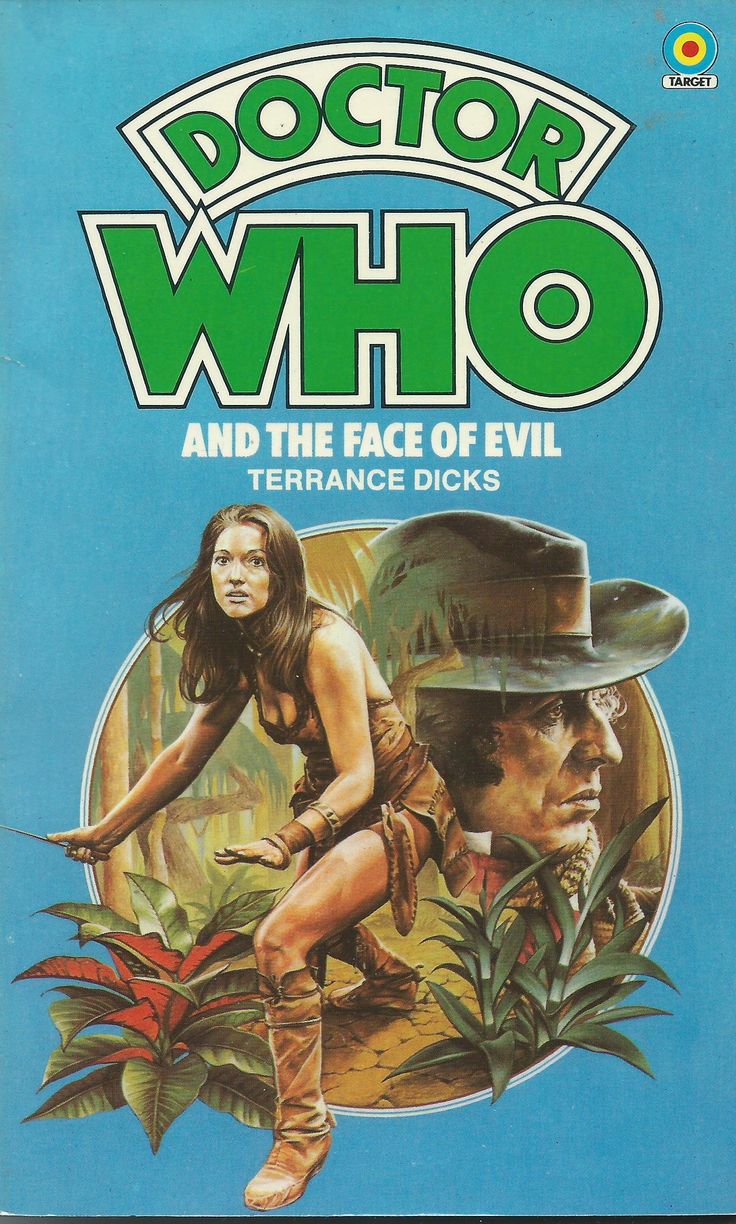
Like all of Leela’s TV stories, this was novelised by Terrance Dicks. His prodigious late-1970s output has sometimes come in for criticism as being more cursory than his earlier books, but I don’t think that can be levelled at Doctor Who and the Face of Evil. He engages with Chris Boucher’s script much more than he did with, say, Doctor Who and the Revenge of the Cybermen, which is clear from some of his additions. The most obvious is the explanation of when exactly the Doctor first met the “Mordee expedition”. Dicks suggests it was soon after his regeneration, during “that business with the Giant Robot” – an adventure Dicks himself wrote, and therefore coming across like an extra seal of approval.
Elsewhere, Dicks is characteristically effective at clarifying or illustrating motivations and characteristics. Would-be Sevateem chief Calib’s ambition and politicking is there in the TV version but is especially vivid in the novel. Similarly, the Tesh leader Jabel’s apparently calm composure is shockingly shown to be a mask when he smashes equipment with his bare hands at the news that the Doctor has evaded him. Dicks spends a lot of time on the detail of Leela, like the way she sharpens her knife on a stone while waiting for the Doctor to work some technical magic, so we get a sense of her as watchful, intelligent and always ready for danger.
Interestingly, Dicks makes us privy to the Doctor’s thoughts throughout the novel much more than usual. This includes his rather harsh reflection on Sarah Jane’s recent enforced departure: “It was more than time that she took up her own ordinary human life again”, as if the Doctor is trying to convince himself. Elsewhere, he is very proud of his “neat turn of phrase”, and sheepish about his own role in Xoanon’s madness.
Beyond characterisation and slight dialogue polishes, Dicks brings the story to life with a few well-chosen comments. Condemned for her blasphemies, though Leela is clearly an important member of the Tribe of the Sevateem, Dicks sardonically adds, “many warriors had looked favourably on Leela. But life was precious and there were other women”, capturing in a sentence an essential truth of this world. Later, during the Sevateem’s attack on the Tesh, Dicks records, “It was very dark in the forest and the air was full of the screams of dying men and the bellowing of invisible monsters”, evoking the terror of Leela’s planet without having to dwell on gory descriptions.
Wrapped inside Jeff Cummin’s beautiful illustration of Leela stepping out of the jungle with a background that pops with bright blue, this is a one of Dicks’ best middle-period novelisations. Grade 2.

Next Time: Doctor Who And… The Horror of Fang Rock.
 Next Time...
One comment