Doctor Who And… 44: The Android Invasion (16/11/1978)
Written by Terrance Dicks, based on Terry Nation’s scripts for the 1975 TV serial.
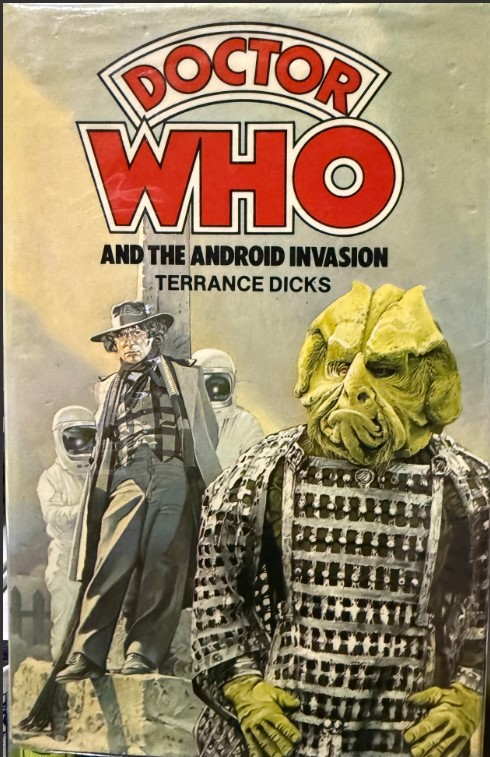
There is an argument that no Doctor Who story is as undermined by its title as The Android Invasion, given that the mystery around how apparently dead soldiers can be returning to life is the route into the story for the Fourth Doctor and Sarah Jane. But perhaps this is all magnificent sleight of hand, with writer Terry Nation wanting his audience to focus on the obvious mystery of the androids and not to guess the story’s real twist: that the TARDIS has not arrived on Earth at all, but a facsimile of Earth prepared as a training ground for the alien Kraals and their duplicates. After all, there had been robot doubles in the past, going all the way back to Nation’s earlier story The Chase. But there had never been a whole mock-up planet.
This is the kind of rug-pull moment that the series excels in: the cliffhanger to the second episode, featuring the Doctor working out the truth, is the TV story’s high point. It is so effective that when he came to write this novelisation in 1978, Terrance Dicks felt no need to further embellish the reveal, presenting it verbatim. Indeed, the whole first half of the novel hews closely to Terry Nation’s scripts. They unfold like he had written them for John Steed and Tara King in 1968. An unsettlingly empty English village with odd incongruities, like tear-off desk calendars which have the same date on every sheet, feels like perfect fodder for The Avengers.
Dicks’ additions in this first half largely focus on the Kraals themselves. On TV, they are not the most effective monsters: they look a bit like someone has left a Sontaran mask in the sun for too long and it has melted. In Dicks’ hands they become more impressive: “heavily jowled with a squashed, pig-like snout… huge eyes glowed in cavernous sockets.” Styggron, the chief scientist, has a voice “deep and throaty, with a kind of gurgle in it. It was not a human voice.”
Dicks also picks up on the tension between Styggron and Commander Chedaki and amuses himself by making them analogous to the Doctor and the Brigadier. Chedaki is constantly keen to crack on with the invasion, while Styggron is more interested in his laboratory experiments. When “Wearily, Styggron shook his massive head at the perpetual narrowness of the military mind” readers will be picturing the Doctor, hunched over a test tube while the Brigadier bristles behind him. “Always one more experiment,” the long-suffering Chedaki complains. It is certainty more character than the Kraals got in the TV version.
Sadly, not even Dicks can completely rescue the second half of the story, although on the page it unfolds with greater pace, suspense, and credibility than on TV. Still, when the Doctor pulls out a convenient android detector, you can almost sense Dicks’ knowing look to the audience, as he adds the Doctor’s comment, “Luckily there’s a short cut’”. Even so, he does the job of script editor, clarifying motivations and including the relieved last line: “The android invasion was over.” Grade 4.

Next Time: Doctor Who And… The Sontaran Experiment.
 Next Time...
One comment