Category: Doctor Who
It’s the end… Regeneration in Doctor Who
Steven Moffat’s first TV Who, The Curse of Fatal Death, described regeneration as ‘the miracle of the Time Lord’, and it’s difficult to disagree with that description. It has bought the show longevity, effortlessly enabling the lead actor to be replaced again and again while maintaining the continuity of the character of the Doctor. Along with the TARDIS, the magic door to the whole of time and space, it’s the fundamental reason why the series has continued since 1963 – no small feat for a plot device born out of desperation when the series’ producers decided that an increasingly erratic William Hartnell had to be replaced when his contract expired.
It’s hard now to get a sense of just how strange and unsettling the first regeneration must have been in 1966. The surviving clips from The Tenth Planet suggest that the transformation was presented as a frightening process – both for the Doctor and his companions. The first Doctor had been presented as frail before – he collapses in The Dalek Invasion of Earth and is still weak and tired in the next story; he’s visibly aged by the time destructor in The Daleks’ Master Plan, and drained by the vampiric Elders in The Savages – so when he tells Polly ‘this old body of mine is wearing a bit thin’ it isn’t anything extraordinary. But when he gets back to the TARDIS after defeating the Cybermen, something is clearly wrong. The clips show strange lights playing over Hartnell’s face. He gazes at his hand on the console, then across the ship, taking it in one last time, looking old and afraid. The controls start to operate themselves. Then Polly screams – a genuinely chilling one – as the Doctor collapses. His face explodes in blinding light – and when it fades someone else is lying in his place. None of this makes any attempt to comfort the audience. The first Doctor gets no valedictory speech. It’s a sudden and shocking change. Unlike later regenerations, it hasn’t even been foreshadowed by the themes in the story, and whatever fan lore might say, there’s no real explanation offered onscreen. It just happens, and whatever justifications we try to come up with now – that the first Doctor had been holding back death for a long time, that Mondas drained his life force, that his death is the capstone to a story about the hollowness of trying to artificially extend existence – are with hindsight. If anything, this is Doctor Who’s JFK moment – a jolt into an uncertain new era, with no chance for fond farewells. In that respect, the first regeneration is different from all that came later.
The second Doctor’s regeneration takes a different approach, one that tentatively paves the way for future changes. The War Games is clearly leading up to the regeneration – presenting the second Doctor with a bigger problem than he’s ever faced before. Not only is he up against another one of his own people, an equal and opposite force, one who stands for everything the Doctor most despises – war, cruelty and exercising power over others – but that’s just the precursor for Terrance Dicks and Malcolm Hulke to pit this most anarchic Doctor against the ultimate authority figures, the Time Lords themselves. The final episode of the story tells us more about the Doctor than the rest of the 1960s episodes combined – revealing the Doctor’s people, his home planet, and his reason for running away in the first place. It’s consciously significant, myth-making stuff, and becomes a cornerstone of the series from this point on. So, as well as giving us a nemesis that’s entirely apt for this specific Doctor – a hallmark of future regeneration stories – the last episode also allows Troughton’s character to give a spirited defence of his actions. Showing us ‘all these evils I have fought’ is an idea that crops up again in Tom Baker’s last episode, nicely summarising things for the audience by reminding us of the Doctor’s greatest hits. The second Doctor then gets to say goodbye to his friends – an idea that recurs in almost all of the subsequent regenerations – before he is executed by his captors. Capital punishment is probably the most horrific method of changing the Doctor, and it’s hardly made any less unpleasant by Troughton pleading his way to his death.
The third regeneration is clearly influenced by the second – unsurprising given Terrance Dicks’ involvement in both – but much more confident, so much so that it becomes pretty much the benchmark of how these transitions should be handled. The process itself is still kept vague and semi-mystical – the transcendental appearance of a Time Lord monk to help the Doctor on his way assures that – but everything that leads up to the moment is handled with an air of grim inevitability. It’s also the only regeneration that’s actually explained by showing us another Time Lord regenerating just before – as K’anpo transforms into Cho’je and explains what he’s doing to Sarah Jane, so that she (and the audience) is ready for the main event. Planet of the Spiders really does have an end of era atmosphere – Jo Grant is present in writing, Mike Yates reappears one last time, the Doctor’s mentor – mentioned many times by the third Doctor – finally turns up, and the third Doctor himself must face up to his own death as the consequence of his intellectual arrogance, which has already killed one man and potentially condemned the universe to alien domination. The spiders, as a manifestation of greed and pride, are thus entirely appropriate enemies. The Doctor is made to realise the price of his actions, and chooses to sacrifice himself to prevent further deaths. Finally, he says goodbye to his friends, and expires after delivering the most perfect epitaph imaginable. This is textbook stuff, and forms the basis of every future, planned regeneration.
I used to think Logopolis, Tom Baker’s farewell, was an inapt and inept way to write out the fourth Doctor. The story is deeply flawed, getting tied up in dull discussions about bubble memory and Christopher H. Bidmead’s beloved computer science when the author could have more profitably focused on the fascinating idea of the next Doctor turning up early because things have got so dire that the chain of cause and effect is breaking down. It’s implied that the Doctor immediately knows that the Watcher – a ghostly figure – is the harbinger of his death. He talks about the causal nexus unravelling. When he goes to speak to the Watcher on the bridge – ‘I’ve just dipped into the future. We should be prepared for the worst’ – he is tacitly acknowledging that he’s sealed his fate: in seeking advice from his future self he now needs to ensure that this future self comes into existence to be able to give him the advice he’s just taken. The fourth Doctor doesn’t fall from the Pharos telescope. He lets go. He lets go because he needs to put time itself back on track. Like Sherlock Holmes at the Reichenbach Falls, he knew this was coming, and has chosen to go over the edge: ‘It’s the end. But the moment has been prepared for’. All of these ideas are somewhere in the episodes, and the novelisation – but they’re buried so far down in the mix, under layers of debate over the laws of thermodynamics and CVEs, that they’re almost lost. And that’s a great shame, because battling time itself is an entirely fitting way for this most elemental of Doctors to go. Logopolis has a great, much-admired funereal atmosphere, and bringing the Master back properly for the final, epic confrontation that Pertwee and Delgado never got does work. But the story sinks under the weight of needless technobabble and badly cast companions, so it never comes close to matching Pertwee’s swansong. Still, a threat to the entire universe is now becoming pretty much standard for these final stories, and along with the clips of old monsters and companions, and a beautiful epitaph, it’s not a bad end.
Peter Davison’s finale, The Caves of Androzani, the last planned regeneration of the “classic” run, is a bit different. Like The War Games and Planet of the Spiders, it is the perfect end for its era. The fifth Doctor’s run was overshadowed by the death of Adric – the first time a long-standing regular had been written out in that way. Adric’s replacement, Turlough, is introduced in almost the same circumstances that Adric died – rescued from a time-travelling ship about to explode above the Earth, and even inheriting the dead boy’s room. Turlough’s redemption by the fifth Doctor is therefore an atonement for his failure to save Adric. However, another companion, the robot Kamelion, was destroyed by the Doctor himself when it was taken over by the Master. So when his new friend Peri falls terminally ill with Spectrox Toxaemia, the Doctor, haunted by his past failures, goes to extremes to sacrifice himself to save his companion. Eschewing universe-destroying plots by intergalactic megalomaniacs, The Caves of Androzani pares down the regeneration to the Doctor desperately trying to prevent Peri from dying. The rest of the plot is practically incidental, though well done. And it’s the pure simplicity of the central story that makes it so entirely compelling. All the best traditions of regeneration – the inevitable countdown to death, the clips of old companions, the tearful farewell – are present and correct. The fifth Doctor’s final word, ‘Adric’, is wonderfully apposite. Everything that was tried and tested and worked in the last three exit stories brilliantly comes together here.
The classic series never attempted to top The Caves of Androzani – it never got the chance. Colin Baker was sacked and understandably declined to come back to record a handover. Sylvester McCoy made a cameo appearance in the 1996 TV movie. In both cases, a regeneration was ill-advisedly inserted at the beginning of the new Doctor’s first episode, slowing down the story and making it difficult for a fresh start. Wisely, when the series returned in 2005 the ninth Doctor wasn’t lumbered with a shoehorned transformation scene but got straight into the action. So, the next proper regeneration story was 2005’s The Parting of the Ways. In a season that concerned itself with the fall-out from the Time War, appropriately the regeneration happens as a result of the final battle of that war, with the Doctor facing his ultimate enemy, the Dalek Emperor, who has also survived the conflict and been driven half mad as a result. But though the Doctor is willing to sacrifice himself to the Daleks, in a nod back to that finest of all regeneration stories it’s ultimately for the sake of one young woman that he chooses to give up his life. Introducing the idea of regeneration to a new audience, Russell T Davies went right back to the original, with shots from Christopher Eccleston’s final moments eerily referencing Hartnell’s departure. But while Polly was terrified by the first regeneration, the ninth Doctor does a good job of reassuring Rose (and the viewers) that while he might be dying, he’s actually cheating death. It’s the first regeneration since Pertwee’s that’s actually explained to the audience as it happens, and while Davies rightly maintains the ‘miracle’ of the process, he takes a lot of the fear out of it.
The next regeneration – the tenth Doctor’s abortive transformation that results in a half-human copy – is the first time it’s been used as an audience-teasing plot device (Steven Moffat subsequently re-used the idea in The Impossible Astronaut et. al), and by rights belongs in the same category as the first Romana’s jokey regeneration in Destiny of the Daleks. The tenth Doctor’s actual death, in The End of Time, explores regeneration in more detail than any previous story. He describes it as feeling like dying, and although, like the third and fourth Doctors he knows it’s coming, unlike them he is desperate to avoid it at all costs. Plunged back into the Ragnarok of the Time Lords at the end of the Time War, whereas his previous incarnation fought the Daleks’ leader, the tenth Doctor faces the Time Lord President, who’s revealed to be every bit as twisted as the Emperor. Russell T Davies seems to reference every previous regeneration story in this one – the Doctor lands in a snowy waste and another planet appears in orbit above Earth (The Tenth Planet), he faces one renegade Time Lord whose appearance heralds the arrival of all of them (The War Games), dies from choosing to suffer radiation poisoning as a punishment for his arrogance (Planet of the Spiders), after falling from a great height and having to join forces with the Master (Logopolis), getting his jacket, hands and face badly cut up, and dying to save one human being (The Caves of Androzani), and being shot down by gunmen in a wasteland (The TV Movie). The Doctor actually recognises that he’s become too arrogant, riding roughshod over the laws of time. Fascinatingly, the tenth Doctor’s end is in his beginning – in his first story he changes history, preventing PM Harriet Jones’s three-term “golden age” and paving the way for the Master to become Prime Minister of Great Britain and ultimately summon the Time Lords back from beyond the grave. In the preceding episode, The Waters of Mars, he learns the terrible cost of time meddling. In The End of Time, he pays the price for it. And yet, he gets his ‘reward’ – time enough to say goodbye to all of his companions before explosively transforming into the eleventh Doctor. The End of Time is perhaps most like The War Games – not only because of the Time Lords’ arrival and a pretty wholesale change in the cast, but because it draws a line under the major themes of the previous decade.
Although the Doctor has now regenerated eleven times, the process still retains some of the wonder and strangeness of that first transformation, in 1966. And each regeneration has taken something from the ones that went before, so that despite the vast variation in the visual effects, causes and explanations for the change, there’s an essential continuity that ties them together. The best regeneration stories give the sense that the Doctor has to make a momentous choice – to sacrifice himself for some greater cause, to abandon himself to the fall. They synthesise the key concerns of his era – anarchy, arrogance, guilt – and confront him with his flaws. And they say that while this Doctor’s song is ending, his story never ends. That’s the miracle of Doctor Who.
The Cartmel “Masterplan”? Really?
Picture the scene: it’s 1995 and I’ve just turned 16. A fan of Doctor Who literally since as long as I can remember (my first memory is of Tom Baker regenerating into Peter Davison), I’ve graduated from the novelisations to the Virgin New Adventures just as they’re at their creative peak – a brief golden age before the Paul McGann movie landed and the BBC decided to bring the books in-house. But I have no inkling of this as yet – for me, the New Adventures are all I have. And they’re brilliant. Not that I can talk to anyone about them, obviously – no-one else in my school admits to reading them, and there is no show to discuss.
Two years later. The TV Movie has aired, and Virgin are having to wrap up their line of books with the long-awaited publication of Lungbarrow: the novel that promises to reveal the secrets of the hallowed “Cartmel Masterplan”, which I know is going to be massive largely because that’s what the trails for Lungbarrow tell me to think. I read the book, and it’s great, even if I don’t get all the references. The big reveal is, briefly, that the Doctor is in some sense a reincarnation of a mysterious and ancient “Other” who formed the third in a triumvirate with Rassilon and Omega, responsible for the apotheosis of Gallifreyans to Time Lords.
But that’s in essence the big secret behind the Cartmel Masterplan: the Doctor is a Time Lord, but with the memories of another, very important Time Lord from Gallifrey’s past. And so an exercise whose original objective was supposedly to reintroduce some mystery and doubt into the Doctor and the Time Lords is comprehensively explained by laying out the answers for us.
Put like that, the “Cartmel Masterplan” seems slightly disappointing. “Masterplan” implies something more coherent than a couple of vague suggestions in the 25th anniversary season and the novelisation of Remembrance of the Daleks. On paper, what does the “Cartmel Masterplan” amount to? The Doctor makes a slip of the tongue talking about the Hand of Omega, Lady Peinforte implies he has a dark secret, and there’s a shadowy third presence behind Omega and Rassilon in Marc Platt and Ben Aaronovitch’s early books. In reality, even the New Adventures barely dwelt on this “Masterplan” beyond about 1993, preferring to develop Peter Darvill-Evans’ future history to create a dirty, “lived-in” shared universe of down-at-heel colonies, cyberspace and Lovecraftian ancients somewhat in line with contemporary sci-fi like Babylon 5. In that sense, Lungbarrow was a climax about four years too late.
That misses the whole point, though. The Cartmel Masterplan was actually about reinventing Doctor Who with the aesthetics of a comic strip. In the early 1980s some of the most intelligent and creative Doctor Who storytelling was found in the pages of Doctor Who Magazine – The Tides of Time, The Moderator, Voyager and The World Shapers frequently point the way to a more fantastic universe than the violent, sterile worlds offered on TV. When Cartmel took over as script editor he pushed the TV show to catch up with the comics, even asking Alan Moore to write for the series. So we have epic, universe-spanning fantasies; final showdowns; alien gods, and hints of an even bigger mythology lurking behind it all. And just as DC were exploding their own continuity and clearing the decks in Crisis on Infinite Earths, so we get a sense that Cartmel is cutting the Gordian Knot of Doctor Who continuity by giving us the final end of Skaro, and the wipeout of the Cybermen. Plus, of course, Lady Peinforte’s dark hints about the answer to the eponymous question – which perhaps makes her just another incarnation of River Song.
Dropping Lungbarrow into Season 26 as planned, as a kind of origin story for the Doctor, is therefore understandable in the context of various classic and long-running comic heroes getting revamped origin stories – for example, Superman in The Man of Steel series: going back to the beginning to start afresh. Cartmel instinctively recognised that to thrive again, Doctor Who needed to adopt the kind of reinvention seen in contemporary comics, with the Doctor recast as a dark and troubled character with a disturbing past. In that respect, the New Adventures are vastly influenced by the Cartmel Masterplan as filtered through the lens of Paul Cornell’s early novels, which successfully marry the Marvel comics approach with the style of the best Doctor Who novelisations. And similarities to shows like Babylon 5 become explicable because both series draw from the same source of 1980s comic books, with J. Michael Straczynski, Cornell, Cartmel, Aaronovitch and others all inspired by the creativity of people like Alan Moore and Neil Gaiman – the latter having written episodes for both B5 and Doctor Who.
Claiming Russell T Davies was influenced by the New Adventures is a no-brainer – but he’s equally influenced by their ur-texts, the 1980s comics. The influence is normally felt in a tone that’s similar to the Cartmel Masterplan: a troubled and damaged Doctor and a new, mythic background of the Time War complete with references to the Could’ve-Been King and the Nightmare Child, coupled with a comic artist’s sensibility to what the show should look like. The most New Adventures-ish episode of the 21st Century series is The Long Game, which riffs on most of the central tenets of the NAs – cyberspace, media manipulation, cynical humanity, grungy space backdrops and kronk burgers – and features a monster that might as well have oozed out of the pages of DWM: Eccleston versus Ectoslime.
Despite focusing more on the time-travel possibilities of the show, Steven Moffat’s hewn closely to Davies’ inspirations, with monster team-ups; a fetishised, gun-toting archaeologist hybrid of the NAs’ Ace and Benny, and complex multi-issue story arcs. And, like Cartmel, he’s returned to the idea of the mystery of the Doctor as a central theme of the show. Under Moffat, the Doctor has gone from the lonely god of the Davies run to the answer to the oldest question in the universe. He has picked up on Cornell’s line that the Doctor is what monsters have nightmares about, and, as he normally does, explored the idea from multiple angles. What we’re seeing now will be known by fans of the future as the “Moffat Masterplan”: at the time what seems important are the answers to the questions. Who is River Song? What is the Silence? Why is the title of a 1960s TV show the oldest question in the universe? But in retrospect, we will see that it’s the tone of the show under Moffat that’s important.
In interviews, Moffat always seems keener to talk about his vision of the show as a kind of dark fairytale, and bats away questions about plot points with the indulgent tolerance of a man who knows that’s not really the point. You read interviews with Cartmel, and the same sense comes across: of a script editor whose vision of the show, whose “Masterplan” if we must, was never really about answering questions about the Doctor’s identity or delving into the reproductive oddities of the Time Lords (which, let’s face it, have both featured heavily in the last series), but about defining a new and fresh approach for a series rapidly approaching a milestone anniversary. At the time, and since, a large minority of fans have been deeply uncomfortable with this reinvention – the McCoy years remain unusually divisive, and the Moffat run is proving equally Marmite – but what can’t be argued is that this continual regeneration is what has made the show last 50 years. It’s what will make it immortal. Lady Peinforte and River Song may think they can answer “Doctor who?” So did the Time Lords, back in ’69. But they’re wrong, just like Light – by the time he’s defined it, the thing he’s defining has moved on, and changed, and is maddeningly out of sight again.
How old is the Doctor?
(With apologies to John Sutherland)
How old is the Doctor? That’s easy. He’s 1103. He said so, in The Impossible Astronaut. Case closed, as Patricia Cornwell might tiresomely say.
Except, while that age is entirely consistent with the evidence we have in the Matt Smith episodes, it is not consistent with other dates established elsewhere in the series:
- The second Doctor tells Victoria that he is 450 years old in The Tomb of the Cybermen.
- The fourth Doctor is “something like” 750 years old in Pyramids of Mars, Romana says he is 759 in The Ribos Operation, and he’s about the same in The Leisure Hive.
- The sixth Doctor says he is 900 years old in Revelation of the Daleks.
- The seventh Doctor says both he and the Rani are 953 in Time and the Rani.
- The ninth Doctor claims he has 900 years of experience in Aliens of London.
- The tenth Doctor states he is 903 years old in Voyage of the Damned and 906 in The End of Time.
- The eleventh Doctor is 907 in Flesh and Stone.
From the onscreen evidence, then, the Doctor ages 300 years between his second and fourth incarnations, 140 years between his fourth and sixth incarnations, and then gets 50-odd years younger between his seventh and ninth lives. Which is odd, to say the least.
For anyone who cares about this kind of thing, then, the “900 Controversy” (as it’s been melodramatically labelled) is one of the most egregious discontinuities between the classic and new series. But need it be? Can the different dates be reconciled?
The only dates that are hard to square are the ages quoted by the sixth and seventh Doctors. If you really want to, it is not difficult to posit a long period of adventures, for example, for the second Doctor after The War Games (for Season 6B purists), or for the third Doctor after The Green Death, to explain the 300-year jump from 450 to 750.
However, Big Finish audios aside, it’s harder to see when the fourth, fifth or sixth Doctors might have aged 140 years. The BBC website on The Doctor’s Age suggests between The Leisure Hive and Meglos, but this seems unlikely, given the serialised nature of Season 18, the fact K9 is still sea-damaged and Romana’s still wearing her Leisure Hive beach outfit at the start of Meglos. The evidence suggests that the fourth Doctor is about 760 when he regenerates. Which means, for the Doctor to gain 140 years by Revelation of the Daleks, either Nyssa ages at a very slow rate between Time-Flight and Arc of Infinity, or Peri gets dropped off somewhere for a long time.
Nevertheless, the seventh Doctor says he is 953 – and unless it’s a particularly obscure joke, which seems unlikely given it fits with the sixth Doctor’s previous declamations, this does not tie up with the tenth Doctor’s stated age of 903.
The Time War then? Suggesting that the Doctor genuinely did de-age 50 years during the Time War is possible, but, like anything that relies on the Time War for justification, seems a bit lazy. And arguing that the Doctor is somehow ageless or that he has forgotten (as Steven Moffat has) is unsatisfactory too, because he is so specific about it on so many occasions; it’s a plot point in Time and the Rani, and the punchline to a joke in The Ribos Operation, both of which depend on Time Lords other than the Doctor stating his age. And both Moffat, Russell T Davies and Graham Williams seemed keen to maintain the consistency of the Doctor’s age, having him get about a year older each series.
So how else can we resolve the “900 Controversy”? The only time in the classic series that we can see the Doctor almost certainly giving his age in Earth years is in The Tomb of the Cybermen, where Troughton makes a great show of having to work it out for Victoria. Arguably, on every other occasion in the classic series he’s talking in Gallifreyan time. That would definitely make sense of his various conversations with Romana, and the 953 comment in Time and the Rani, as both Romana and the Rani are exceedingly unlikely to measure their ages in Earth years. If you follow this logic, then in the classic series the Doctor is about 450 Earth years old, and in the new series he is 900-odd Earth years old – there being no Gallifrey to measure years by any more.
If we take that one step further (and why not, given we’ve got this far), let’s say 450 Earth years equals about 740 Gallifreyan years. That means one Earth year lasts 1.6 Gallifreyan years. Which would mean in Pyramids of Mars the Doctor is actually about 460, and in Revelation of the Daleks he’s about 550. That still means he ages 90 years at some point after The Leisure Hive, but otherwise fits the bill. And the big, 300-plus jump between Time and the Rani and Aliens of London can be explained by the adventures of the seventh, eighth and ninth Doctors during the New Adventures, EDAs, Big Finish plays and the Time War. It’s certainly easier to believe than 300 years between The Tomb of the Cybermen and Pyramids of Mars.
But that still leaves the question why Russell T Davies didn’t just make the ninth Doctor 1000 years old to avoid fans jumping through hoops to reconcile two dates. It’s hard to believe he wasn’t aware of the discontinuity, and he’s a thoughtful enough writer not to throw in a random number for the sake of it. The answer’s simple. There’s something mythic about 900 years – it rolls off the tongue, and has a weight to it that the more prosaic 1003 doesn’t. It’s an Old Testament kind of a number, a Yoda kind of a number. Davies’ Doctor is 900 years old because he’s mythic: the lonely god, the last of the Time Lords. He has to be 900. He couldn’t be any other age.
Did Doctor Who end in 1976?
In About Time: Volume 2, Tat Wood and Lawrence Miles ask the question “Did Doctor Who end in 1969?” The premise of their argument is that in 1969 the programme was altered so fundamentally by a wide range of factors (including the arrival of colour, the change to the UNIT format, and the end of the space race) that no episode produced after The War Games is entirely like those before it.
I think an argument can be made that 1976 is a similar watershed moment, and that the impact of various creative decisions made that year explain the way the show developed in the later 1970s, and ultimately triggers a series of events that have ramifications right through to 1989.
The most immediate effect of The War Games is that the Doctor is exiled to Earth for three years, and the kind of stories that had cropped up as an annual event between Seasons Three and Six became the norm, aided by the introduction of a whole military infrastructure to support the Doctor’s earthbound adventures. Clearly, by 1976, that “Yeti on the loo” approach was in decline, but far from defunct – four out of the first 11 Tom Baker stories feature UNIT to some extent, and for a viewer switching off the TV after The Seeds of Doom there’s nothing to suggest that you won’t be getting one or two contemporary Earth-based adventures per year for as long as the show is on the air.
Season 14 seems to confirm this when The Hand of Fear reliably returns the TARDIS to a familiar Twentieth Century science establishment, of the type we’ve seen in some shape or form every season since 1970. But there is a subtle difference – for the first time since The Sea Devils, UNIT aren’t on hand to assist the Doctor. In this respect, The Hand of Fear is a deeply unusual “Yeti on the loo” story. And as with The Sea Devils, removing UNIT from the equation adds more jeopardy for the Doctor – he has no back up. There is no comforting Brigadier on hand to lay on a helicopter and five rounds rapid. Taken in context with Elisabeth Sladen’s departure making the national news, The Hand of Fear has a grimmer tone than, say, The Android Invasion or The Claws of Axos (which is assumed to be set in the same power station). There’s the possibility that Sarah Jane’s burial in an explosion, possession, and wandering into a nuclear reactor could really be curtains for the character. And Professor Watson’s final phone call to his wife is unprecedented – this time, the reactor really might go critical.
After all this, it’s a miracle that Sarah Jane walks out alive (and it’s well known that Hinchcliffe planned she wouldn’t). The audience is in a similar place as we are at Journey’s End, when Donna’s death has been foretold so often that we can’t quite believe she’s made it. But just as in 2008, there is a sting in the tail when the Doctor gets the call he can’t refuse, and forces his most loyal companion out of the TARDIS. Suddenly, all the rules have changed. The Doctor might have been summoned to his death. After all, the last time the Doctor visited his home planet he was “executed” (or whatever the equivalent of losing a life is) and his companions had their minds wiped of all but their first adventures. In that sense, his parting “Don’t you forget me” has sinister overtones – because there’s the very real possibility that if he takes her to Gallifrey with him, Sarah Jane will suffer a similar fate and be robbed of all her memories of this Doctor.
It’s hard to gauge just how jarring this must have been for a contemporary viewer, and how shocking a set up it is for the following story – but in my mind this is Amy dissolving into the Flesh, or Rose Tyler telling us that Next Time we’ll hear the story of her death. The audience is being set up for something awesome.
They got The Deadly Assassin, which is about as big a pay-off as it would be possible to deliver in 1976. After all, this is a series that’s already shown you the genesis of the Daleks. What could possibly top that, other than the Doctor’s first adventure on his home planet and a final battle against his Time Lord arch-enemy? Everything about The Deadly Assassin suggests what we’d nowadays call Event TV. It’s even positioned as the end of a mini-series of adventures, followed by a six-week gap – Steven Moffat must’ve been taking notes.
Creatively, The Deadly Assassin is the climax of Doctor Who as it unfolded in the 1970s. The Doctor begins the decade cast down from Heaven and exiled to one place and time. His return to Gallifrey as its saviour is therefore his ultimate triumph. But it’s also clearly positioned as his ultimate adventure – in the sense that it really feels like it could be his last. Having been stripped of UNIT and even Sarah Jane in the previous story, the Doctor is entirely alone. We’ve never seen him so vulnerable. And he’s going into battle against a Master who is no longer the charming, honey-voiced seducer of the Pertwee years, who has also been stripped to his basics; robbed of his attractive facade, he becomes the very image of Death itself. This, then, is the kind of primal, final battle that Russell T Davies is recreating in The End of Time. However wrong she was on every other count, Mary Whitehouse was right to recognise the Doctor is in extraordinary peril in the final cliffhanger: his body is lying dying on a slab and he’s fighting for his soul in a hellish world of the Master’s creation.
But mention of Mrs Whitehouse reminds us why, behind the scenes, The Deadly Assassin represents a kind of climax as well – because, on the basis of her hysterical complaints about this story, Philip Hinchcliffe was reassigned, and Graham Williams brought in with the explicit instruction to tone the show down. Of course, that doesn’t happen for another three stories – but we also know Hinchcliffe, with nothing left to lose, decided to overspend on The Robots of Death and The Talons of Weng-Chiang which had a knock-on effect on Season 15’s budget and landed his successor with a financial as well as creative crisis.
The legacy of The Deadly Assassin can therefore be felt both onscreen and behind the scenes. Onscreen, after a final, lavish mini-series of adventures, we get the cash-strapped Williams stories which, for all their brilliant attempts to overcome the need to avoid any kind of of visual horror, unarguably look shoddy in comparison to any previous colour stories (and, strikes aside, lose between three and five million viewers). Creatively as well, there is a sudden lack of purpose in the show. After The Hand of Fear, the Doctor only visits contemporary England twice more in the whole of the 1970s. 1978’s The Invasion of Time is a direct sequel to The Deadly Assassin, and completes the work of debunking the Time Lords and making Gallifrey a likely return destination for the Doctor. In the next story, he gets a Time Lady companion and humans – let alone contemporary ones – altogether stop being the main baseline of normality for the show.
In 1970-76 there is a constant tension in the Doctor’s relationship with UNIT and the Time Lords: he craves his freedom but accepts his responsibility for defending Earth and intervening on behalf of his people – even after he regains the use of the TARDIS and regenerates. After 1976, this tension is lost, and the Doctor is again free to wander, more in control of the TARDIS and his adventures than he’s ever been, with no “Establishment” to rail against. In response, Williams introduces the Guardians as the godlike replacements for the Time Lords who can send the Doctor on missions, and then the Randomiser as an abortive attempt to go back to basics and recapture the “TARDIS on the run” feel of the 1960s, to try to find a viable alternative to the “Yeti on the loo” format.
When this all gets too much for Williams, and Nathan-Turner comes in, there’s a new aesthetic, but an ongoing commitment to trying to go back to basics – in that sense, the creative decision to introduce the Randomiser is more important because it’s about trying to make Doctor Who “like it used to be” than stopping the Doctor from steering the TARDIS. With the rise in organised fandom (pretty much united in their condemnation of The Deadly Assassin), that appeal to Doctor Who’s past, and to the creative imperatives of a previous era of TV becomes deeply destabilising. The over-abundance of companions in Season 19 (including one who’s desperate to get back home) is an attempt to go back to the 1960s, even though there is no production need either to split stories between multiple characters to facilitate “as live” scene changes or to take the pressure off the leading man in an age of all-year-round recording. Equally, The Invasion of Time is a precedent for a string of sequels and the wheeling out of monsters that haven’t been seen for years and are presented as a greater treat for the audience than they actually are. Arguably, it isn’t until 1987 that Doctor Who finds the viable long-term alternative to the “Yeti on the loo” format – by which point, no-one’s watching.
So, did Doctor Who end in 1976? Self evidently it did not. It didn’t even become “worse” in the sense that many of the best stories were made in the 1980s. However, I do think the show became less consistent and for a long while floundered about searching for a useful new direction, toying with Guardians, Randomisers, ”Hard SF” and ultimately its own history without ever settling on one for very long, and shedding viewers as it became increasingly self-reverential. Equally, changes behind the scenes caused their own issues: two script editors oversaw Doctor Who in 1970-76. In the following six years there were six.
The Deadly Assassin is a fitting climax to seven years of Doctor Who, but unlike The War Games, it fails to provide a roadmap for the seasons to come, and leaves a legacy from which it takes the show 11 years to recover.
Time Can Be Rewritten… But Probably Shouldn’t Be
Updated 1/4/12
They say that the definition of madness is doing the same thing and expecting a different result. In which case, the eleventh Doctor really is a madman with a box. His messing about with time has brought about the end of the universe twice in the space of 18 months. But he really should know better, given that this incarnation owes his existence to the consequences of rewriting time, in the longest, most complex and most ambitious “story arc” the series has ever attempted.
In World War Three the ninth Doctor says that Harriet Jones’s historic three-term premiership will be remembered as a new Golden Age for Great Britain. Six months later, in pretty much his first act as a fully-cooked incarnation, the tenth Doctor re-writes history and deposes her. And that is his downfall.
Consider that for a moment: the first act of the tenth Doctor’s life is the cause of his downfall.
How so? I’m glad you asked. Harriet Jones’s untimely removal clearly wrought havoc with history. The ninth Doctor unambiguously states that she was known to posterity as a three-term Prime Minister. The tenth Doctor ends her reign after less than a year. Time has been rewritten because the Doctor has decided Harriet Jones is not worthy of her office.
And that opens the way for all kinds of changes. In the general election triggered by her resignation, the victor was Harold Saxon. Now, presumably, the Master (for it is he!) took advantage of time being rewritten to write himself into 10 Downing Street. Certainly, there’s no suggestion that he had to engineer a prime ministerial vacancy, nor resort to the crude methods of the Slitheen. And, once in power, the Master turns the TARDIS into a paradox machine to allow the last of humankind to decimate their ancestors and conquer the Earth, taking further advantage of what is presumably becoming a kind of temporal weak spot.
As we know, the Doctor becomes the Space Jesus and undoes the Master’s time-vexing naughtiness (although not, we note, his own time meddling). And that, it seems, is that. Except exactly one year later, Harriet Jones makes a reappearance, mounts a spirited defence of her own record and the need to defend the Earth – and is exterminated for her efforts by a bunch of Daleks that, in a roundabout way, exist because the locks around the Time War are starting to break down.
So, in the space of two years, the great white hope of Great Britain has been humiliated, deposed and murdered, largely due to the intervention of the Doctor.
And at this point, the Doctor nearly loses his own life – and it’s only thanks to a handy keepsake from his previous encounter with Harriet that he’s able to cheat death. But the threads linking his first adventure and his eventual death are starting to draw together.
And it gets worse. The Master, as usual, had a Plan B. Saxon’s followers organise his resurrection just in time to take advantage of the Immortality Gate (which, incidentally, is a piece of alien technology that would surely have been snapped up by Torchwood had the tenth Doctor not also brought them down), which in turn allows the Master, in a slightly roundabout way, to finally break the locks and release the Time Lords from their imprisonment at the end of the Time War.
And once the Time Lords return, it really is the end for the Doctor. And all this because he has rewritten time in a small act of spite against one woman.
I think this is a deliberate and clever story that Russell T Davies played in the background of David Tennant’s time as the Doctor. Certainly in interviews, Davies has said that Saxon emerged just after the fall of Harriet Jones to take an advantage of a new gap in history. And there is something ultimately right in seeing perhaps the most cocky Doctor undone by an unthinking moment of over-confidence, as though this incarnation is being punished for his character flaw in the same way Troughton’s Doctor had to finally stay behind to clear up the results of his anarchy, or Pertwee’s Doctor paid the price for his own intellectual pride.
And for viewers who haven’t followed four series worth of plot unfolding, Russell T Davies kindly re-plays the tenth Doctor’s hubris in miniature in The Waters of Mars. Saving Adelaide Brooke is presented as the action of a man who thinks he is above the law – who, if you like, has risen higher than ever before. But in changing history, the Doctor fails to save Adelaide, The lesson the Doctor takes from that story is time can be rewritten – but the consequences are unpredictable and horrifying. And he seems to grasp that he will not survive it: his reaction to Adelaide’s death and the appearance of Ood Sigma: “Is this it? My death?” In the following episode, we learn that events from the Doctor’s past are now impacting on his present and the future. “Time itself is bleeding,” says the Ood Elder. And the Doctor is the one who made the first cut.
All the way through the Russell T Davies years the series has looked over its shoulder at the Hartnell era, when the Doctor would not even save one young girl from the Massacre for fear of altering time. Father’s Day showed the consequences of altering established history. The Fires of Pompeii directly addresses the fate of Anne Chaplet by having the Doctor relent and rescue Caecilius and his family from Vesuvius.
But the ultimate lesson Davies leaves us with is that even the Doctor is not above the law: that he can’t just go about changing history to suit himself, or to guarantee that, say, a grumpy miser will do as he’s told at Christmas. Trying to cheat, to alter the facts to fit your views, is the kind of self-destructive behaviour we expect from the villains, not the Doctor. It’s a lesson his next incarnation seems to have forgotten, but which, perhaps, he needs to re-learn if he’s to avoid a similar fall.
In this instance, Genesis of the Daleks is a good reference point: the fourth Doctor’s much-quoted “Do I have the right?” speech isn’t really about whether he has the right to kill the Daleks – he’s done that many times before – it’s about whether he has the right to re-write time. Taken alongside Davros’s earlier speech about genocide setting him up above the gods, the Doctor is reflecting that if he does play God and chooses to change history, he puts himself in a similar position – and he has to then take responsibility for the consequences of his choice, which in this case includes a whole new timeline. Or, to put it in Davies’ own words, “If you could choose, Doctor, if you could decide who lives and who dies… That would make you a monster.” Time can be rewritten, says Russell T Davies, but if you do, you become a monster.
The whole Moffat era so far seems to be circling a similar conclusion without quite reaching it (yet). The eleventh Doctor’s careless manipulation of history is undermining the whole morality of the series. Kazran Sardick’s personality is changed so the Doctor can get out of a tight spot. The sequence of cause and effect has been cheated, with sonic screwdrivers appearing from nowhere to save the day. Death loses all meaning. Actions no longer have consequences, and therefore no-one needs to take responsibility. History is now the Doctor’s playground, and we are his playthings. No wonder every nightmare in the universe formed an alliance against him: the Doctor has become the biggest monster of all.
Mean Wiles… Waiting for God
I’ve been reading the first Kindle volume of Philip Sandifer’s TARDIS Eruditorum, and have been thoroughly enjoying it (Troughton soon please!). I’ve been particularly interested in Sandifer’s surprisingly vehement and provocative views on the run of episodes between The Myth Makers and The Ark:
“For all his skill in making a good programme, the fact of the matter is, the 24 episodes produced by John Wiles are mean-spirited, reactionary, and, frankly, in the final analysis, racist.”
While I think this reads rather too much into Maureen O’Brien being sacked, and the general rubbishness of Dodo, I do think there are significant problems with Wiles’ episodes which Sandifer’s book reminded me of. And in my mind they are problems that are almost exactly similar to the creative issues that plagued the programme during the mid-1980s: a gaping void where the Doctor is supposed to be.
Wiles produced The Myth Makers, a comedy for three quarters of its length, which ends with an infamously bleak massacre of its characters, the abrupt and downbeat departure of Vicki, and Steven mortally wounded. Four episodes later, Vicki’s replacement as “girl companion”, Katarina, is killed off, and eight episodes after that, her replacement, Sara, goes the same way. Then we have a story which is explicitly about practically everybody being horribly killed – even the Doctor (or at least, his double), and finally an adventure that almost has the TARDIS crew casually wipe out the last remnants of humankind just because of their reckless arrival on the space ark. This isn’t just about shaking the show up after the cosy comedy of Season Two. It’s a sustained assault on the Doctor himself by a producer who, you sense, just cannot believe in the character’s essential heroism and “goodness”.
In the Wiles episodes, every victory is achieved only at a terrible cost – if there is any victory at all. The Myth Makers and The Massacre are about the Doctor and Steven merely surviving their ordeals. In The Ark, they stop humankind dying out, but condemn the weakened survivors to domination by the Monoids. Companions die. The Doctor brings destruction in his wake. This is a long way from one year before, when the Doctor could reverse the Dalek Invasion, unmask Bennett, outwit Nero, and trounce the Morok Empire without breaking into a sweat.
Perhaps Wiles thought the Doctor was too powerful. Perhaps Hartnell’s act as a kind of senile delinquent giggling his way through time and space was an inappropriate response to Viking raids and the enslavement of the ant people. It won’t be the last time in the programme’s history that an incoming producer has deemed things “too silly” and vowed to bring a new sense of seriousness. But in so doing, the baby has been thrown out with the bathwater. The Doctor is suddenly ineffectual, and shown to be ineffectual because not only can he not save everyone, but he can’t even save anyone. Katarina escapes from Troy, but her death is only deferred. Sara doesn’t outlive her first adventure. Anne Chaplet must remain in Sixteenth Century France to face her doom. That last failure is so jarring and so fixed in fan memory that 40 years later The Fires of Pompeii directly addresses it.
And the problem is not only that the Doctor fails – the serialised format of the classic series means that most stories rely on the Doctor not succeeding for large chunks of time – but that he fails at the critical moments even to save the people he most cares about. The same problem crops up again in the mid 1980s: Adric dies, Tegan leaves after a breakdown, Peri either dies or else is abandoned. The Doctor continually leaves a vast body count in his wake so that every planet he lands on resembles a crime scene, and he bemoans the fact that “there should have been another way”. And in some ways the problem in the 1980s is less egregious because Eric Saward takes it to the logical extreme by having the Doctor put on trial and revealed to be the ultimate foe, after which there’s really nowhere else you can go with the idea (and wisely, Saward’s replacement didn’t even bother to try). Wiles, meanwhile, just seems to shrug his shoulders, sigh and walk away.
To Sandifer, this lack of resolution represents a “ludicrous failure… to quite resolve the ongoing plot arc of the Doctor’s inadequacy.” I’m not entirely sure I accept Sandifer’s premise. The Doctor’s inadequacy in Season Three is less a story arc and more the failure of the imagination of a producer who apparently despised his leading man and had no natural sympathy for the programme. Or to put it another way, Wiles genuinely thinks the Doctor is not up to saving the universe. And perhaps far from being “mean spirited and reactionary”, there’s a different cause. In an interview with DWM, Wiles alludes to an idea he had for the Doctor meeting God, in much the same way as Captain Kirk in Star Trek V. He says, “Of course it would be proven all is not as it seemed.” The subtext I see is that Wiles can’t believe in gods and heroes (and see The Myth Makers for another hint of this), and that includes the Doctor. Only we can save ourselves. I think Russell T Davies addresses this by having especially the ninth Doctor inspire us to take control of our own destinies. But Wiles never comes up with such a compelling alternative, and so ends up as the grumpy old man who tells kids there’s no such thing as Father Christmas. Basically, Kazran Sardick was producing Doctor Who in 1965-66.
Doctor Who and the Daleks, by David Whitaker
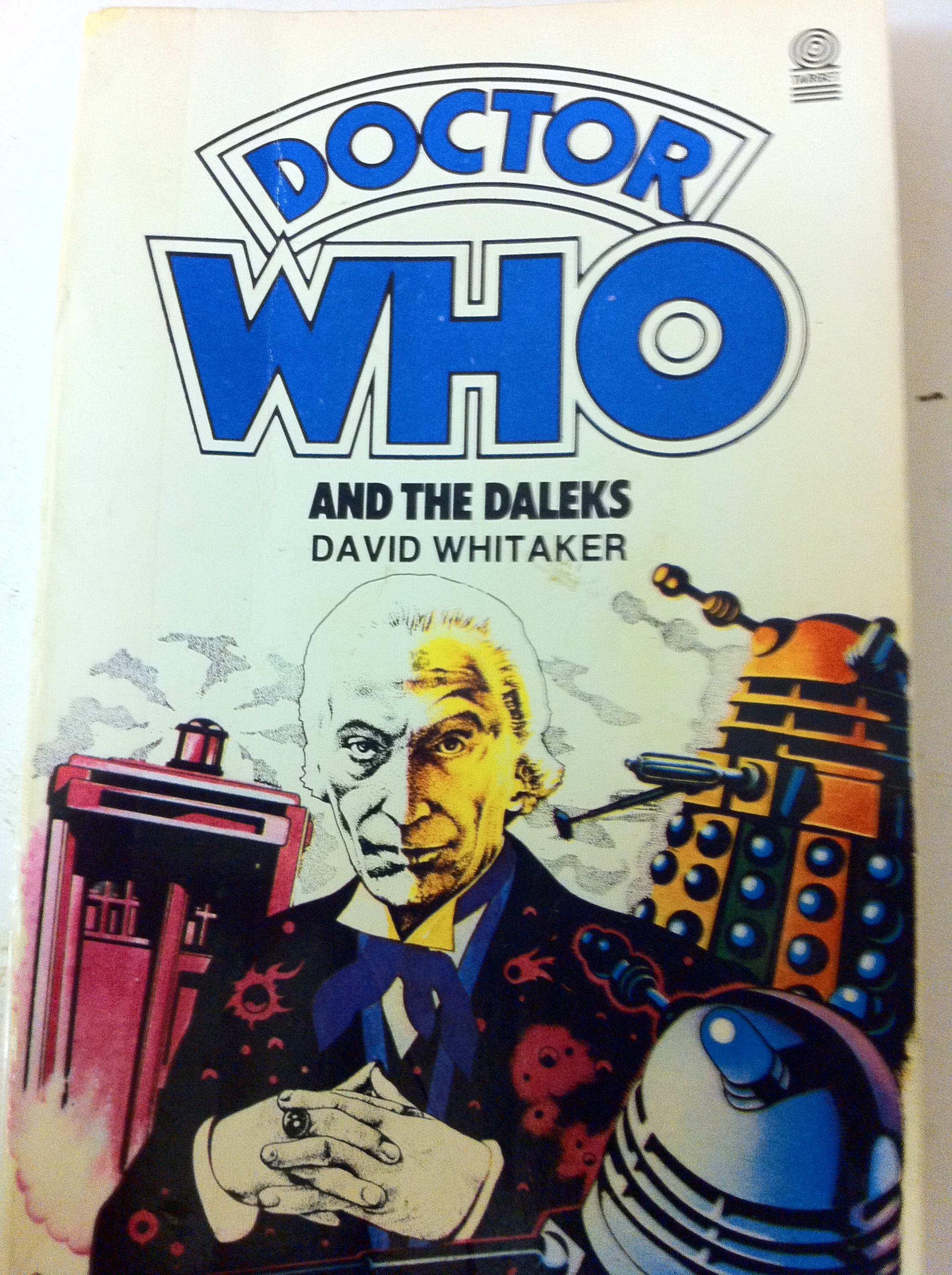
The first three Target Books, released in May 1973, were actually reprints of novelisations published in 1964, and so the style of the subsequent novelisations of the early 1970s came from books already a decade old.
Doctor Who and the Daleks sets that style very well, although it’s much longer than the later norm (150 pages of small print against the usual 120 pages). Although clearly written for children, it has the same kind of feel as, say, Susan Cooper’s writing for Puffin: that is, it’s pretty dark in places. It begins with a car crash, there’s a dead body on the third page, the Doctor is initially presented as a malevolent alien (mellowing gradually as the book goes on), and the Thal death scenes are rather horrible.
This is certainly more graphic than on TV: for instance, we only saw the claw of a Dalek mutant whereas here, Whitaker describes them as evil imps covered in slime with a single, alien eye. There are very few laughs (except unintentionally: Ian’s obsession with the TARDIS’s toilet facilities provoking one). In some ways it’s less subtle – Ian and Barbara’s budding relationship unfolds as a slightly embarrassing sub-plot – but mostly this condenses 170 minutes of TV action into a crisply effective and very readable book. It probably helps that it was written by the programme’s original script editor, who must have been used to reshaping other people’s scripts for time or effect.
And there are some expedient changes from the broadcast version (Susan Foreman is re-christened Susan English to emphasise that she’s an alien posing as a British schoolgirl; Barbara’s relationship with Ganatus is excised because she’s now all a-flutter for Ian). The most significant is to give the Daleks a leader, a glass Dalek, which hints at Whitaker’s later creation of the Dalek Emperor and has no onscreen precedent (although it obviously did inspire the makers of Revelation of the Daleks 20 years on). Ian’s confrontation with this very specific Dalek adds a bit of weight to the book’s climax which makes it preferable to the relatively weak TV version. For the most part, though, it’s a faithful adaptation, with Whitaker taking the opportunity to make cosmetic tweaks and streamline some of the baggy midsections of Terry Nation’s scripts to the overall benefit of the story.
Interestingly, the 1964 edition of Doctor Who and the Daleks was titled “Doctor Who” – the reference to an exciting adventure with the Daleks was merely a tagline. That helps to make sense of the opening, which re-imagines the TV pilot episode into a brutal, terse and gripping encounter on Barnes Common. Therefore, this isn’t just a novelisation of The Daleks, it’s Doctor Who’s original script editor setting out the series’ premise (and in so doing making me wonder quite how much he input to Anthony Coburn’s scripts for An Unearthly Child).
When I first read these novelisations, probably aged about 6 or 7, I gave them a mark. For the Pertwee novels onwards this was a normal 1-5 star rating. Oddly (and I was obviously an OCD fan even then), I rated the “black and white” stories differently, assigning a Grade from 1 (“excellent”) to 5 (“boring”). Doctor Who and the Daleks rated a Grade 3 (“good”). Given that my copy is very dog eared and held together with sellotape, I think I was being ungenerous. This is a great start.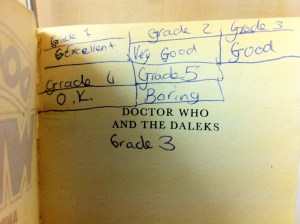
Clichés: Chapter 5 is entitled “Escape Into Danger” which is near enough to “Escape to Danger” to qualify. The creatures in the Lake of Mutations are as big as a house – the first of many monsters that will be much larger than onscreen.
 Next Time...