Mean Wiles… Waiting for God

I’ve been reading the first Kindle volume of Philip Sandifer’s TARDIS Eruditorum, and have been thoroughly enjoying it (Troughton soon please!). I’ve been particularly interested in Sandifer’s surprisingly vehement and provocative views on the run of episodes between The Myth Makers and The Ark:

“For all his skill in making a good programme, the fact of the matter is, the 24 episodes produced by John Wiles are mean-spirited, reactionary, and, frankly, in the final analysis, racist.”

While I think this reads rather too much into Maureen O’Brien being sacked, and the general rubbishness of Dodo, I do think there are significant problems with Wiles’ episodes which Sandifer’s book reminded me of. And in my mind they are problems that are almost exactly similar to the creative issues that plagued the programme during the mid-1980s: a gaping void where the Doctor is supposed to be.

Wiles produced The Myth Makers, a comedy for three quarters of its length, which ends with an infamously bleak massacre of its characters, the abrupt and downbeat departure of Vicki, and Steven mortally wounded. Four episodes later, Vicki’s replacement as “girl companion”, Katarina, is killed off, and eight episodes after that, her replacement, Sara, goes the same way. Then we have a story which is explicitly about practically everybody being horribly killed – even the Doctor (or at least, his double), and finally an adventure that almost has the TARDIS crew casually wipe out the last remnants of humankind just because of their reckless arrival on the space ark. This isn’t just about shaking the show up after the cosy comedy of Season Two. It’s a sustained assault on the Doctor himself by a producer who, you sense, just cannot believe in the character’s essential heroism and “goodness”.

In the Wiles episodes, every victory is achieved only at a terrible cost – if there is any victory at all. The Myth Makers and The Massacre are about the Doctor and Steven merely surviving their ordeals. In The Ark, they stop humankind dying out, but condemn the weakened survivors to domination by the Monoids. Companions die. The Doctor brings destruction in his wake. This is a long way from one year before, when the Doctor could reverse the Dalek Invasion, unmask Bennett, outwit Nero, and trounce the Morok Empire without breaking into a sweat.

Perhaps Wiles thought the Doctor was too powerful. Perhaps Hartnell’s act as a kind of senile delinquent giggling his way through time and space was an inappropriate response to Viking raids and the enslavement of the ant people. It won’t be the last time in the programme’s history that an incoming producer has deemed things “too silly” and vowed to bring a new sense of seriousness. But in so doing, the baby has been thrown out with the bathwater. The Doctor is suddenly ineffectual, and shown to be ineffectual because not only can he not save everyone, but he can’t even save anyone. Katarina escapes from Troy, but her death is only deferred. Sara doesn’t outlive her first adventure. Anne Chaplet must remain in Sixteenth Century France to face her doom. That last failure is so jarring and so fixed in fan memory that 40 years later The Fires of Pompeii directly addresses it.

And the problem is not only that the Doctor fails – the serialised format of the classic series means that most stories rely on the Doctor not succeeding for large chunks of time – but that he fails at the critical moments even to save the people he most cares about. The same problem crops up again in the mid 1980s: Adric dies, Tegan leaves after a breakdown, Peri either dies or else is abandoned. The Doctor continually leaves a vast body count in his wake so that every planet he lands on resembles a crime scene, and he bemoans the fact that “there should have been another way”. And in some ways the problem in the 1980s is less egregious because Eric Saward takes it to the logical extreme by having the Doctor put on trial and revealed to be the ultimate foe, after which there’s really nowhere else you can go with the idea (and wisely, Saward’s replacement didn’t even bother to try). Wiles, meanwhile, just seems to shrug his shoulders, sigh and walk away.

To Sandifer, this lack of resolution represents a “ludicrous failure… to quite resolve the ongoing plot arc of the Doctor’s inadequacy.” I’m not entirely sure I accept Sandifer’s premise. The Doctor’s inadequacy in Season Three is less a story arc and more the failure of the imagination of a producer who apparently despised his leading man and had no natural sympathy for the programme. Or to put it another way, Wiles genuinely thinks the Doctor is not up to saving the universe. And perhaps far from being “mean spirited and reactionary”, there’s a different cause. In an interview with DWM, Wiles alludes to an idea he had for the Doctor meeting God, in much the same way as Captain Kirk in Star Trek V. He says, “Of course it would be proven all is not as it seemed.” The subtext I see is that Wiles can’t believe in gods and heroes (and see The Myth Makers for another hint of this), and that includes the Doctor. Only we can save ourselves. I think Russell T Davies addresses this by having especially the ninth Doctor inspire us to take control of our own destinies. But Wiles never comes up with such a compelling alternative, and so ends up as the grumpy old man who tells kids there’s no such thing as Father Christmas. Basically, Kazran Sardick was producing Doctor Who in 1965-66.
A Podcast to the Curious

Over the last fortnight I’ve been listening to the first 10 installments of A Podcast to the Curious – a story-by-story journey through the M.R. James canon. As a relative newcomer to podcasts, I’ve thoroughly enjoyed the banter between the hosts, Mike and Will. What I particularly like about the podcast is that the hosts do their homework beforehand – and include their sources and research on their website, here), referring, for example, to Warnings to the Curious, the splendid collection of critical writing on James, and to the Michael Cox biography. This means that their obvious enthusiasm for the stories is backed up by some informed insights that inspired this listener to pick up his hallowed copy of A Pleasing Terror and to read some of the tales with a new perspective.

So far, the podcast has covered all the tales in Ghost Stories of an Antiquary – James’s most well-known volume. So it’s a perfect moment to catch up, and then launch with them into More Ghost Stories of an Antiquary. I’m particularly looking forward to the hosts covering A Thin Ghost, James’s least-loved collection, and some of the less-studied stories such as ‘The Fenstanton Witch’, which will be tougher to research but therefore have a lot that’s new to say.

The podcast is available on iTunes, and you can also follow Mike and Will on Facebook and Twitter.

The Night Comes On, by Steve Duffy

Available now as an e-book from Ash Tree Press, this 1998 collection of short stories is an admiring pastiche of M.R. James’s style which contains 20 tales, mainly set between the two World Wars. Duffy is an award-winning writer, and the quality shows through in every story – not one is without at least one shiver, and as a whole the collection sticks loyally to James’s rules, particularly that ghosts should be malevolent, and furious at the living. Even A.N.L. Munby had some friendly phantoms – but not Duffy. All his spooks are meant to frighten. And all of them seem to have their roots in an older world of Pagan rituals and black magic, of curses and Faustian pacts, so that modern civilisation is never more than a thin veneer over something dark and unknowable.

The weakness of the collection is that it frequently wears its influences too heavily, which means the reader begins playing a game of “spot the James story” rather than enjoying Duffy’s prose on its own merits. So, for instance, ‘The Close at Chadminster’ is another ‘Episode of Cathedral History’, ‘The Last of the Scarisfields’ is apparently inspired by ‘Lost Hearts’, though with a neat twist, while ‘The Hunter and His Quarry’ is more or less a re-write of Count Magnus. Perhaps the best synthesis of James’s approach with Duffy’s Pagan monsters is ‘Figures on a Hillside’, which features antiquarians uncovering a hillside giant – and in so doing unleashing something awful, hunched and spidery.

Equally, the ghosts themselves owe an immense debt to James’s thin, spiderlike and hairy, and invariably thoroughly tangible, apparitions. And so in ‘The Vicar of Wryde St Luke’ – a story that is so indebted to ‘Canon Alberic’s Scrap-Book’ that Dennistoun is name-checked – the monstrous guardian of a grimoire is of the same genus as the beast in the James story. Elsewhere, the gaunt keepers of a cursed book that is more than it appears have the same cobwebbed, dessicated visages as the watcher of ‘The Tractate Middoth’. And occasionally Duffy’s turn of phrase is drawn directly from James, such as the publican found “dead and black” just like Sir Matthew Fell.

In general, though, Duffy is less adept as James at revealing his horrors. Though famed for his reticence, James’s most outstanding moments of terror are depicted with sudden, startling clarity – as a horrible shape in the shadows suddenly illuminated by a flash of lightning. We remember, for example, the vast brown, mewling spiders in ‘The Ash Tree’, or that intensely horrible face of crumpled linen. Duffy’s ‘Out of the Water, Out of the Earth’ has overtones of ‘The Treasure of Abbot Thomas’ with its hellish horrors emerging from an ancient well. But while James gave us a few telling and lingeringly nasty details about the amphibian Guardian of his treasure, Duffy’s monsters are left vague and rather abstract, and so fail to stick in the mind after the story ends and the lights go out.

By contrast, the best stories – including ‘The Night Comes On’, with its muggy Egyptology and furiously vengeful monster, and ‘Running Dogs’ which features a memorably sinister isolated railway station and a rather Aickmanesque sense of oppressive doom – have an inter-war period style of their own, which nods to James without slavishly following him. ‘The Story of a Malediction’ by contrast takes James’s idea of visiting disproportionately harsh punishments on his hapless victims to an unforgettably horrifying extreme, as a bystander in a dispute with Satanist gypsies is hunted down by a phantom straight out of Le Fanu’s ‘Green Tea’. In its cold, unblinking perspective on an arbitrary, unfathomable universe, careless to the existence of human beings, it’s as bleak a tale as there can be.

I enjoyed this collection, and at his best Duffy probably comes closer than any of his contemporaries to successfully evoking the Jamesian style in any sustained way. Certainly, if you’re a fan of James you can’t help but enjoy this. And at about £5.00 the e-book is too good not to buy.

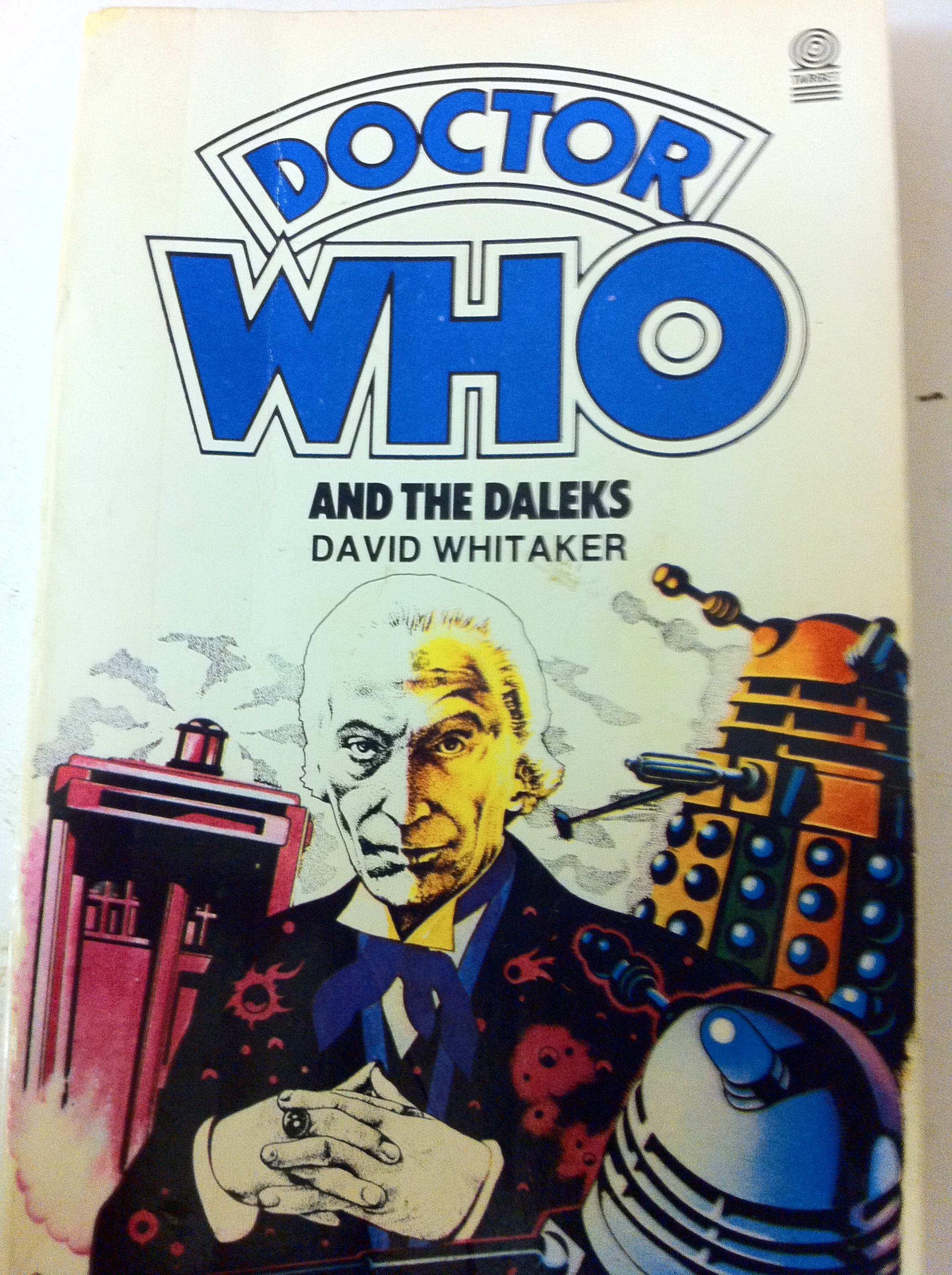
Doctor Who and the Daleks, by David Whitaker

Doctor Who and the Daleks

The first three Target Books, released in May 1973, were actually reprints of novelisations published in 1964, and so the style of the subsequent novelisations of the early 1970s came from books already a decade old.

Doctor Who and the Daleks sets that style very well, although it’s much longer than the later norm (150 pages of small print against the usual 120 pages). Although clearly written for children, it has the same kind of feel as, say, Susan Cooper’s writing for Puffin: that is, it’s pretty dark in places. It begins with a car crash, there’s a dead body on the third page, the Doctor is initially presented as a malevolent alien (mellowing gradually as the book goes on), and the Thal death scenes are rather horrible.

This is certainly more graphic than on TV: for instance, we only saw the claw of a Dalek mutant whereas here, Whitaker describes them as evil imps covered in slime with a single, alien eye. There are very few laughs (except unintentionally: Ian’s obsession with the TARDIS’s toilet facilities provoking one). In some ways it’s less subtle – Ian and Barbara’s budding relationship unfolds as a slightly embarrassing sub-plot – but mostly this condenses 170 minutes of TV action into a crisply effective and very readable book. It probably helps that it was written by the programme’s original script editor, who must have been used to reshaping other people’s scripts for time or effect.

And there are some expedient changes from the broadcast version (Susan Foreman is re-christened Susan English to emphasise that she’s an alien posing as a British schoolgirl; Barbara’s relationship with Ganatus is excised because she’s now all a-flutter for Ian). The most significant is to give the Daleks a leader, a glass Dalek, which hints at Whitaker’s later creation of the Dalek Emperor and has no onscreen precedent (although it obviously did inspire the makers of Revelation of the Daleks 20 years on). Ian’s confrontation with this very specific Dalek adds a bit of weight to the book’s climax which makes it preferable to the relatively weak TV version.  For the most part, though, it’s a faithful adaptation, with Whitaker taking the opportunity to make cosmetic tweaks and streamline some of the baggy midsections of Terry Nation’s scripts to the overall benefit of the story.

Interestingly, the 1964 edition of Doctor Who and the Daleks was titled “Doctor Who” – the reference to an exciting adventure with the Daleks was merely a tagline. That helps to make sense of the opening, which re-imagines the TV pilot episode into a brutal, terse and gripping encounter on Barnes Common. Therefore, this isn’t just a novelisation of The Daleks, it’s Doctor Who’s original script editor setting out the series’ premise (and in so doing making me wonder quite how much he input to Anthony Coburn’s scripts for An Unearthly Child).

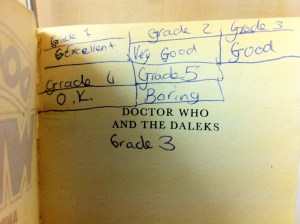
When I first read these novelisations, probably aged about 6 or 7, I gave them a mark. For the Pertwee novels onwards this was a normal 1-5 star rating. Oddly (and I was obviously an OCD fan even then), I rated the “black and white” stories differently, assigning a Grade from 1 (“excellent”) to 5 (“boring”). Doctor Who and the Daleks rated a Grade 3 (“good”). Given that my copy is very dog eared and held together with sellotape, I think I was being ungenerous. This is a great start.Young me's rating for Doctor Who and the Daleks

Clichés: Chapter 5 is entitled “Escape Into Danger” which is near enough to “Escape to Danger” to qualify. The creatures in the Lake of Mutations are as big as a house – the first of many monsters that will be much larger than onscreen.