The Sarah Jane Adventures episode 5: Eye of the Gorgon – Part Two (8/10/2007)

‘No one listens to you when you’re old.’ Between this and Revenge of the Slitheen there’s a clear template for the Sarah Jane Adventures: first episodes are the mystery and investigation, second episodes are the action and climax. Which absolutely makes sense, but it does mean – unless there’s a significant twist – that the back end of the stories largely involve lots of breathless running around. Meanwhile, the parent show is reaching for a more sophisticated way of working its multi-part stories by radically changing the setting and tone between episodes (as in Utopia and The Sound of Drums). Doctor Who is going to push further down that route once Moffat takes over.

Continue reading

The Sarah Jane Adventures episode 4: Eye of the Gorgon – Part One (1/10/2007)

‘Sometimes people have thought I’ve been mad, but I’ve seen things too.’ The focus shifts from the school to another institution, this time for the confinement of the senile rather than juveniles. Amusingly, it’s run by Graham Crowden’s daughter. One of the inmates is Bea Nelson-Stanley, now suffering from Alzheimer’s Disease but in her lucid moments able to remember a life spent travelling, battling Sontarans and Gorgons, and secreting powerful talismans.

Continue reading

The Sarah Jane Adventures episode 3: Revenge of the Slitheen – Part Two (24/9/2007)

‘I can’t believe you were going to save those Slitheen. They tried to destroy the entire planet. Billions of people. What was the big dilemma?’ Clyde is a brilliant character. Not for him the hand-wringing angst of so many modern Doctor Who characters. Instead, he’s full of Old Testament piss and vinegar. Literally, in the case of the vinegar – a critical element of the fight back against the Slitheen which he smartly works out from a few hints, justifying his position as the fourth member of Sarah Jane’s extended family.

Continue reading

The Sarah Jane Adventures episode 2: Revenge of the Slitheen – Part One (24/9/2007)

‘Something mysterious inside a school: that would be ridiculous, wouldn’t it?’ The series proper launches with an episode that’s largely a mash-up of Aliens of London and School Reunion. Which underestimates how fresh it feels coming off the back of Series Three, which, with episodes like Human Nature and The Sound of Drums, was clearly pitched at an audience two years older than in 2005. And as Doctor Who “matures” with its viewers, it creates space for this, a show much closer in tone to Eccleston than latterday Tennant.

Continue reading

Doctor Who episode 752: Last of the Time Lords (30/6/2007)

‘Dying. Everything dying. The whole of creation was falling apart, and I thought, there’s no point. No point to anything. Not ever.’ This is a much messier proposition than either The Parting of the Ways or Doomsday. Unlike those episodes, it’s not really built around the departure of a regular character – Martha’s exit comes with the reassurance that she’ll be back, and none of the finality of the ninth Doctor’s, ‘I’m not going to see you again’ or Rose’s last farewell at Bad Wolf Bay. The audience already knew Jack would be appearing in Series Two of Torchwood, and even the Master gets an escape clause as a red-fingernailed hand picks up his ring as his chuckle echoes.

Continue reading

Doctor Who episode 751: The Infinite Quest (30/6/2007)

‘He has the data chip we need to continue this treasure hunt.’ Initially broadcast as 12 mini episodes as part of Totally Doctor Who, the complete episode (including the concluding 13th instalment) was broadcast ahead of Last of the Time Lords. Sensibly, Alan Barnes structures it as a quest story, with a range of locations and vividly distinct characters like the reptilian gun-runner Meregrass (played by Torchwood’s Paul Clayton). It’s hard to inject much depth given the brevity of the run time (and the target audience), but there’s a neat moral at the end, and no pot of gold at the end of the rainbow. The end result is the closest Doctor Who has yet come to the animated Star Wars spin-off The Clone Wars.

Continue reading

Doctor Who episode 750: The Sound of Drums (23/6/2007)

‘It’s as if he’s mesmerized the entire world.’ The challenge for RTD after Series One was to up the ante every year, making each finale even more elaborate and expansive. After you’ve had millions of Daleks and Cybermen battling each other across the world, how do you top it? RTD’s answer is to have the Doctor arrive back in 21st Century Britain at the precise moment when the Master has already won, and then to play out the idea of the Doctor having to defeat a global threat with no support structure. Which sounds like it should be par for the course – but normally wherever the Doctor arrives he’s able to find allies, and particularly in the new series’ present day episodes where he’s got psychic paper, his UNIT pass and friends, like Harriet Jones, in high places.

Continue reading

Doctor Who episode 749: Utopia (16/6/2007)

‘‘Not even the Time Lords came this far.’ The first new series three-parter (the proof of the pudding is the placement of the Next Time trailer at the end of the credits, per other multi-part story cliffhangers, rather than at the top) begins with an opening that, like The Seeds of Doom’s, tells an effectively terse and self-contained story that gains greater weight and horror as subsequent events unfold. Like director Graeme Harper’s masterpiece The Caves of Androzani, this is a “spiralling descent” which begins relatively innocuously with the standard Cardiff joke (Martha is horrified to have landed there), and then builds inexorably towards an astonishing, relentless final act which stands even above Earthshock or Army of Ghosts as the greatest returning baddie moment ever. In the process, RTD looks at Moffat’s hidden-in-plain-sight solutions and laughs at them, as he wraps Gridlock and Human Nature into a pay-off that, at the time, was jaw-dropping.

Continue reading

Doctor Who episode 748: Blink (9/6/2007)

‘Don’t turn your back, don’t look away, and don’t blink.’ Steven Moffat’s reworking of his 2006 Annual story, What I Did on My Christmas Holidays by Sally Sparrow, is the third adaptation this series, which might suggest a show running out of fresh inspiration except Moffat’s key new addition is the Weeping Angels, the only new series monsters that approach the old favourites in public recognition. They’re truly brilliant creations, brilliantly realised: the placid, Axon-like stares of the neutral Angels flipping to horrifying Medusa masks when they attack. You can draw a line back from them to Bok or the Malus, and there’s something of the original Autons in their ability to hide in plain sight then spring to life, but it took Moffat’s genius to mix these influences and Granny’s Footsteps.

Continue reading

Doctor Who episode 747: The Family of Blood (2/6/2007)

‘They’re all safe, aren’t they? The children, the grandchildren. Everyone’s safe?’ After the set-up of Human Nature, the first half of this episode is almost relentless action as the Family and their scarecrow army attack the school and Smith mobilises the boys into a makeshift fighting force to the disgust of Joan. Given the emotional heft of the back half of the episode, it’s easy to overlook the power of these sequences. The Headmaster’s stand-off with Son of Mine, a threat he doesn’t understand and can’t conceive the enormity of, is superb. Son of Mine carries the knowledge of the wars to come, and the Headmaster can’t stand against the entire weight of history. The scene of terrified children machine gunning scarecrows to pieces is a horrible analogy for what is going to happen to them in just a few years.

It sets the scene for an episode about the nature of sacrifice, laying down your life for people you’ve never met. Smith’s revulsion at the idea of the Doctor, the possibility of a long and happy life with Joan, is offset against ‘war across the stars for every child’. In the end, Martha’s appeals for Smith to become the Doctor because she loves him and it was always meant to be are basically irrelevant to Smith’s decision. It’s Joan’s appeal to his duty of care to the children, first at the school and then basically everywhere that makes the difference. Under Moffat, the series often returns to this idea of the Doctor as protector of children. While the Family of Blood are equally committed to making sacrifices for their own Son of Mine: ‘This is all for you so that you can live forever’, theirs is motivated by selfishness not Smith’s final, literal selflessness. Arguably, the Remembrance Day service at the end labours the point, but I think seeing an elderly Tim having enjoyed a long life is the pay-off to the earlier flash forward to an aged Smith: he died, but Tim lived, there’s balance.
FamilyofBlood

The whole piece lives or dies on the relationship between Smith and Joan. Tennant’s performance didn’t need to be his strongest so far, but the fact that it is lifts this towards greatness. Smith is a tangibly different performance from the Doctor, which shines through in the scenes when he flips between the two (especially when he slips into Doctorese when Tim hands him the watch). But for me, the greatest moment is his reaction when Joan asks the Doctor the killer question: ‘If the Doctor had never visited us, if he’d never chosen this place on a whim, would anybody here have died?’ Tennant’s eyes harden as the Doctor realises how much Joan, ever so politely, hates him.

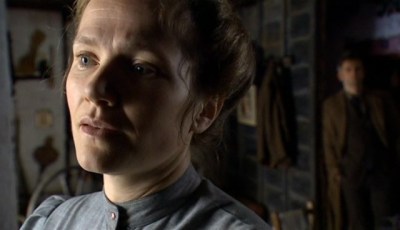
Jessica Hynes is brilliant as well, beautifully playing Joan’s public and private faces. I love the way she clings to the journal whenever Martha and Smith’s arguments start to get heated, as she represses her own emotions in a very period-appropriate way. I also admire Cornell and RTD for making her spout the racist views of her time, rather than writing her as an impossibly perfect anachronism.

It’s a masterpiece, then. Like the Dalek Emperor using the Human Factor to help define the Dalek Factor, it makes Smith’s incipient pacifism, bravery, basic decency and floundering humanity highlight the Doctor’s defining traits. The major difference is the pitiless punishment of the Family, putting on screen the often promised but rarely shown ‘no second chances’ side to the tenth Doctor. Sitting right at the middle of Tennant’s run, this might just be his definitive story. Should have called this episode Love and War, though.

Next Time: Blink