Sideways in Time: Dr. Who and the Daleks (1/7/1972)
This big-screen reimagining of the first Dalek serial is not strictly in the scope of the Pilgrimage – as it wasn’t made by the BBC. But it has at least been broadcast on BBC One several times since it first aired in July 1972, in the downtime between The Time Monster and The Three Doctors. Thus, while it was the first colour Doctor Who when it played in cinemas during 1965, by the time it reached TV screens it was too late to be either the first story broadcast in colour, or the first Dalek story broadcast in colour.
Even so, I think it has an important place in the run of the TV series. Whatever its strengths, Day of the Daleks is not a good showcase for the Daleks themselves – the voices are wrong, and the props aren’t well used. By the time Planet of the Daleks was made in January 1973, Dr. Who and the Daleks would have been freshly broadcast, Terry Nation might have been reminded of the plot and everyone else how the Daleks looked and sounded at the peak of their powers. It’s been frequently pointed out that Planet of the Daleks is virtually a remake of the original Dalek story – I’d argue it’s more a remake of this than the TV version. In particular, the Spiridon jungle looks very much like the Petrified Jungle here. The scene of Daleks cutting into a sealed-off room and then following Dr. Who and friends up a shaft is present in the original, but the style and colour palette are from the movie. The pace is much more movie-like, and the presence of a movie prop as the Supreme Dalek is the icing on the cake.
Dr. Who himself was probably less influential. I suppose there might be slight elements in Patrick Troughton’s portrayal – but if so, I imagine they were incorporated in 1966, rather than 1972. By the time the film was made, the first Doctor’s initial shifty and brusque manner had evolved into a Yoda-ish wizard. This script tries to straddle that divide – but it’s impossible to imagine the 1965 TV Doctor doing anything as underhand as sabotaging a fluid link to get his own way, and the retention of that idea in the movie script while at the same time trying to include the lighter characterisation of Season Two results in an uncomfortable hybrid that’s reflected in Cushing’s awkward performance. He was an extraordinarily fine character actor, quite easily the equal of Hartnell and Troughton, but here has to resort to a strained “old man” voice and a funny walk to try to find something to latch onto. Dr. Who’s costume on the other hand – brown jacket, checked trousers, short scarf, huge hanky dangling from the coat pocket – is the prototype of the seventh Doctor’s, and is almost recreated for the 1996 movie.
If Dr. Who is thinly characterised, Ian is a bowdlerisation of the TV Ian Chesterton. Roy Castle does what he’s been employed to do just fine – bumbling, awkward in that old-school “juvenile lead” performance that crops up in all manner of 1960s films (Bernard Cribbins is going to repeat it in the next film, and Jim Dale perfected it for the Carry Ons). Barbara Who is almost non-existent – it might have been wiser to have combined her and Susan Who into a single granddaughter although that would have necessitated an older actor than Roberta Tovey. Susan is, amazingly, given the best material in this and it’s not surprising they got her back for the sequel.
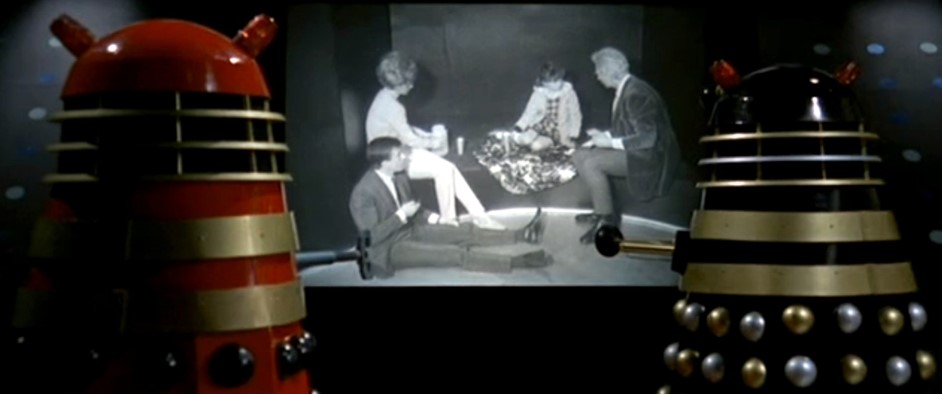
The critical consensus is that the movie lacks the punch of the TV serial. I’d agree, with the caveat that the highlights of the episodes are all present in the film, often done the same way but with more polish. The tracking shots following the Daleks through the city look great, and I appreciate the playfulness of the Daleks, like TV viewers at home, watching Dr. Who on a black and white TV (which neatly shifts to colour as the camera pushes in from the Dalek surveillance room to the scene they’re observing). Alydon’s big reveal – a shifting, scaly shape glimpsed through a crack in the TARDIS doors before they swing open to show his powder-white face – is surprisingly like Frank N Furter’s entrance into The Rocky Horror Picture Show. When Ian first goes inside the TARDIS he goes back out and walks all the way round it like pretty much all companions do now.
Next Time: Daleks’ Invasion Earth 2150 A.D.


2 comments