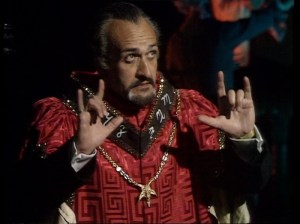
- The Daemons
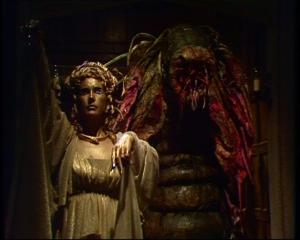
I’ve been a fan as long as I can remember. My earliest memories are of Tom Baker regenerating into Peter Davison at the start of Castrovalva, and then of being sent to bed just after the opening titles of the July 1982 repeat of The Curse of Peladon as it would be ‘too scary’ for a three year old (probably true). But I wasn’t ‘in fandom’ until the late 1990s, at a point when BBC Books had just started publishing the Eighth Doctor Adventures. I used to make the faithful pilgrimage down the first Thursday of each month from Leeds to the Fitzroy Tavern, where I, and a gaggle of other teenage boys (Guerrier, Clapham, Robson, Miller, Howells, Belcher et al.), hung on the words of fandom’s Upper Echelons (Paul Cornell, Gareth Roberts, Gary Russell). It was amazing, in that smoky pub, clutching your cheap, warm pint while Tat Wood handed out Yak Butter Sandwiches and Lawrence Miles passed his own, torn-edged A4 fan version of Private Eye under the table. There was a real sense of community. Happy times. Our bible – the teenagers, that is – was Cornell’s Discontinuity Guide, which demolished a lot of the sacred cows of ‘Establishment fandom’ (Howe, Bentham, Haining) with anarchic glee and very barbed wit. The Daemons was one of the most obvious casualties: the Discon Guide’s pointed ‘For a certain age group, this story is the most memorable example of 1970s Doctor Who’ says it all: the old folks reckon this is good, but actually it’s rubbish. I wasn’t entirely comfortable with that even at the time: I’d seen The Daemons, newly restored to colour, in the 1992 BBC2 repeat, and it seemed to me a pretty decent, if not all-conquering, ‘spooky’ Doctor Who. Plus the novelisation was really good. I think my gut feel was right: this isn’t the most memorable example of 1970s Doctor Who. But it’s not a risible failure either. In it’s assertion that the devil genuinely exists and is an alien, it’s just picking up on Quatermass and the Pit, but it’s still a bit more in your face than ‘the Great Intelligence is disguising robots as real-life yeti’ or ‘legends of the Kraken might be partly inspired by sentient seaweed’. This was memorable enough for RTD to re-use the idea in 2006.
Continue reading →



 Next Time...