1999: Doctor Who Night

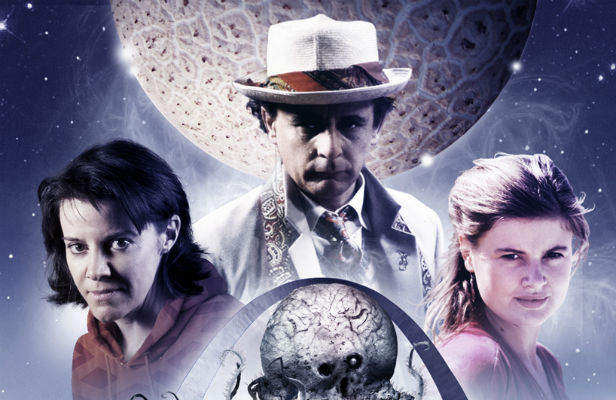
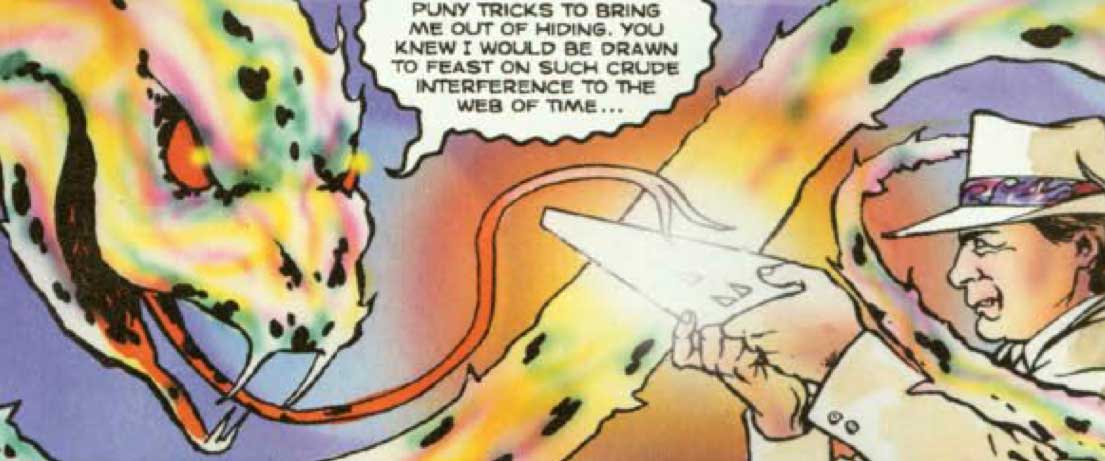
13th November 1999. The Eighth Doctor Adventures continue to be published monthly, to mixed enthusiasm. In August, Lawrence Miles’ magnum opus, the two-volume Interference, is released, expanding on the ideas of Alien Bodies and kicking off a year-long story arc that will eventually end in Gallifrey’s destruction at the Doctor’s hand on the last day of the Time War. Meanwhile, the DWM strips have brought back Grace and the Master from the TV movie, plus Beep the Meep and Kroton the Cybermen as the strip kicks off its own second big story arc. On TV, in March, Steven Moffat’s Curse of Fatal Death airs as part of the BBC’s Comic Relief. It’s a hint of some of the ideas Moffat’s going to seriously present in the 2010s, as he ploughs through the Doctor’s remaining lives, brings back the Master with breasts, and has the Doctor’s adoring companion beg the universe to resurrect him during his final battle with the Daleks. And in November, 36 years after it first aired, Doctor Who is back on the BBC. For one night only.

All the above makes 1999 sound like the series is finally getting its act together. But it didn’t feel like that at the time. The Curse of Fatal Death is an affectionate pastiche, not Moffat’s bid to resurrect the programme. It’s clearly much, much better than Dimensions in Time – but John Nathan-Turner’s intent was to make an epilogue to the show he’d made in the 1980s, not to look back at Doctor Who as a slightly tatty, but loved old kid’s programme. I laughed a lot at The Curse of Fatal Death, but I also recognised the undertone that Doctor Who was a thing of the past.

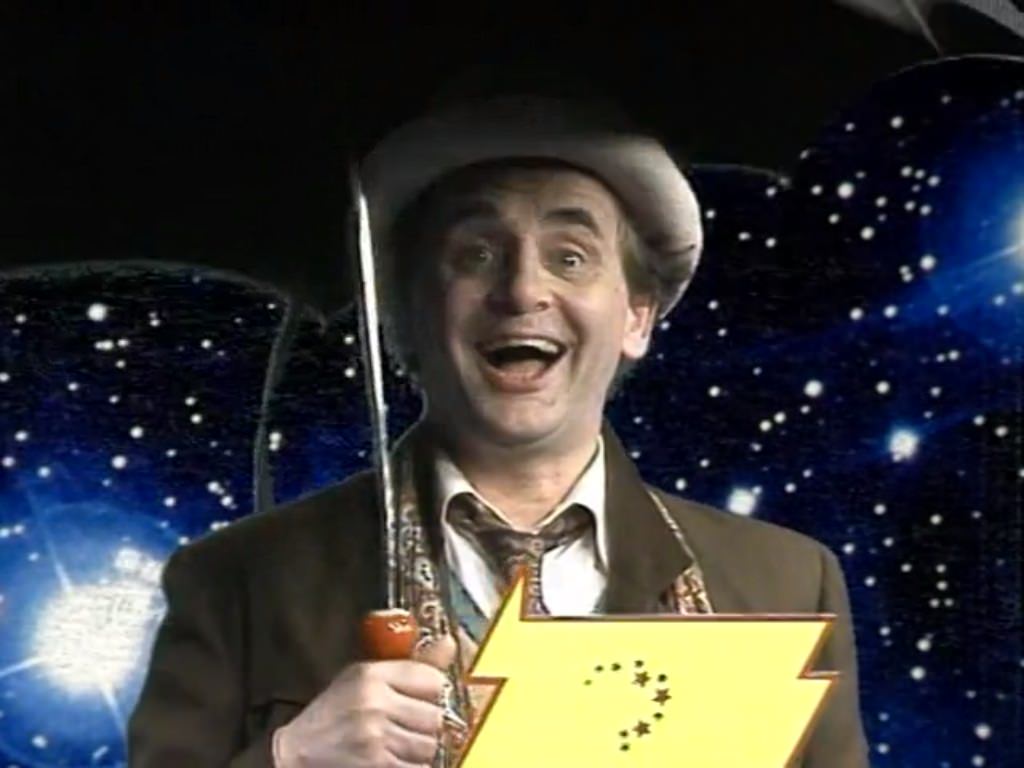
So when the BBC announced Doctor Who night, it was hard to get too excited. Particularly when the trailers featured a nonplussed little girl on the sofa with her balding, middle-aged father hiding behind it (the implication: Doctor Who is something that only odd middle-aged men are much interested in). The scheduling reinforced the point: this really was a Night, starting at 8.55pm on BBC2. Even the continuity announcer seemed slightly disdainful: ‘Once sandwiched between Grandstand and The Generation Game, tonight you get a whole night to hide behind the sofa’.

The night’s schedule is modelled on the format of BBC2’s Star Trek Night, broadcast to celebrate Trek’s thirtieth anniversary in 1996, which featured a mix of science shows, comedy sketches, documentaries and the BBC premiere of Voyager. Doctor Who Night similarly mixes a couple of documentaries, Adventures in Space and Time and Carnival of Monsters, with two science documentaries focusing on regeneration and building TARDISes, three infamous comedy sketches from Mark Gatiss plus the final episode of The Daleks and a repeat of Doctor Who: The Movie. The night’s end credits even feature a woman warbling in the style of the Star Trek theme.

This says a lot about how the BBC saw Doctor Who in 1999: as a sci-fi franchise, with creepy fans who’d like to know how to build a TARDIS, if they weren’t off kidnapping Peter Davison. Whereas in my experience the Venn diagram crossover of Doctor Who and Star Trek fans is surprisingly small. We care more about how the costumes and scripts are put together than the imaginary technology behind trans-dimensional engineering.

So even though I laughed at Gatiss’ sketches (particularly The Pitch of Fear’s description of the later Doctors as ‘any old fucker with an Equity card’, which, in a feat of Soviet revisionism, has since been stricken from the record). Even though I enjoyed seeing Tom Baker playing himself playing the Doctor. Even though, actually, a couple of the documentaries were quite interesting, I knew this was a one-off. Doctor Who‘s lack of popularity was cruelly hammered home when a heavily-trailed new season of BBC2 repeats planned for all the colour episodes starting with Spearhead from Space petered out after just three stories.

For me, 1999 was probably the nadir of Doctor Who: it felt like the BBC thought it a slightly weird obsession for a young man to hold. I was like Vince, in Channel 4’s Queer as Folk, attached to some old camp nonsense from his childhood. Had I not met a group of like-minded, talented, inspiring friends at university and the monthly Fitzroy Tavern meets in London, I think this might have been the point when Doctor Who and I parted ways.

Fortunately for me, and for Doctor Who, there were some very talented fans in a position, if not yet to revive the show on TV, then to reinvigorate it in other media. 1999 was the low point. From now on, things are starting to look up.


Next Time: ‘You all burnt, all of you. Ten million ships on fire. I watched it happen. I made it happen.’ – The Burning

1998: Wormwood

Eighth48July 1998. It’s been over two years since Doctor Who in any form has aired on the BBC. The Eighth Doctor Adventures have failed to live up to the reputation of Virgin’s novels. There’s no imminent prospect of Doctor Who being made for film or TV again.

First off the mark in the wake of the TV movie was, amazingly, the Radio Times, which ran an eighth Doctor comic strip between June 1996 and March 1997. But Doctor Who Magazine wasn’t far behind, launching its own eighth Doctor strip in October 1996 with a story set in Stockbridge, a quintessential English country village first introduced in the 1982 strip The Tides of Time. As in the Eighth Doctor Adventures, DWM seemingly felt the need to ground the unknown new Doctor in familiar continuity and surroundings, as if to anchor him into the canon.

The comic strips have always had a slightly tenuous connection to the rest of Doctor Who: for most of the ‘classic’ series they only paid to use the likeness of the Doctor, so swathes of strips feature the Doctor travelling alone, or with strip-only companions, from John and Gillian through to Frobisher. This semi-detached relationship to continuity was interrupted for a brief spell in the early 1990s when the DWM strip featured Bernice Summerfield and the War Ace, Paul Cornell wrote DWM strips alongside New Adventures, and artist Lee Sullivan produced some concept art featuring Bernice to help nail the look of the character (including the cover to Love and War). However, by 1996 the strip was again forging ahead in its own direction.

In May-August 1996, DWM featured Ground Zero, a final seventh Doctor story that killed off Ace as a brutally effective way to demonstrate the strip’s independence from Virgin’s continuity. It also introduced a new enemy in the Threshold, an organisation that sells its ability to travel between dimensions to the highest bidder. The Threshold returned to face the eighth Doctor in Fire and Brimstone (a Dalek story that’s about a million times better than the Eighth Doctor Adventures‘) and The Final Chapter, which featured a shock cliff-hanger lead-in to Wormwood. The Doctor saves Gallifrey but only by sacrificing his life and regenerating into a ninth incarnation, based on Nicholas Briggs’ Doctor from the fan-made Audio Visuals.

It’s a tribute to the comic’s own strong sense of its own identity that in 1997 when the novels were struggling to define a character for the eighth Doctor, the strip was confidently slotting him into an ongoing story arc. I think maybe it was easier to convince the audience partly because the strip could actually use McGann’s likeness, so you were never in any doubt this was the new Doctor, and partly because a more expansive, ‘bigger’ incarnation was a natural fit for a strip, while the books really benefited from the broody introspection of the seventh Doctor. Regardless, kudos to DWM because their eighth Doctor strips in 1996-98 remain more convincing than most of what BBC Books were turning out.

The shock regeneration is representative of that self-confidence: a strip that can count among its back-issues stories by Alan Moore and Grant Morrison has clearly got an illustrious history. But the regeneration also probably reflects a lack of confidence in the eighth Doctor. It’s no coincidence that, as of 2015, between the BBC and DWM we’ve been presented with five different ninth Doctors. By comparison we were never presented with a range of possible eighth Doctors (for example, Virgin’s plan to introduce a new Doctor in the New Adventures was quickly nipped in the bud by the BBC). The plethora of Number Nines is indicative of multiple ranges pulling in different directions, and Doctor Who fragmenting and losing its identity.

The response to DWM’s ninth Doctor in the magazine’s letters pages is fascinating: a few disappointed voices lamenting the brevity of the ‘McGann era’ (with comments like ‘We haven’t got to know the eighth Doctor yet’), but almost an equal number jumping to praise the move. I’m guessing had DWM pulled the same trick with McCoy’s Doctor in 1991 there wouldn’t have been quite such balance. People clearly hadn’t had chance to build their affection for McGann, and there were still some people – like Vince, in Queer as Folk – who held the view that ‘Paul McGann doesn’t count’, so anything done to his Doctor was irrelevant to the unfolding text.

Of course, four months later it turned out to have been a massive deception: the ‘ninth Doctor’ was part of the eighth Doctor’s cunning plan to defeat the Threshold, and the strip ends with him promising, ‘this body’s just getting warmed up’. But as DWM’s deliberate test run for a potential change in “lead man”, a taster of how fans might react if the McGann Doctor was dropped, and an insight into the readiness of the tie-in series to consider moving on from TV Doctors, Wormwood is instructive. By 1998, most of us had pretty much given up on seeing Doctor Who on TV again.


Next Time: ‘I know you never forget a face. And in years to come, you might find yourself revisiting a few. But just the old favourites, eh?’ – Doctor Who Night

1997: Alien Bodies

name_doctor-12November 1997. It’s been six months since So Vile a Sin was published, and the New Doctor Who Adventures came to an end. Virgin is ploughing on with Doctor-less New Adventures fronted by Bernice Summerfield, which largely have the same authors – and audience – as the Doctor Who books. As expected, Fox did not pick up the TV movie for a series. There’s no imminent prospect of Doctor Who being made for film or TV again.

Against this unpromising backdrop, BBC Books have launched a new series of Eighth Doctor Adventures featuring the TV movie Doctor and a new assistant, Sam Jones. The first in the series, The Eight Doctors, is widely agreed to have been a disaster at least as bad as Timewyrm: Genesys, making the uphill struggle to win over those of us who’d been loyal Virgin fans even more difficult. Particularly because, in a parting up-yours to the BBC, Virgin had published a single, widely admired eighth Doctor New Adventure of its own.

In retrospect, the first six months of the Eighth Doctor Adventures aren’t as awful as it felt at the time. Barring one, they were all written by Virgin authors, and four of them wouldn’t have been out of place as New Adventures. The exceptions are the abovementioned The Eight Doctors and War of the Daleks, a novel that tended to imply its author John Peel hadn’t liked any Doctor Who made since 1975, a view that might have endeared him to some fans but probably not many who read the books.

The biggest problem with the Eighth Doctor Adventures is a lack of direction. Unable to use any of the new characters or situations introduced in the TV movie, faced with a BBC Books policy to ‘neither confirm nor deny’ the New Adventures, a new Doctor and companion who were pretty much blank slates and no Peter Darvill-Evans setting the tone, the writers had pretty much nothing to build on.

Understandably, the writers took the opposite approach to Virgin, which had dropped the known quantities of the seventh Doctor and Ace into ‘previously unexplored realms of time and space’, and instead put the unknown eighth Doctor and Sam up against enemies and situations that were familiar to readers. Hence the first five books feature all seven previous Doctors, two re-matches with the Vampires, the revenge of the Zygons, the return of Jo Grant, and the resurrection of the Daleks and Davros. The eighth Doctor’s personality likewise became ‘opposite’ to the seventh’s: open, spontaneous, upbeat, ‘light’. Anyone who describes these books’ eighth Doctor as a “Byronic hero” clearly has no idea what the term actually means (it doesn’t mean floppy hair and a frock coat). Sadly, he’s just not that interesting.

We can be overly harsh on the books, though: the DWM strip was doing exactly the same, pitting the new Doctor against the Celestial Toymaker, the Daleks and a court room full of defeated enemies. A character with an hour of screen time is too narrow a basis for a million words a year, particularly when the different ranges are actively not collaborating, and there’s no one person – like Darvill-Evans – willing to step up and take charge. This problem ultimately lasts until Paul McGann starts to work with Big Finish, and brings his own take on the eighth Doctor – a kind of sardonic detachment – that’s closer to the concept of a Byronic hero than anything done to that point.

Until then, Doctor Who was hobbled, pinning too much on too little. But given the “leading man” was inadequate, Lawrence Miles comes up with a clever solution. Alien Bodies, BBC Books’ sixth Eighth Doctor Adventure, gets round its tabula rasa Doctor and companion by making that in itself part of the story. Sam Jones is revealed to be a construct, whose biodata has been rewritten to make her a better companion: there’s a more troubled, more real version somewhere buried in her essence. Meanwhile, the Doctor is confronted with his own future death, in battle, on an alien planet, during a Time War between Gallifrey and its great Enemy. His corpse has become a complicated space-time event, much sought after by his enemies.

The New Adventures had their ‘Cartmel Masterplan’, and a dark secret in the seventh Doctor’s history. By making the interesting thing about the eighth Doctor his awful future, Miles tips the focus of the Eighth Doctor Adventures on their heads, gifting BBC Books a whole new mythology to play with, shifting the series away from delving into revelations about what might have happened in the Dark Time, or in the Doctor’s past and urging the range to look to the future, to build towards something rather than trying to build on the thin foundations of the TV movie.

This is a genius solution to the problems of BBC Books in in 1997, a way for a range that was becoming increasingly trapped in nostalgia to look forward. Because the Time War is in the future, it never has to actually arrive, but it does offer a pole star, a direction of travel for a directionless series.

Most people talking about Lawrence Miles’ influence on Doctor Who – both the Eighth Doctor Adventures and the TV series – pick up on plot details: like the Time War, or the Celestis, Time Lords that have abandoned physical form to become ‘creatures of consciousness alone’, or the Doctor’s death on Dronid/Lake Silencio/Trenzalore: not a past he’s running away from, but a future. For me, the best thing about Miles’ work is this focus on the future. That’s also at the heart of Steven Moffat’s belief that the fiftieth anniversary couldn’t just look backwards, that the Doctor had to always be wondering what was over the next hill. I see that clearly at the end of The Day of the Doctor, when the “thirteenth” Doctor (the one Alien Bodies says will die in battle), says:

‘I have a new destination. My journey is the same as yours, the same as anyone’s. It’s taken me so many years, so many lifetimes, but at last I know where I’m going…’


Next Time: ‘Change, my dear, and it seems not a moment too soon’ – Wormwood

1996: Damaged Goods

Screen-Shot-2013-11-24-at-6.06.16-PMOctober 1996. It’s been five months since Doctor Who: The Movie aired on Fox and BBC1. Despite a flurry of excitement at the start of the year, there is no Paul McGann series on the horizon. However, BBC Books have published a novelisation of the TV movie as a prelude to them launching their own, in-house book series featuring the new Doctor.

1996 is like a re-run of 1989, with added disappointment. Having been promised a revival since 1990, fans understandably got their hopes up, only to have them dashed on the indifference of the Fox network. Meanwhile, Virgin, which might have been able to rally the troops as it did in 1991, has just been denied the Doctor Who publishing licence. A deep gloom is descending, darker and more protracted than after 1989.

In the immediate term, the movie’s failure was a crushing disaster. Taking a longer view, it’s merely a blip. There are elements – like the TARDIS set design – that might, possibly, have played some part in the thinking of BBC Wales in 2004. Paul McGann’s eighth Doctor was generally liked, even by people who hated the movie, but his inclusion in the 2005 series’ official roll-call is due more to the amount of tie-in material featuring the eighth Doctor from the BBC and Big Finish than any reflection on the TV movie itself (Richard E Grant’s ninth Doctor was firmly excluded). In every other respect – particularly the half-human revelation – the TV movie is barely relevant.

More damaging was its impact on the New Adventures, now consigned to history. This was a tough time to be a fan. I’d only started following the range in 1995, and quickly become an avid reader. For me in 1996, the news that the New Adventures were ending was worse than knowing the TV movie wasn’t being picked up for a series: you can’t miss what you never had.

The final, bittersweet months of the New Adventures maintained the quality of the range since 1994, but they inevitably have an autumnal tinge, having to wrap up plot threads and write out characters to tie in to a movie that the writers knew was going nowhere. This is the backdrop to Russell T Davies’ first professional Doctor Who work, a story that had about one five hundredth the audience of the TV movie. But it’s important because seven years later Davies was the man the BBC chose to bring Doctor Who back to TV.

It’s impossible now to read the novel without consciously looking for evidence that Rose was already in Davies’ brain. Gosh, a council estate, a Time Lord war and the Tyler family! Obviously, though, that’s ridiculous. Even in 1996, Damaged Goods wasn’t even the most NuWho-ish thing Davies had done (that would be 1991’s Dark Season). Yes, you can spot the Doctor visiting Bev Tyler as a child on a terrible night, and coming back to her years later like he does to Elton in Love & Monsters. You can notice the discomfort at those who die because they’re caught in the Doctor’s wake: ‘the ranks of the Doctor’s fallen extras’. You can spot Mrs Hearn desperately flirting with the Doctor like Jackie Tyler will in Rose. You can strip away the gory details and notice that Davies re-uses the generic plot for Partners in Crime (fat capsules dissolving people into cute little Adipose rather than cocaine turning them into N-forms).

The point is that Davies is writing in the New Adventures idiom – in The Writer’s Tale he admits he looks for ways to imitate the ‘voice’ of other writers when doing rewrites. Damaged Goods reads like him imitating the ‘voice’ of the New Adventures. There’s nothing uniquely different about Damaged Goods – previous novels did drugs, sex, squalor, body horror. What the most insightful reviewers at the time noticed was Davies took the most fundamental idea of Doctor Who, putting ordinary people face to face with the extraordinary, and he did it exceptionally well.

In this respect, Davies is in the same camp as Cornell, Cartmel, right the way back to the team that invented Ian and Barbara and dropped them into a dimensionally transcendental Police Box. Even the TV movie got this right, blowing apart Grace’s world with a man that can’t die. I can’t imagine any circumstances where Davies would have a TARDIS crew consisting of a mathematical genius, a Time Lady and an electronic dog.

For me, Davies’ Doctor isn’t down to earth, he’s not ‘descending’ to our level. Instead, he lifts us up to the sky. There’s a moment in the book where the Doctor reflects, ‘the silent lives of the Quadrant’s inhabitants were escalating beyond the personal on to an epic scale’ which seems to me emblematic of Davies’ writing. Later, he writes:

‘The Doctor spoke of wars and legends and histories older than the galaxy while smaller, more intricate, equally deadly patterns took their final shape as human and Gallifreyan lots intertwined. The people now gathered in the design would not amount to the smallest scintilla against the vast panorama which had set events in motion, and yet each person played a vital role in re-creating that vista.’

For Davies, the epic is the personal, made up of individual lives every bit as important as ‘legends and histories older than the galaxy’, ‘a universe of secrets’ behind each door. You see this in Damaged Goods, and again in The Parting of the Ways – when Rose’s ‘ordinary’ life on the Powell estate is directly linked to the vast space opera of the year 200,000: ‘That fight is happening right now, and he’s fighting for us, for the whole planet, and I’m just sitting here eating chips.’

All this is in the 2005 series. All of it’s there in Damaged Goods. And in Davies’ other work, not least Century Falls. This novel isn’t a template for the future of Doctor Who, but it holds the future in its principles and values.

In 1996, though, that future never seemed more like a fading dream. The New Adventures are finished. The TV movie failed. If Doctor Who’s going to survive at all, what comes next will have to be truly remarkable.


Next Time: ‘Welcome to the final resting place of the cruel tyrant. Of the slaughterer of the ten billion, and the vessel of the final darkness. Welcome to the tomb of the Doctor’ – Alien Bodies

1995: Human Nature

s4420912May 1995. Long ago in an English spring. It’s over five years since Survival. The belief that the show might return sometime soon is fading. Since the celebrations of 1993, the BBC seems to have cooled towards the show. BBC2’s repeats finished in March with Pyramids of Mars, and only viewers with satellite TV channel UK Gold could see past adventures. In the absence of any positive noise from the BBC, some fans have responded by making their own, copyright-skirting videos – Shakedown and Downtime. By the end of 1995, the real reason for the BBC’s quiet will become clear.

In the meantime, Virgin’s New Adventures are in their imperial phase. Ace has been written out, this time for good, in February’s Set Piece, and there is even talk of regenerating the seventh Doctor into a new incarnation “played” by David Troughton – an idea ultimately nixed by the BBC, which has other plans.

Still, by hiring ‘name’ writers, refusing to be tied to the cast of the old series, and publicly declaring themselves the one true continuation of Doctor Who, the New Adventures pretty much became just that. Luckily, a significant proportion of the books are actually good enough to justify this presumption, and none more so than Human Nature: the only ‘tie-in’ story so unmissable it was remade for TV, in 2007 (Dalek, Rise of the Cybermen and Planet of the Dead were inspired by elements in Jubilee, Spare Parts and The Highest Science – but Human Nature is a straight-up adaptation).

Basically, by 1995 the New Adventures were churning out Doctor Who stories good enough to be remade 10 years later. A comparison of the novel and TV versions of Human Nature shows them to be remarkably similar: many of the differences are of context, rather than content. Paul Cornell himself points this out in his introduction to the novel’s 2015 reissue. The previous New Adventure, Sanctuary, was the books’ first ‘pure historical’: a reimagining of The Massacre with Bernice and Guy de Carnac standing in for Steven and Anne Chaplet. This – plus the fact that they’re interesting to Cornell – helps explain Human Nature’s themes of sacrifice, loves and lives chewed up in the grand sweep of history. The novel concludes ‘that’s the thing about time, its like a big story and its never over’ – a vast universal narrative in which we’re all just characters appearing for a few scenes, and only the Doctor can dip in and out of other pages.

The novel is also about core principles: the heroic characters, even the unbending headmaster Rocastle, are ultimately defined by (and often willing to sacrifice themselves for) their principles. In contrast, the Aubertides (the novel’s ‘Family of Blood’) are superficial, unprincipled creatures, lacking any morality at all. This dwelling on principles is key because the book is maybe the ultimate articulation of the theme that haunts all of Cornell’s books, summed up in Terrance Dicks’ description of the Doctor:

Much has changed about the Doctor over the years but much has remained the same. Despite the superficial differences in appearance, at heart, or rather at hearts (the Doctor has two) his character is remarkably consistent.

He is still impulsive, idealistic, ready to risk his life for a worthy cause. He still hates tyranny and oppression and anything that is anti-life. He never gives in and he never gives up, however overwhelming the odds against him.

The Doctor believes in good and fights evil. Though often caught up in violent situations, he is a man of peace. He is never cruel or cowardly.

In fact, to put it simply, the Doctor is a hero. These days there aren’t so many of them around.

All of the above is present in the TV version, although Russell T Davies adds his own flourish to the description of the Doctor:

He’s like fire and ice and rage. He’s like the night and the storm in the heart of the sun. He’s ancient and forever. He burns at the centre of time and he can see the turn of the universe. And he’s wonderful.

The TV version also adds a new theme not greatly present in the book: the ambivalence that haunts the revival:

 The Doctor might be wonderful, but thinking back, I was having such a special time. Just for a bit. I had this nice little gang, and they were destroyed. It’s not his fault, but maybe that’s what happens if you touch the Doctor. Even for a second. I keep thinking of Rose and Jackie. And how much longer before they pay the price.

Elton Pope’s words echo in Joan Redfern’s final question: ‘If the Doctor had never visited us, if he’d never chosen this place on a whim, would anybody here have died?’

The equivalent scene in the novel is equally heart-wrenching, Joan is fundamentally the same character, a prim Edwardian able to maintain a stiff upper lip when faced with ‘two hearts but no love’. In both, her brusque dismissal of the alien Doctor precludes any further discussion.

Essentially, the changes are cosmetic. Human Nature points the way forward for stories that, in contrast to the classic series, are unambiguously about the nature of the Doctor, echoing through the oldest question, ‘Doctor who?’, and the twelfth Doctor asking ‘Am I good man?’

In Human Nature, John Smith is given to asking himself similar questions about his nature, ‘For what season or circumstance was I built.’ He also ponders that his appendix feels newly made – no problem with the colour of the kidneys, though. Once you know (from Cornell’s foreword) that Steven Moffat had a hand in these diary entries, you can’t help but look for hints of the future, of what these writers are eventually going to do. The seeds of Rose were in Survival, but the roots are in the New Adventures.

So by 1995 the books have given us Paul Cornell, Gareth Roberts, Mark Gatiss and now Steven Moffat. How could they possibly be more of a lead in to 2005?


Next Time: ‘When you’re a kid, they tell you it’s all, grow up, get a job, get married, get a house, have a kid, and that’s it. But the truth is, the world is so much stranger than that. It’s so much darker, and so much madder. And so much better’ – Damaged Goods

1994: Tragedy Day

Tragedy Day CoverMarch 1994. Given this is well into the ‘Wilderness Years’ the previous 12 months have been a boom for Doctor Who with brand new episodes airing on BBC1 (watched by over 13 million viewers) and BBC Radio 5 to mark the thirtieth anniversary. Also, the conclusion of two years of repeats on BBC2, plus substantial documentaries on TV and radio – 30 Years in the TARDIS and Doctor Who: 30 Years. More ominously, and perhaps most representative of the legacy of 1993, there’s been a special edition of The Antiques Roadshow, a reminder that Doctor Who itself was becoming a relic. Before 1993, past Doctors only turned up for repeat seasons, anniversaries or one-offs; afterwards they were ever present.

Meanwhile, in the 10 novels published since Deceit, the New Adventures have continued to plough their own furrow. The ‘future history cycle’ concluded in Lucifer Rising in May, and to acknowledge the thirtieth anniversary Virgin published five ‘alternate history’ novels that revived “classic” monsters and villains such as the Silurians, the Vardans, the Master of the Land of Fiction and the Meddling Monk. These idiosyncratic choices are reflective of Virgin’s uncomfortable relationship with the series’ past. In the afterword to Deceit, Peter Darvill-Evans had gone on record as saying he disliked looking backwards. But the explosion of celebratory nostalgia in 1993 – and, perhaps, the realization that there was lots of money to be made from revisiting the past – overrode the principle that the New Adventures should carry forward Doctor Who single-handedly, or that, ‘if we spend time looking into the past of our favourite television series, we can hardly blame the BBC for failing to look to its future.’

Launching in July 1994, Virgin’s Missing Adventures set the precedent for an ongoing series of ‘Past Doctor Adventures’ that was continued by BBC Books in 1997, and ultimately by Big Finish since 1999. Arguably, the subsequent dilution of writing talent across multiple ranges was damaging to overall quality in the long run, but the immediate impact seems to have been a change in direction, and an upping of the game, for the New Adventures. After all, it wouldn’t do for the past to overshadow the present, or the future.

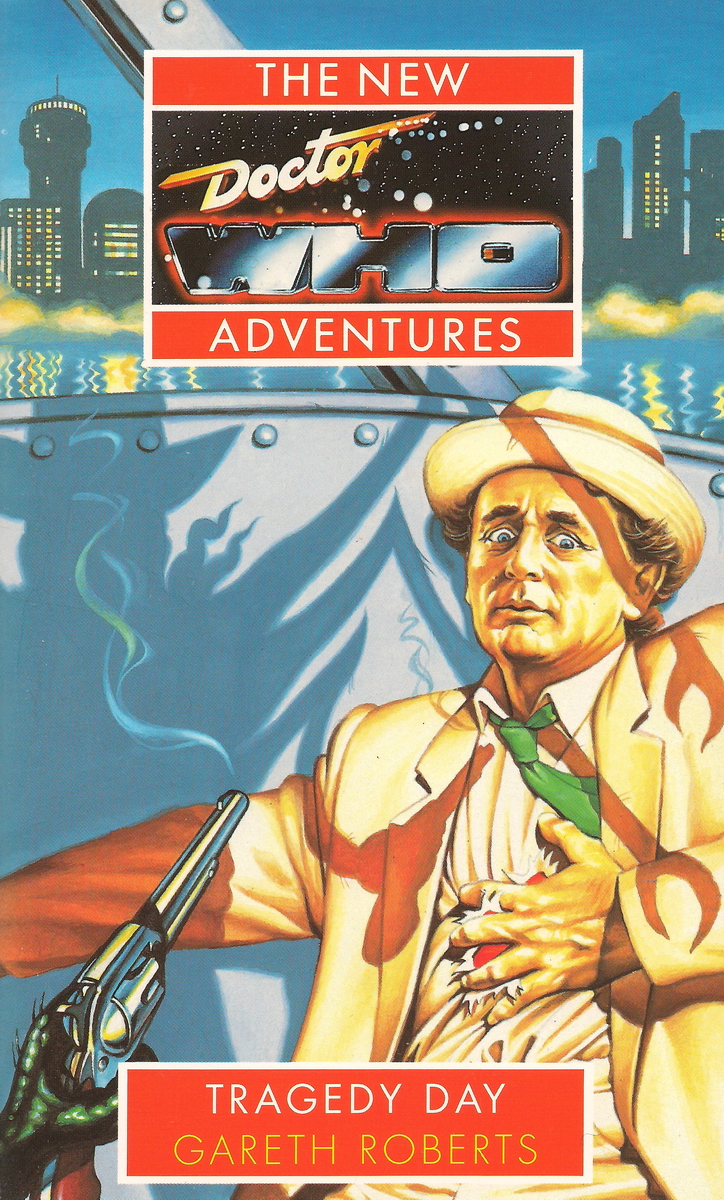
That said, there were casualties: the biggest loss being Gareth Roberts, whose Tragedy Day is practically a soft re-launch for the New Adventures, and who, with a single exception, now departs the main range for the Missing Adventures. As one of the regular writers of the 2005 revival, Roberts’ novels are particularly interesting because they show the evolution of his writing style. What’s fascinating is that even in 1994, after only one previous book (1993’s The Highest Science) he’s already been pegged as ‘the funny one’, a tag he still carries in 2015. The Unicorn and the Wasp is the ‘comedy’ episode that breaks up what could otherwise be a pretty grim fourth series; The Lodger and Closing Time are light-hearted interludes before their respective season finales.

So, Roberts is the man you bring in when you need to lighten the tone. And in March 1994, the tone of the New Adventures definitely needed lightening. Since the War Ace arrived in Deceit, the seventh Doctor’s TARDIS crew has been at each others’ throats: mistrustful and angry. One of the undercurrents in the ‘alternate history’ cycle is the team falling apart, losing faith in each other and generally having a pretty miserable time. This was directly addressed and apparently resolved in the previous novel, Paul Cornell’s No Future – but given Doctor Who’s past form at actually paying off resolutions (cf. The Armageddon Factor; The Trial of a Time Lord), readers might have been forgiven for thinking ‘gritty’ and ‘grim’ were going to be the constant watchwords for the New Adventures.

Which means it’s a genuine pleasure when Tragedy Day turns out to be a sprawling, messy satire that pokes fun at practically every aspect of 1990s life (because its setting, the planet Olleril, is a cultural echo of Twentieth Century Earth). Roberts’ most popular novels, his fourth Doctor and second Romana Missing Adventures, explicitly align themselves to Douglas Adams’ Doctor Who, but Tragedy Day is unmistakeably cut from the same cloth, with the same mix of absurd bathos, ridiculous juxtapositions (Ernie the arachnid assassin, the Celebroids, and monsters called the Slaags) and deliberate damp squib revelations that only highlight the pathetic pretentions of galactic dictators.

Best of all, Tragedy Day was genuinely a new start for the New Adventures. With Rebecca Levene gradually taking over editorial duties from Peter Darvill-Evans, the books became generally less uptight. They could ‘keep the flame burning’ without having to aggressively shun the past. Later in 1994, readers got sequels to both The Monster of Peladon and State of Decay, and the return of the Master. Drama wasn’t generated by the antagonism between Ace, Bernice and the Doctor, but by external menaces. It’s not surprising that this is by and large the books’ most fondly remembered ‘era’ – the one Big Finish revisited in The Shadow of the Scourge, and DWM chose to celebrate (and poke fun at) in their New Adventures tenth anniversary comic strip The Last Word (written by Gareth Roberts).

The New Adventures’ ability to gracefully and convincingly reinvent themselves in 1994 – before Darvill-Evans’ approach had run out of steam – shows they were genuinely worthy successors to the TV series. When BBC Books tried to pull off the same trick in 1999, in response to competition from Big Finish, the Eighth Doctor Adventures floundered and never regained their momentum. Conversely, the New Adventures went from strength to strength, producing, in 1995, one of the all-time classic Doctor Who stories.


Next Time: ‘No, it’s not just a story, no. Every word of it’s true. I found my great grandmother’s diary in the loft, and she was a nurse in 1913, and she fell in love with this man called John Smith. Except he was a visitor from another world. She fell in love with a man from the stars. And she wrote it all down.’ – Human Nature

1993: Deceit

Ace!-119April 1993: the 30th Anniversary year of Doctor Who. Although the show has been off the air for three and a half years, it is still fresh in people’s minds thanks to an ongoing series of BBC2 repeats (which have just reached Battlefield), and regular press speculation about a comeback on the big or small screens. Pertwee, Davison, Colin Baker and McCoy have just promoted a significant package of BBC Video and Audio releases for the anniversary, and BBC Enterprises confirm a script has been prepared for a special episode. The speculation will reach fruition in November, when a 3D anniversary story, Dimensions in Time, airs as part of Children In Need (with the show’s first Radio Times cover since 1983). In 1993, Doctor Who is therefore by no means a ‘niche’ or ‘cult’ show.

Meanwhile, since Love and War was published in October, there have been three further New Adventures featuring the new team of the seventh Doctor and Bernice, and the series has moved from bi-monthly to monthly publication in time for the anniversary celebrations. The second most notable thing about the April release, Deceit, is that it brings back Ace – several years older – as a battle-hardened space marine and Dalek hunter. While Tegan left and came back in consecutive episodes, and we visited the Brigadier at various points after the 1970s, this is the first time a companion has re-joined after their leaving story. New Adventures editor (and the writer of Deceit) Peter Darvill-Evans has taken the opportunity to reformat the character as an actively unwilling participant in the Doctor’s schemes: an unpredictable third wheel in the TARDIS crew to shake up the potentially too-cosy new pairing. Fans imaginatively nicknamed this version of Ace ‘new Ace’, but in a kiss to the future I’m going to call her ‘the War Ace’

In theory, the War Ace adds an interesting new dynamic for the books to explore – and it’s notable that both the New Adventures and the later Eighth Doctor Adventures prefer having two companions rather than one to provide more opportunities for drama. In practice, it takes several, slightly brutal, months of ‘future history cycle’ novels for the War Ace to really work. There aren’t many readers who’d pick the 12-month run between Love and War and Blood Heat as the highlight of the New Adventures. And given I suggested in the last entry that Darvill-Evan’s courage in writing out one of the TV regulars gave the books additional freedom and legitimacy, you might very well wonder why he brought Ace back so soon, and why he made her so unlike (and, initially, unlikeable) the screen version.

I think the answer comes at the end of Deceit, in the most notable thing about the book. It features a relatively lengthy essay that lays out Darvill-Evans views of the New Adventures, his scepticism about doing (still unannounced) ‘Missing Adventures’, the nature of time travel in the Doctor Who universe and the state of Doctor Who in general. And it’s an extraordinary, ambitious manifesto. In it, Darvill-Evans states that:

‘The New Adventures are not intended to be a support for the TV series, or a temporary substitute for it: we may never see Doctor Who on network television again, and in that case the New Adventures have to be ready to take most of the strain of pulling Doctor Who forwards.’

Given the introduction to this post, and the context of 1993, that’s an unusually pessimistic view. A significant chunk of people expected Doctor Who to be back on television within a few years – and as it happens, they were right. But Darvill-Evans has set out his stall: the New Adventures are unambiguously the continuation of Doctor Who in the 1990s. That view gained support when Doctor Who Magazine began to preview upcoming New Adventures in the same way it previews new TV episodes today, and its comic strip explicitly tied in to Virgin continuity. In a very real sense, Darvill-Evans was right: the New Adventures matter in a way no other Doctor Who spin-offs (with the exception of the Big Finish Paul McGann audios) matter. Russell T Davies, Steven Moffat, Mark Gatiss, Paul Cornell and Gareth Roberts all began their professional Doctor Who writing careers with work for Virgin’s seventh Doctor. But it’s not only because of the calibre of writers Darvill-Evans cultivated. It’s because, in the early 1990s, he publicly stated that he was the de facto producer of Doctor Who, and by taking the mandate he pretty much made it happen.

But Darvill-Evans was also very conscious that Virgin merely held the licence, and he had a second aim with the New Adventures: to create a shared SF universe that could endure even if he lost the Doctor Who mandate. This is explicitly the purpose behind the ‘future history cycle’ – an attempt to sketch out a vision of the galaxy in the middle of the third millennium, of an expanding Earth Empire beholden to massive corporations and threatened by powerful forces, many of which lurked in cyberspace. This is the time period that’s home to Bernice and later companions Roz and Chris. In some respects it presages Russell T Davies’ Satellite 5 or Year Five Billion eras – a familiar but non-contemporary backdrop.

So the point in introducing the War Ace is that the New Adventures now have a character that slots perfectly into the kind of Aliens-style space adventures Darvill-Evans wants to tell, picking up the action sequences and freeing up the Doctor to flit, mysteriously, at the edges while Bernice fulfils the more traditional companion role, while also, often via diary entries, offering a sardonic commentary for the readers. In theory, Darvill-Evans believed this ‘future history’ could endure beyond the Doctor. And in fact it did: Virgin’s New Adventures continued, with Bernice as the lead, for two and a half years beyond the loss of the Doctor Who licence. And by the time the books ended, Big Finish had already started their own run of Bernice Summerfield stories, set in the same era. Of course, these plays begat the Big Finish Doctor Who audios, and a house style that even, in 2015, owes a heavy debt to Darvill-Evans’ future history cycle – plays like Nick Briggs’ Fourth Doctor Adventures or the Dark Eyes boxsets have more than a hint of the New Adventures about them.

And so Deceit, while only partly successful as a novel, remains an enduringly influential Doctor Who story. As Darvill-Evans’ most overt attempt at a manifesto for the series, a ‘house style’ every bit as distinctive as Letts’ Yeti-on-the-loo or Moffat’s dark fairytales, it’s perhaps the seminal New Adventure.


Next Time: ‘It’s a very dangerous book and I have been very careless. It is the key to Shada’ – Tragedy Day

1992: Love and War

loveandwarThis entry expands on a review of the audio adaptation, originally written for Doctor Who Magazine in 2012

October 1992: Doctor Who has now been off the TV screens for three years, although there are persistent rumours of a film or new series in the pipeline, and plans are afoot for a 30th anniversary special, The Dark Dimension. The BBC has also embarked on the biggest series of repeats since 1982’s Five Faces season, with one story from each Doctor (and two for Pertwee) airing on BBC2 between January 1992 and May 1993. At this stage in ‘the Wilderness Years’, then, the show is still on terrestrial TV, and people are actively planning to get a new series, movie or at least a straight-to-video special made.

And rather than playing it safe during this period of uncertainty, sticking with the familiar TV team of the seventh Doctor and Ace, Virgin decides to radically overhaul the New Adventures, exiting one of the lead characters and replacing her with a new, novels-only companion. Professor Bernice Summerfield must surely be the most important Doctor Who character never to have appeared on TV – having appeared in 22 years and growing of novels, audios, comic strips and short stories. She is by far the New Adventures‘ most significant addition to the canon, and in many ways is the reason why the Big Finish audios exist. When Looms, and the Other and the Adjudicators are barely-remembered footnotes, Bernice is still a living, breathing part of Doctor Who continuity. Not least because she went on to appear in 45 of the remaining 52 New Adventures, making her the most prolific companion to date.

Partly this is because she arrives at precisely the right moment, when Virgin has done pretty much all it can with the Season 25/26 TV set-up. In Love and War, the Doctor and Ace join up with a band of space travellers on the cemetery planet Heaven, where they have to battle an attempt by the fungal Hoothi to infest the dead and conquer all of time and space. As usual, the Doctor has allowed his tendency for secretive forward planning to override his better judgement. As the story unfolds Ace falls in love with one of the travellers. This threatens to drive a wedge between the two of them that could drive them apart forever. Yadda yadda yadda. We’ve seen the same basic scenario playing out in various permutations since Remembrance of the Daleks – most recently in Mark Gatiss’ first Doctor Who story, Nightshade – and we know exactly how it pans out. Ace is furious with the Doctor, he makes a halting, heartfelt apology. Ace gets over it and they saunter off into the bushes.

Paul Cornell’s genius is to take this plot, and make it really matter in a way no-one has before. This time, the Doctor really does go too far. Ace really is heartbroken. Their split really does seem permanent. This seems necessary – in the TV series all the Doctor’s tests were supposed to be leading up to Ace becoming a Time Lady, a kind of baptism of fire that would prove she had what it took to go to the Gallifrey Academy. In retrospect this has a slight whiff of patronising paternalism about it (and notably, Cartmel and Aaronovitch changed it when they came to write the ‘Season 27 Lost Stories’ 20 years later). Instead, Cornell punishes the Doctor for his presumption. His manipulation is not ok, the end doesn’t justify the means, and he can’t just use his friends as pawns. Love and War is the kind of self-correction that the TV series occasionally did (cf. Steven in The Massacre or Tegan in Resurrection of the Daleks), but followed through to a more devastating conclusion.

That’s where Bernice comes in – at this Doctor’s lowest moment, when he’s saved the universe but lost his best friend. Like Donna Noble 15 years later, she’s brittle and spiky, refusing to be patronised or manipulated. Like Donna, at the moment when the Doctor is at risk of losing himself completely, she reminds him of who he is, and why he fights. And like Donna, she buries the angst under layers of fun. No wonder readers embraced her.

Love and War is Virgin’s most important novel. Not only because it’s a better pay-off to the Doctor and Ace’s relationship than the planned Season 27, but because it enabled the books to free themselves from the constraints of the TV series and genuinely go off to tell stories ‘too broad and too deep’ for the small screen.


Next Time: ‘I don’t suppose there’s a need for a doctor any more. Make me a warrior now’ Ace returns – in Deceit.

1991: Timewyrm: Exodus

SevenVersusTimewyrmAugust 1991. In the 18-month hiatus between Survival and Timewyrm: Genesys, the world has turned upside down. The West intervenes to end Iraq’s invasion of Kuwait, although the failure to bring the man responsible, Saddam Hussein, to justice has consequences we’re still dealing with. Meanwhile, in the East the Warsaw Pact is officially dissolved, and, despite a last-ditch attempt to preserve it in August 1991 the Soviet Union breaks up. And Germany finally gains its independence from the occupying Allied powers.

While in Doctor Who, the second New Adventure is published. The consensus view is that the first was a bit of a disaster, with a deeply suspect attitude towards women, bare breasts, underage sex and an author who at best seems deeply ambivalent about the seventh Doctor and Ace, and would clearly prefer to be writing an adventure for Jon Pertwee or Tom Baker.

Timewyrm: Exodus, on the other hand, is generally regarded as a slightly surprising success. Slightly surprising, because by the 1990s a lot of Doctor Who fans would have been sympathetic to the view that Terrance Dicks had gone a bit off the boil. He’d last written for the TV series eight years before, and although he kept writing novelisations almost to the end, even those, simple re-tellings of the TV stories, drew some unfavourable comparisons with the expanded, experimental books that Target started to put out in the 1980s. While Ben Aaronovitch was introducing new scenes and hints of the wider “Cartmel Masterplan” in his own novel of Remembrance of the Daleks, Dicks was pumping out a straightforward adaptation of Planet of Giants.

That said, Dicks was, and is, probably the safest pair of hands in Doctor Who’s history. Virgin were pitching the New Adventures not only as the continuation of the TV series, but also as a replacement for the Target novelisations which had reached a natural end in July 1991 with the publication of Battlefield, so it made perfect sense to bring Dicks in early to help smooth the transition and get people onside, like sticking Status Quo on to open Live Aid.

And rather than turning in a safe book, Dicks not only gives us the first Doctor Who changed history story (there are many, many more of those to come, but this is the original), but goes right for the big one: what if Germany had defeated Britain and won the Second World War? Not only that, this isn’t just about some Nazis. These are Hitler, and Himmler, and Goering and all their insane beliefs.

The Nazis haunted the Sylvester McCoy TV stories, so we got pseudo-Nazis and alien Nazis in Remembrance of the Daleks, neo-Nazis in Silver Nemesis and Nazi paraphernalia in The Curse of Fenric. But until Timewyrm: Exodus, the series hadn’t actually tackled the Nazis themselves. In that sense, the book feels like a natural progression from the last couple of years of the TV series. What’s interesting about Timewyrm: Exodus is that Dicks doesn’t simply portray the Nazis as monsters, although he makes it clear they are. Instead, he confronts the seductive power of Nazism. True, he does this partly by having Hitler inherit the hypnotic powers of a time-travelling alien goddess. However, less crassly, he shows us a potential future where Great Britain succumbed to Nazism, and, in the book’s strongest moment, even has Ace experience the pleasure that comes from imposing her own views on others.

Opening the book at an alternative Festival of Britain – a vision of the early 1950s that’s both a million miles away from the pomp and circumstance of Elizabeth II’s coronation, and yet still haunted by the fall-out from the Second World War – is masterful. The British community is recognisable, but the emphasis is horribly changed. Instead of Cockney bovver boys causing trouble, these young thugs have been co-opted into the British Free Corps, and their casual cruelty turned against their fellow citizens. And as most English people prefer to just get on with it without making too much fuss, the implication is that a decade after the German victory most people have learned to live with the new regime, the police won’t intervene if the Free Corps are involved and the resistance is an irritation.

This is chilling – as is Ace’s reaction to the Doctor’s convincing impersonation of a Nazi officer, which he puts on to stop a couple of Free Corps thugs threatening a Jewish stallholder. Ace is delighted at the Doctor’s show of strength, and the subsequent exchange is worth quoting:


The Doctor gave her one of his enigmatic looks. “Enjoyed it, did you?”

“Yeah, why not?”

“So did I,” said the Doctor. “That sort of thing gets enjoyable very quickly. We scared the man at the tea-stall too – did you enjoy that?”

“All right, I get the point.”


In that exchange, which is early in the book, Terrance Dicks – writing his first seventh Doctor adventure – nails the character so well you can hear McCoy saying the lines, quizzing Ace, testing her. What’s more, he captures one of the reasons Nazism was so appealing, why so many young people joined organisations like the SA and the Blackshirts, directly and straightforwardly.

The rest of the book plays out with similarly straightforward, punchy prose. Timewyrm: Exodus is a brisk read, showing off Dicks’ strengths as a storyteller and an unfussy writer – everything he’s learned both about Doctor Who and about writing accessible, enjoyable novels is poured into this. The result is one of the genuine triumphs of the New Adventures – a novel that’s as pacey as a McCoy era TV story and as readable as a Target novelisation. Dicks even introduces a new signature style – introducing one of his own old villains, the War Chief, in a move that would be self-indulgent if only it didn’t appeal so irresistibly to the fan gene, and reconciling the TV series and the books for those fans wavering about accepting the New Adventures. Later, he re-uses the Vampires, Borusa, the Raston Warrior Robot, the Rutans and Morbius so that every one of his TV episodes has its own sequel. Plus, in its own way, this is Terrance Dicks’ most important Doctor Who work since The War Games so the re-use of the War Chief is entirely appropriate.

The War Chief is just one element though – along with Nazis, zombies, plus the Timewyrm herself. There’s a sense that Dicks really let rip here, and the result is intoxicatingly insane. In a book range that’s trying to both pick up where Target left off, and become the primary continuation of a defunct TV series, something like Timewyrm: Exodus is almost exactly the kind of thing you need to.

When Joss Whedon decided to continue Buffy the Vampire Slayer as a series of comics he promised that it was going to be “conceptually bigger and more fantastical” than the TV series, able to achieve things on a scale that would have been impossible on a budget. Terrance Dicks does exactly the same thing in Timewyrm: Exodus – a recognisable Doctor Who story that’s grander and more epic than anything the TV show could have delivered had it still been going in 1991. It worked – this is still one of the best-loved New Adventures, and deservedly so. Though later novels were more obviously ground-breaking, Timewyrm: Exodus kick started the range, just like second TV story kick started the series: this is The Daleks of the 1990s – a book that showed what “too broad and too deep for the small screen” actually meant in practice.

But Dicks was about to be superseded by a new writer, one whose work not only defined the New Adventures, but won him a place as the earliest Doctor Who author to write for the new series…


Next Time: “The Doctor’s soul is revealed. See him. See the heart of him. The man who abhors violence, never carrying a gun. But this is the truth, Doctor. You take ordinary people and you fashion them into weapons.” Love and War.

1990

Seven_Search_Out_Science_Search_Out_Space1990. After a decade in retreat, the British left wing seems to be rising. 200,000 protestors riot in London against the introduction of the Poll Tax. The UK slips into a recession, and against an apparently inexorable rise in Labour’s opinion poll ratings, Margaret Thatcher is finally deposed by her own cabinet. The moment Andrew Cartmel and his stable of writers have been hoping for for the last three years finally comes to pass.

But Doctor Who isn’t about to witness it. Because for the first time since 1962, there is no new Doctor Who on TV. Which is a blessing and a curse for this blog. A blessing, because to cover one story a year from 1963 to 2013 would technically have meant I’d end up with 51 stories, and 1990’s wilderness year is therefore a good way to reflect the break between Survival and Timewyrm: Genesys, and stick to the 50 story limit. And a curse, because I’m a Doctor Who fan and therefore a completest, and the idea of having no entry at all for 1990 is therefore unthinkable.

The thing is, from one point of view 1990 really is the wilderness year. It was the year when it became obvious the show wasn’t coming back any time soon. Apart from the ever-reliable Doctor Who Magazine comic strip and the tail end of the Target novelisations, about the only new stories put out in 1990 were the Abslom Daak: Dalek Killer comic book, Mission to Magnus (the last of the novelised ‘lost stories’ from the aborted 1986 series) and Search Out Space, in which the seventh Doctor, Ace and K9 battle the Celestial Toymaker in the form of sinister man-child Cedric, possibly.

As for me, by 1990 I was 10 years old and definitely a Doctor Who fan. No trip to Worcester was complete without a visit to WH Smith and 75p on a Target novelisation. The first time I ever ordered a book was The Daleks’ Master Plan Part I: Mission to the Unknown (Smiths in Worcester only had Part II: The Mutation of Time). I’d been an avid reader of the novelisations since the mid-1980s. Terrance Dicks was my JK Rowling. I was always faintly disappointed that in my primary school library the only Doctor Who book they had was Full Circle by Andrew Smith. I, on the other hand, had piles of Target novelisations – the lists of “also available” books that made up the endpapers of every Target release were carefully ticked, and I was always on the look out to plug any gaps. Preparing for a school trip to Switzerland, my parents took me to the Kingfisher Shopping Centre in Redditch where along with a shell suit (oh, the humanity) and toiletries I bought the novelisations of Planet of GiantsThe Space Pirates and Remembrance of the Daleks.

I really can’t overstate how much I adored the Target novels. I always had at least one on loan from Pershore Library, and it was a red letter day whenever I found one withdrawn from stock and on sale for 10p. For my 7th or 8th birthday I’d received Doctor Who and the Tomb of the Cybermen (a particular favourite). For my 9th birthday, my parents took me to Hay-on-Wye and I spent all my birthday money buying up novelisations of mysterious stories like The Awakening and Doctor Who and the Sea Devils. Basically, I really loved the books. And I guess there must have been thousands of people just like me, for whom Doctor Who was largely experienced as a series of books, occasionally interspersed with a TV programme – meaning that continuing the Doctor’s adventures in print was, if not ideal, then entirely reasonable and congruous with the way fans had been following the show since the mid-1970s.

Which means I should have been queuing up for my copy of Timewyrm: Genesys when the New Adventures launched in June 1991. Sadly, though, I just looked on this interloper novel (not on any of the story lists in any of the novelisations) with suspicion. It looked dauntingly long compared to most of the novelisations, and the blurb made it all sound a bit wearisome. And so, when the Target novelisations dried up, so did my interest in Doctor Who, for a couple of years anyway. I didn’t read a New Adventure until 1995. At which point, probably having reached the target age for the Virgin books, I fell in love with the series all over again and bought up almost all of them from a remaindered bookstore, called Bookends, in Worcester – I was lucky that my renewed interest happened to coincide with Virgin losing the licence to do the books, and therefore I think I hit jackpot – picking up rare releases like The Dying DaysSo Vile a Sin and Lungbarrow for £2.95.

So, for me 1990 was very much business as usual, even with no TV show. And after 1995, the TV movie came along, and then I was there for the kick-off of the BBC eighth Doctor books, the Big Finish audios and, ultimately, the new series. But, all that’s in the future. In the meantime, let’s see. You’ve got a time machine; I’ve got a gun. What the hell. Let’s kill Hitler.


Next Time: “What did he mean, we saved his life? We could not have just saved Hitler.” Timewyrm: Exodus.