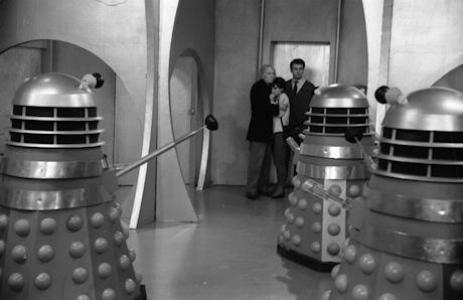
1970: Spearhead from Space
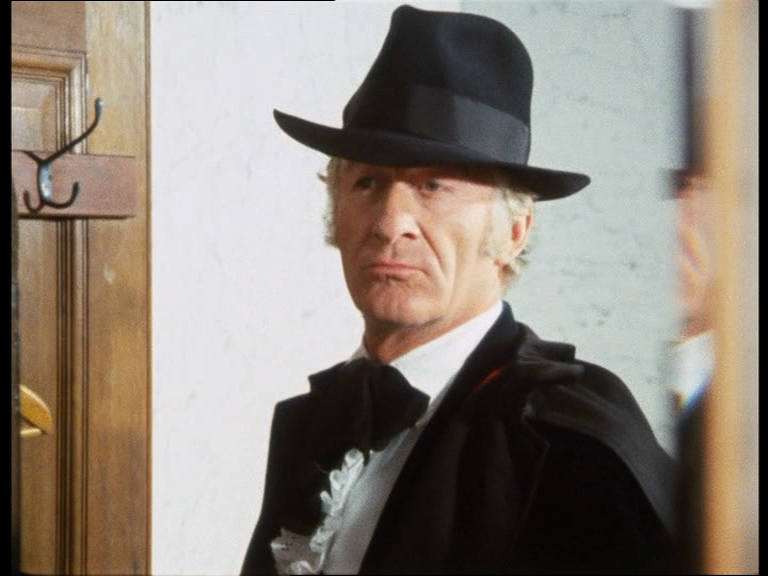
vlcsnap-2011-10-28-15h48m45s89January, 1970. In the six months since Doctor Who went off the air, the biggest news has been the Apollo 11 and 12 Moon landings. Four human beings have walked on another planet, and looked up to see the Earth in the sky. Which makes the opening shot of this serial – our lonely planet, floating in the blackness of space – especially poignant.

There’s something to be said for the argument that once we got to the moon and found nothing there, space lost its appeal slightly. Certainly, in the popular imagination the early 1970s are more notable for their introspection – meditation and mysticism – than the questing spirit of the 1960s. Having established that we were alone in the Solar System, if not the universe, there was suddenly an increased sense of urgency to protect our own planet. Environmentalism was on the rise, and series such as Doomwatch captured the mood of the times, where the biggest threat to humankind was our own short-sightedness.

On TV, Star Trek‘s voyage to strange new worlds, new life and new civilisations, ended in 1969. The biggest sci-fi movie franchise was the Planet of the Apes series, which, famously, was Earth all along. So ending the Doctor’s adventures in space and time and exiling him to 20th Century Earth fits very well with the zeitgeist. And as the first story in the new house style, Spearhead from Space is promising.

Given the persistent idea that the UNIT stories take place in the future, it’s interesting that in the first scene of the 1970s, a woman is in charge, giving a male radio operator a dressing down for his fanciful speculation. Blink and you miss it, but it’s an important detail: straight away, the show establishes that we’re in a time when women are the unquestioned equals of men. Later, the Brigadier is shown to be embarrassed by the chauvinist attitudes of a stuffy old British Army general, siding with the smartest person in the room – Dr. Elizabeth Shaw – rather than the most senior man. At this stage, the Brigadier is being set up very much as a ‘new man’, which ties back to The Web of Fear when he’s far more open than his colleagues to the possibility of a Police Box that travels in time and space. Given he’s later reduced to chauvinist comic relief, the Brigadier we get here is much more in the spirit of Haisman and Lincoln’s original creation, and a more interesting character.

Robert Holmes establishes the new set-up of the series with an economical two-hander between the Brigadier and Liz. Reiterating the predominant theme of the Troughton years – space is dangerous and the Earth is surrounded by alien monsters hungry for a piece of us – the Brigadier tries to convince Liz to become UNIT’s new scientific advisor. And fuelling the mood of paranoia and mistrust of politicians, he states, “There was a policy decision not to inform the public” about two previous alien invasion attempts.

So before we even meet the new Doctor, Holmes has established the Brigadier as the leading man in this show. There’s a hint that the new dynamic might be the Brigadier and Liz – who enjoy a slightly flirtatious relationship – being assisted by an eccentric alien Doctor, who’s a whimsical secondary presence, coming up with moments of genius in the lab: a sort of precursor to Dr. Walter Bishop in Fringe. This fits with reports that Derrick Sherwin wanted to cast a known comic actor to play the guitar and goof around. But all that’s put paid to the moment the new Doctor wakes up from his coma.

If Troughton was charismatic, and made the Doctor into the dominant lead of the series, then Pertwee just turns that up to 11. He dominates the screen, from the moment he starts pulling faces into Liz’s mirror. Taking Troughton’s occasional clowning and charm, and Hartnell’s screen-hogging arrogance, Pertwee is a presence in every one of his scenes. It’s impossible not to be drawn to him. Tom Baker, with an uncharacteristic hint of awe, described him as a glittering light bulb, and he was right. Any idea the producers might have had to make Courtney a lead are clearly untenable when Pertwee is so obviously the star of this show. Director Derek Martinus, one of the series’ best, has clearly clocked this, and gives the audience plenty of close ups of the new lead, and enough time to show his flair for comedy, for example in the shower scene. When the new Doctor drives up to UNIT’s secret headquarters and demands to see the Brigadier, you can practically see Derrick Sherwin – who’s playing the hapless security guard – roll over and surrender.

Of course it helps the new Doctor that his predecessor hasn’t been seen for six months, and that the last time we did see him he was at rock bottom, But nonetheless, even without a Ben or Polly to help the audience accept him, Pertwee establishes himself in the role remarkably quickly, and with none of the lingering suspicion that Troughton’s Doctor engendered.

While the audience has been focusing on the Brigadier setting up the new format and Pertwee taking over the show, in the background the Auton invasion has been unfolding quietly but methodically, the pieces dropping into place before things properly kick off in Episode Three. We ought to give Robert Holmes credit for this balancing act, because the big invasion story is really only a sideshow while UNIT and the new Doctor to set themselves up, and then an opportunity for them prove their mettle. However, this is only really problematic when you notice that the second and third cliffhangers involve bit-part actors being threatened because our leads aren’t really yet part of the invasion story.

It’s the fourth episode which gives us the money shot – one of the best of the entire run – when the Autons smash their way out of their window displays and start gunning down shoppers. This is the Yeti on the Loo scenario playing out in a way we’ve never really seen before – the War Machines shooting a man in a phone box are so out of the ordinary that they might as well be Daleks on Westminster Bridge. But this image takes what Doctor Who is good at – juxtaposing things that shouldn’t be together – and pushes it to a new level. This isn’t putting two very different things side by side: it’s putting the bizarre inside the mundane, thus making the everyday horrifying and uncanny. A shop window dummy that’s actually an alien robot is horrific in a way that a mythical abominable snowman that’s actually an alien robot isn’t. The genius of the TARDIS – an alien time machine inside a London police box – appropriated as the way to scare children.

Robert Holmes and Terrance Dicks clearly recognise this is the real innovation of Spearhead from Space, and to their credit when they re-make this story in the following season, the whole thing revolves around everyday objects being possessed by alien intelligence. Which results in Holmes getting his first rap on the knuckles for going too far into the realms of horror. Nevertheless, he clearly takes all the right lessons from this story when he becomes the show’s head writer.

So, this is clearly one of the classics, and it kicks off a highly-acclaimed season. Which might suggest that Derrick Sherwin’s instincts were right, that the show did need to go with the zeitgeist, and bring the Doctor down to Earth. In the short term, the approach works. However, looking at this story critically we have robot monsters collecting alien energy spheres to help manifest a disembodied intelligence. And we have monsters waking up and marching around London, while the Doctor and UNIT go to their factory with a gizmo that disrupts their brains. Yes, it’s a reductionist description, but the reality is there isn’t much here that hasn’t already been done in The Web of Fear or The Invasion. There’s even a dismantled Yeti sphere included in the Doctor’s Nestene-killing gizmo, while the Auton factory is exactly the same location as Tobias Vaughn’s factory. For all that, though, Spearhead from Space is unquestionably a success.

The real problem with the Earth exile format is that after 1970, it goes on for another two years. Once Season Seven has cycled through variations on Quatermass (Inferno tries to break the mould with a premonition story with sci-fi trappings), Season Eight struggles to find anywhere new to go. Hence we get two re-makes of this and another buried evil story. If anything, the miracle of the Pertwee era is that they managed to make a short-term decision, prompted by production problems and mounting costs, spin out so long. While there’s nothing inherently wrong with UNIT stories – after all, series like Doomwatch and UFO managed to get by just fine on a similar premise, and The X-Files ended up lasting for nine years – this in itself is telling. Other shows can do these stories as well as Doctor Who.

All along, the issue is staring us in the face. In the second episode, Liz re-states the basics of the series: “You really believe in a man who’s helped to save the world twice? With the power to transform his physical appearance? An alien who travels through time and space in a Police Box?”. The trouble is, she’s describing a show that’s more interesting than the one they’re making now. In the third episode, the Doctor and the Brigadier spend ages talking about the TARDIS – even though we’re not going to see it for another 15 months. Yes, you can do very good, even great stories about invasions of Earth. Spearhead from Space is one of them. But they’re not the only stories this series ought to be telling.

The Doctor showed us the dawn of man and the end of the world. We saw planets ruled by butterflies, and a land where every story was real. We visited China with Marco Polo and saw the Daleks on top of the Empire State Building. We’ve seen the wonders of the universe because of a madman with a box. But take his box away, and what do you have left?

Next Time: “Outside those doors, we might see anything. We could find new worlds, terrifying monsters. Impossible things…” After two years’ absence, Doctor Who returns in Colony in Space.
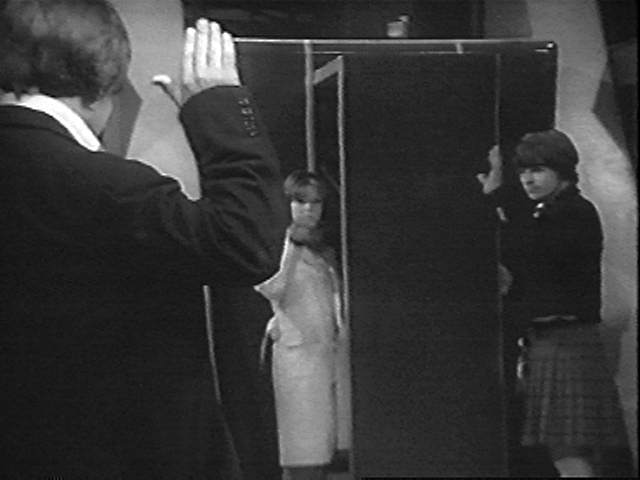
1969: The War Games

st-2z95It’s April 1969. In the 14 months since the last blog post, the world has changed. In the USA, a string of political assassinations and the escalation of the Vietnam War precede the election of the Republican Richard Nixon. In France, student riots briefly threaten the right-wing government, which nevertheless triumphs in subsequent elections. While in the UK, the Conservatives surge ahead of Labour in the polls, and, the day after Episode One of The War Games airs, troops are deployed to Northern Ireland to reinforce the RUC.

Across the Western world, after a decade of youthful rebellion, 1969 is the moment when the conservative Establishment reasserts its authority. Doctor Who has been ringing the changes as well. After The Web of Fear, Haisman and Lincoln’s next script is a stinging rebuke to the All You Need is Love generation, and while the Earth under siege format’s still going strong in The Invasion and The Seeds of Death, it’s been joined by odder offerings like The Mind RobberThe Krotons and The Space Pirates – the last two by Robert Holmes, the author of episodes of the weird alien invasion serial Undermind and the Quatermass-inspired movie Invasion.

Then there’s The War Games: the climax of both Troughton’s tenure, and Doctor Who in the 1960s. There are some very obvious things to say about this: at 10 episodes, it’s the longest serial since 1966. It’s the first story with Terrance Dicks’ name in the titles. He’s going to be the writer with the longest association with the series, and you can already see his respect for continuity in the scenes where he has Zoe and Jamie returned to their own times. It’s exceptionally well directed by David Maloney. And it introduces the Time Lords and sets up the third Doctor’s exile to Earth.

All these are true facts. But there are also some commonly-repeated fallacies. This isn’t the first story to be set in Earth’s history since 1967, because it isn’t set in Earth’s history, but on an alien planet. That’s important, because throughout Troughton’s era, we’ve seen that the Earth is the default destination for the TARDIS – the Doctor even comments on it in The Web of Fear. So it’s a marvellous twist when it turns out that this isn’t Earth, and that the Doctor has become caught up in events that transcend one planet and one time. Previous sci-fi/historical mash-ups have depended on placing something anachronistic into Earth’s past. The War Games flips this by placing Earth’s past into a sci-fi story: a trick that the series won’t convincingly pull off again until Enlightenment.

Another fallacy says the story is a nine episode story plus a practically stand-alone, one-part epilogue. However, that’s nonsense: the tenth episode is absolutely integral to everything that has gone before. This last point’s important, because some commentators have suggested that focusing on the last episode and ignoring the first nine is a mistake. And to an extent they’re right – why would you ignore the first nine episodes when they’re as compelling and brilliant as Doctor Who gets? But the fact is, they are a lead-in to the final showdown – just as the first six episodes of The Evil of the Daleks are only meaningful as a set-up to the confrontation with the Emperor and the Dalek civil war.

Terrance Dicks and Malcolm Hulke make the story a gradual escalation. It begins with the TARDIS arriving in what looks like the First World War – and the Doctor immediately decides it’s far too big a problem for him to solve, and wants to just leave. Then it’s revealed that somehow there are Romans on the battlefield. Then that there’s mind control involved. Then that there are aliens involved. Aliens with TARDIS-like devices. Another one of the Doctor’s people. A plot to conquer the universe. And, finally, an intervention by the Doctor’s own people. There’s easily enough plot there to justify the 10 episodes, with revelations dropped in at regular intervals. The point being, by the end of Episode Nine, without us even seeing it happen, the stakes have got so huge that they’re beyond the Doctor’s ability to handle. It’s a neat way of bringing the story – which begins with the Doctor trying to run away from an insoluble problem – full circle. And it immediately establishes the Time Lords as a credible power because they can succeed where the Doctor has failed.

The final episode wraps up the plot quite cleverly, by having the Time Lords run their own version of the Nuremberg trials and condemn the warmongers to dematerialisation. The universe is saved, and the kidnapped human beings are returned to their own times. However, just as the Establishment is reasserting itself in the real world, so the Time Lords impose themselves on the Doctor’s universe.

Because, the 1960s ended in failure. The Summer of Love and the 1968 revolutions failed. The optimistic belief that youth could change the world was shot down. The War Games reflects this. The Doctor looks shabbier than ever before – coat ripped, trousers torn, hair a mess. He looks like he’s coming apart at the seams. Threatened by the Time Lords, he just seems impotent. Strangers wander in and out of his TARDIS; the War Lord tries to take it over, and the Doctor stands by and wrings his hands. This is abject. Even his final attempt to escape, through the strange, Tara King Avengers style sets of his home planet, is half-hearted.

Of course he mounts a defence of himself – bringing up images of his most iconic enemies – Daleks, Cybermen, Ice Warriors, Yeti and, yes, the deadly robot Quarks (they were still flogging that dead horse right to the end). But he crumbles in the face of the greatest monsters of all. I’ve previously suggested that since The Evil of the Daleks, the producers have been searching for the next big monster. Terrance Dicks gives it to them. A people that stand by and do nothing while the Daleks wipe out billions; a people that smile as they wipe you from existence, and a people that are more interested in stifling revolution and preserving their own power than helping anyone else. No wonder the Doctor ran. These Time Lords are horrifying: the very embodiment of the deadening forces of conservatism sweeping the globe, crushing the spirit of youth. The British director Pete Walker made a series of horror films in the 1970s exploring similar themes, and over in the USA George A Romero had just made a starkly nihilistic zombie movie in which the hero is killed not by the monsters, but by the National Guard on the clean-up operation. Terrance Dicks and Malcolm Hulke tell us that the real monsters aren’t besieging us. They’ve been inside the base all along.

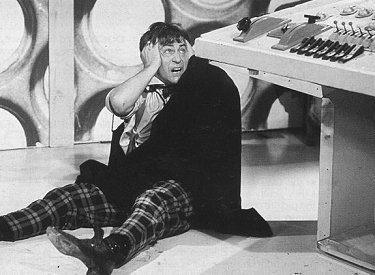
And that’s how the 1960s end for Doctor Who: a brilliant masterpiece that is, at the same time, the bleakest story of all. The second Doctor is utterly defeated. He’s stripped of his companions, his TARDIS and his persona. He can’t beat the system, he can only surrender to it. Our last sight of him, this anarchic Doctor who defeated the Dalek Emperor, the Cyber Controller and the Great Intelligence, is swirling into the darkness, gurning and begging for mercy. There is no shred of comfort for the audience, no glimmer of hope in all of this.

It’s a quite brave culmination to six years of adventures, to have your hero brought so low, all his victories bargained against his continued existence. While he tumbles away into the darkness, the show’s about to go on its first extended hiatus: in the next six months, the production team have to find a way to continue the series when they’ve just got rid of its entire premise. Who will survive, but what will be left of him?

Next Time: “It’s an invasion, plain and simple.” The third Doctor arrives amid a Spearhead from Space

1968: The Web of Fear

bridgstewartFebruary, 1968. In the seven months since the last blog entry, Doctor Who has settled into a state of comfortable complacency. Having defined a new direction and style for the series during its fourth season, the production team’s biggest concern seems to be trying to find a replacement for the Daleks. As such, Season Five plays out like Doctor Who’s version of The X-Factor auditions, with new monsters turning up, doing their turn for six weeks, then lumbering off the stage. So far we’ve had the Cybermen, the Yeti and the Ice Warriors, plus a genre-busting script from David Whitaker. And coming up are a seaweed creature, more Cybermen and the fearsome Quarks.

And then we have this story. It’s widely hailed as one of Doctor Who’s great classics, and even though one episode is still missing presumed wiped, it’s not difficult to understand why. As we’ve seen, the show has gone from being an exploration of strange, new worlds to a series where the Earth is a base under siege by cosmic horrors. We’ve also seen the show explicitly state that humankind is important in a way that other races aren’t. And finally, the Doctor has been established as the Earth’s protector. The Web of Fear is finally the story that takes all these strands and pushes them towards a logical climax.

The first episode gets the tiresome business of the Yetis’ resurrection out of the way with admirable economy – whereas it took two episodes to wake up the Cybermen and an episode to defrost Varga, we get our first Yeti attack about 10 minutes in. There is a neat call-back to The Abominable Snowmen (which, to be fair, was only 12 weeks earlier), and then we cut to several months later, with Professor Travers and his daughter Anne assisting the British army combat the conquest and invasion of London. At the point when the TARDIS arrives, the capital has already been evacuated, and the monsters are already in control. The speed with which the story is being told suggests that the writers and director assume that the audience is now familiar enough with the basic formula of the series to want to cut to the chase. And The Web of Fear is all about giving the audience what it wants.

So, having established what’s going on up front, we then get half an episode of the Doctor, Jamie and Victoria wandering around deserted London Underground tunnels while we sit on the edge of our seats waiting for one of the new, scary Yeti to jump out of the darkness. It’s that anticipation which makes the first episode such a masterpiece of suspense. The second episode, which coincides with one of Troughton’s holidays, then fills in some of the gaps. But it also makes a virtue of it’s star’s absence, by having everyone wonder what has happened to him – a trick the show has occasionally pulled off in the 1960s but won’t again until the “Doctor-lite” episodes of the 21st Century series.

Then, the (missing) third and fourth episodes tighten the net further around the base at Goodge Street, firstly by having it quite literally get encircled by the enemy (represented by the entire Circle Line falling to the web infestation), and then having the tensions in the group erupt into suspicion and recrimination when it becomes clear that the Great Intelligence has a spy in the camp – most likely, the mysterious Colonel Lethbridge-Stewart who’s turned up claiming to have escaped an ambush at Holborn. After the Colonel has led a daring raid to try to capture the TARDIS at Covent Garden, which only succeeds in wiping out most of the surviving soldiers, the fourth episode ends with Professor Travers being possessed by the Intelligence.

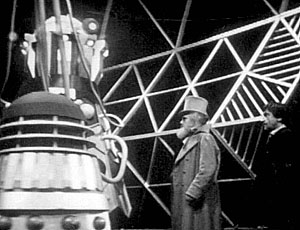
It isn’t until the fifth episode that the Intelligence reveals its plan: the entire invasion of London has been a trap to snare the Doctor. At which point, the Doctor tinkers with a Yeti and mind duels with the Intelligence to defeat it – and the audience realises that we’ve been hoodwinked: that actually, the story has been treading water for four weeks, and this could all have been over much sooner had the Intelligence just issued its ultimatum to the Doctor when he first arrived.

That would spectacularly miss the point, though. The Web of Fear succeeds despite its flimsy plot because it is utterly relentless. There isn’t time to think, because no sooner has one threat subsided than another arises. New characters – Evans and the Colonel – are introduced at precisely the right moments to extend the traitor-in-the-camp sub-plot; there’s one behind-the-sofa moment each episode where the Yeti attack to the sound of a toilet-flush roar and the stirring tones of Space Adventure. And the characterisation is good enough to hold it all together even in Troughton’s absence. The Yeti are effective because there’s no way to talk to or reason with them, they’re just huge, unstoppable monsters that will stalk you till they kill you – the Doctor Who equivalent of Michael Myers; while the Great Intelligence, a disembodied and malevolent ghost from the cold of space, is as alien a menace as we’ve ever seen. The story takes the Season Five formula and does it exceptionally well, setting a new benchmark of quality for the series.

In fact, it does it so well that it becomes the story that everyone remembers. Though it’s not the first of its kind, the Yeti-on-the-loo genre is named for it. Script Editor Derrick Sherwin is going to re-make it twice in the next 18 months, and the series will still be going back to it for inspiration until 1974. Had they not had a massive falling out with the producers over their next script, The Dominators, Haisman and Lincoln would probably have become the main writers for the show as it went into the 1970s – a role that Robert Holmes inherits. And while the Yeti didn’t come back (the quibbling over the rights to the Quarks probably soured that one), Colonel Lethbridge-Stewart did go on to be the show’s most enduring supporting character during the next four decades. The success of this story shows that with some investment in an impressive set, three good monster costumes and dynamic direction you don’t even need to head out to a quarry. Once Sherwin takes over as producer in 1969, he’s going to take The Web of Fear as his template for how to make Doctor Who. And Barry Letts is going to inherit that approach and, largely, default to it throughout his tenure. That’s how influential this story is: they were still making stories like it when Tom Baker was the Doctor.

And on top of this, The Web of Fear also shows how thankless the role of the Doctor Who girl has become. Victoria is entirely side-lined in this story. Instead, Anne Travers takes on the role of one-story companion to the Doctor, and proves that you need to be able to do more than just scream if you’re going to be good enough. She gets a marvellous line in the first episode when a soldier asks her what a nice girl is doing in a place like this. “When I was a little girl, I thought I’d like to be a scientist,” she says, though gritted teeth. “So I became a scientist.” In 12 weeks’ time we’re going to meet Zoe, who’s far more like Anne than she is Victoria. And thereafter, the Doctor’s companion is never quite as useless again.

Yet despite all that, it’s only with retrospect that we can see The Web of Fear as more than just another in a series of identikit horror serials. At the time, no-one was picking up on the discordant notes here: the fact that it’s the Doctor’s failure to properly clean up after the Intelligence’s first incursion in Tibet that condemned so many people to die here. The fact that the Intelligence was only interested in Earth or humankind as a way to get to the Doctor.  The fact that he hurries away again, on a curiously unresolved note, admitting that the Intelligence has only been defeated, not destroyed. The Doctor, the self-appointed protector of the Earth, has brought death and destruction down on us, and he doesn’t even stick around to put things right.

However, the Colonel has now seen that Great Britain has enemies beyond imagination. Is it any wonder that he proposes the United Nations set up a task force to investigate these strange happenings, and to fight them? Is it a surprise that he names it “Intelligence”? And if the Intelligence should return, it should beware. Because UNIT will be waiting…

Next Time: “There was a war. A time war…” The second Doctor fights his last battle for the sake of all creation in The War Games.

1967: The Evil of the Daleks

Evilofthedaleks_titleMay, 1967. In the six months since the last post, the new Doctor has lost Ben and Polly, but gained Jamie. He’s visited Atlantis, battled Cybermen on the moon, Macra on a distant Earth colony and Chameleons at Gatwick Airport. But all of these dangers fade into insignificance against the biggest threat the show’s ever faced: Terry Nation has decided to try to launch a Dalek TV series in the USA and so this story – though fitting into the normal half-yearly rhythm of Dalek episodes – has been decreed as their Doctor Who swansong.

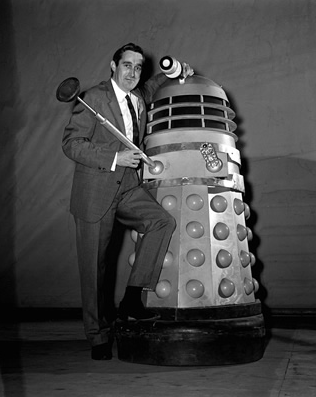
The Evil of the Daleks could not have been more aptly titled. Assessing it soon after The Power of the Daleks, it’s fascinating to see so many of the ideas and themes of the earlier story re-stated and elaborated on. David Whitaker again shows he grasps the Daleks’ mythic nature better than their creator. Whitaker makes them something more than space Nazis: he makes them the source of evil in the cosmos, playing on human weakness for their own ends. In Power, Lesterson, his mind broken, realises with a thrill of horror that the Daleks are pure evil. Here, once again, they have been summoned up like demons by men who are driven by a thirst for knowledge and power, who are prepared to broker a deal with the Devil – and Whitaker explicitly links them with the Devil, with references to “infernal meddling” and “creations of the Devil” – to learn the secrets of alchemy. And if the Daleks are modern-day demons, then their plan entails nothing less than the corruption and damnation of all humankind by spreading the Dalek Factor throughout the entire history of Earth (and note it’s specifically Earth they’re interested in). In their Hartnell stories, the Daleks plan to conquer the universe. Here, at their most terrible, they plan to take over the human soul. Which makes the Doctor’s climactic return to Skaro analogous to a descent into Hell, and the enthroned Dalek Emperor – well, it hardly needs spelling out why he’s the Doctor’s ultimate enemy.

The thing is, this absolutely fits with the way the show has been developing during the new Doctor’s tenure. The Hartnell Doctor was an explorer on a scientific mission, and many of the aliens he faced – like the Sensorites, the Menoptra, the Rills, the Aridians and the Monoids – weren’t really monsters. Even the Cybermen of The Tenth Planet had a skewed kind of morality. But the Troughton Doctor, from the outset, has been a crusader against evil, issuing dire warnings to humankind about meddling with the unknown. He believes that there are corners of the universe which have bred terrible things, which must be fought. Here, he can “feel” evil even before he knows the Daleks are involved. Though it’s impossible to believe that Whitaker intended it, the lesson we could take from the way Season Four is panning out is that alien equals bad.

And this happens at the same point that the show is focusing more on Earth and humankind. There are at least six Hartnell stories that, aside from companions, don’t feature any human beings. There are only two such Troughton stories (and one of those is a rejected Hartnell-era script), and only one Pertwee story (which is a remake of a Hartnell script). So, when The Evil of the Daleks posits that the Human Factor represents goodness – mercy, friendship, courage – and expressly equates the Daleks with Satan then we’re getting into the kind of simple, dualistic universe of the Hammer Horror movies.

The point of all this is not to suggest that the production team of late-1960s Doctor Who is racist, but to show how the series is moving to a place where in two years time the makers can seriously contemplate turning their back on adventures in space and time and repositioning the Doctor as defender of the Earth. The roots of that sea change go back to the transition, in Season Four, from a show about going and exploring the universe to a show about protecting humankind from all manner of cosmic horrors.

But while the show’s morality is getting a little less complex, its production is getting more ambitious. The storytelling is a lot more visual with large stretches entirely free of dialogue, and, especially in the middle episodes, relying on the spectacle of Daleks lurking in the shadows of an old house. The move to discrete serials with their own titles has also had an effect – while the producers could have extended The Daleks’ Master Plan ad infinitum by dropping in yet another episode in a strange environment, it’s far harder to hide the joins in the new format. If it’s true that this story was extended from six to seven episodes at short notice, then it’s easy to spot how: the plodding middle episodes focusing on Jamie and Kemal’s quest have been desperately padded out. All of this makes trying to appreciate the story – which is missing six out of seven episodes – very frustrating.

Once you get past those padded middle episodes, though, The Evil of the Daleks becomes the iconic story of repute. Because this is far from being business as usual. All the way through, David Whitaker has inserted odd little nods to the very beginning of Doctor Who – like the way a strange man in Victorian clothes whisks two nosey parkers away from present-day London, taking them back in time and then off to Skaro. The final two episodes in the Dalek city are taking the series back full circle in a very modern way, just as the last episode of Star Trek: The Next Generation revisited its first episode, or the tenth Doctor’s final trip took him back to the location of his first. And it works, adding a real sense of raised stakes and resolution to the last episode, a triumph of human good over alien evil. “The final end,” muses the Doctor, as he watches the Daleks burn. In that line it’s hard not to sense the nervousness that must have been going on behind the scenes. After all, Hartnell was replaceable in a way that the Daleks – the show’s breakout stars – weren’t.

It’s not as though they hadn’t tried before, but the Zarbi and the Mechonoids just didn’t cut it. At this stage, the production team seem to be pinning their hopes on the Cybermen, which had been reinvented in The Moonbase three months earlier and already lined up for the next serial. However, recognising that the re-imagined Cybermen didn’t capture the imagination like the Daleks did, the next year – the infamous “monster season” – plays out like a desperate attempt to find a new iconic monster. So we get the Yeti, the Ice Warriors and – last and most definitely least – the Quarks all being positioned as the new Daleks. Which, to be fair, isn’t a bad record even if none of them is more than second rate. The problem is, the producers are on to a loser before they start because with this story in particular, the Daleks have been cemented as the paragon of monsters, the antithesis of humanity. They are everything we define ourselves against. They’re everything the second Doctor defines himself against – which is tragic, given he never gets to face them again. Even if they don’t return for five years, the Daleks’ ghosts haunt the series in The Wheel in SpaceThe War Games and The Mind of Evil. This story was uniquely repeated in 1968 as part of the continuity of the series. It’s that seminal.

While the Daleks are gone, David Whitaker continues writing scripts until 1970. However, his stories are increasingly out of step with the new house style of the series. As though rebelling against the show’s new black-and-white morality, Whitaker’s next story, The Enemy of the World, is the sole monster-free story of Season Five. And his final script, The Ambassadors of Death, in line with the more sophisticated Seventh Season, entirely rejects the idea that alien equals bad by making misguided humans the root of its evil. But I’m getting ahead of myself. Before we jump into the height of the UNIT era, let’s start at its beginning…

Next Time: “We can’t be in much danger from a disembodied intelligence that thinks it can invade the world with snowmen. Or that the London Underground is a key strategic weakness…”

1966: The Power of the Daleks

power_of_the_daleksIt’s November 1966, and Doctor Who is in a very different place than where we left it. In the 18 months since our last story, the show has gone through a series of significant changes in producers, script editors and cast members, shedding about a third of its audience in the process. But none of these has been as traumatic and risky as the change that happened at the end of the previous episode, The Tenth Planet, in which the Doctor, his body worn out, collapsed and transformed in front of us into a new and unknown character.

It’s hard, at this late stage, to find much to say about The Power of the Daleks that hasn’t been said. Everyone knows it’s Doctor Who’s most important make-or-break story until 2005. That said, the introduction of the new Doctor is handled as safely as possible. Sydney Newman got involved in the casting decisions and a well-respected character actor was chosen in much the same way that Peter Davison would later be a safe option to take over from Tom Baker. After 18 months’ absence, David Whitaker, the show’s original script editor, was brought back to write the transition story. And the Daleks also return after 10 months off the screen (their longest absence since 1964). In short, everything about the making of this story shows a production team careful to mitigate the impact of losing their leading man.

And on the surface, the changeover was successful in boosting the ratings of a show that had been in decline throughout 1966, pretty much since February when, in the aftermath of The Daleks’ Master Plan, viewing figures went into a steady decline. The first episode of The Power of the Daleks was watched by 7.9 million viewers, the show’s best performance since The Celestial Toymaker in April. And the improvement was sustained across the remainder of the fourth season. The average ratings of the four months prior to The Power of the Daleks were 5.3 million viewers. In the four months after they jumped to 7.7 million. For some reason, the last block of Hartnell episodes was not bringing in audiences – which suggests that on top of all the behind-the-scenes concerns regarding Hartnell’s increasingly difficult behaviour, there was a very obvious drive to visibly renew the show and hopefully bring back audiences who had switched off in droves during the past six months.

So, The Power of the Daleks is not just ringing the changes for the Doctor. It heralds a new approach to making the series, albeit one that’s been trailed by small tweaks like the removal of individual episode titles from The Savages onwards – helping to sign-post each new adventure as a discrete entity with its own “opening night”, and allowing viewers to know exactly how far through each one they were. After the prototypical base under siege story of The Tenth Planet – which still found time for scenes in Geneva and in space – Vulcan really is an isolated outpost, with its sabotaged communications room precluding any contact with Earth. And the story is set on a human colony in the near future, involving a struggle between rebels and the established order. Nowadays those elements sound like the most clichéd Doctor Who plots imaginable.  But, with the arguable exceptions of The Space Museum and The Tenth Planet, they never crop up during the Hartnell era.

In this power struggle, the Daleks are an insidious menace – an entirely unimaginable role for them in any previous story. But, as we have seen, in an odd way their power mirrors that of the Doctor, and, like him, they enter this story diminished: a strange, unknown quantity. And that’s true of The Power of the Daleks too: although we have the soundtrack, screen grabs and several clips, this is one of those tragically missing stories that’s just beyond our grasp, where we have to second guess what’s going on. There’s a lengthy TARDIS sequence at the beginning of the first episode which, presumably, is about Troughton making the Ship his own space, and which the audio and telesnaps can’t adequately recreate. That’s going to be an increasing issue as we go into the largely-missing Troughton years, which coincide with this new way of making the show and its growing reliance on the grammar of action TV.

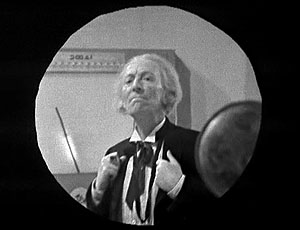
Then there’s the new Doctor himself. As Ben says, “It’s not just his face that’s changed, he doesn’t even act like him.” The Hartnell Doctor took a delight in seeing the spectacle of the universe, always wanting to know what was on the other side of the hill. The Troughton Doctor knows that it’s something horrible, something evil. The child-like delight is still in there, but this is a darker, more suspicious character, hovering ominously at the edges rather than marching boldly in. In many ways Whitaker is taking the show back to its origin, with the Doctor a mysterious, even dangerous presence and the audience identifying with his two human companions, snatched from contemporary Earth and not entirely trusting his motives. But, crucially, whereas the first Doctor was wrong to fear Ian and Barbara, Whitaker makes this new Doctor right to be suspicious. His dire warnings invariably come true. Here, Lesterson has been prying into corners of the universe that should have been closed off, and unearthing things that should have been forgotten. Like the protagonist of an M.R. James story, his crime is intellectual pride and curiosity, and his punishment is to unleash a demonic evil whose retribution is disproportionately cruel.

That’s a huge shift for the show: from the universe of wonders of the Hartnell years, to a universe of terrors for Troughton. Base under siege doesn’t just describe most Troughton stories – it’s an appropriate description for the whole tone of the era, where Earth and humankind are now besieged and at the mercy of terrible things from the cold, dark corners of the universe. That cosmic paranoia and creeping horror is going to be the norm for the show for most of the rest of its existence, and whether he’s visiting Earth or exiled there, from now on the Doctor is going to have to protect us.

Next Time: “We’re talking about the Daleks: the most evil creatures ever invented. You must destroy them!” It’s the final end on Skaro in The Evil of the Daleks

1965: The Chase

terrynation_dalekMay, 1965. Since our last entry, the Doctor, Ian and Barbara have rescued Briton of the future Vicki, caused Rome to burn, visited the planet of the insects and been caught up in a bizarre hybrid of comedy and timey-wimey sci-fi on the planet Xeros. No wonder as this story starts they’re all taking a week off.

There’s an old story that certain editions of Trivial Pursuit contained the question “Who created Doctor Who?” The answer given was Terry Nation. For many fans, that’s a laughable assertion given that Nation is more well known as the hack whom Barry Letts accused of trying to sell the same script four times. And there’s no doubt that Nation was at the least a lazy writer – this is his fourth script for the show and already he’s done two dead planets and two deadly jungles. But to focus on the repetitive elements in his work tends to overlook how much he actually did contribute to Doctor Who, and just how creative a writer he can be – even in a piece of work that’s as widely derided as The Chase.

The opening episode, for example, has some beautifully judged comic lines (unsurprising, given Nation started his writing career with a script for The Goon Show), and is as charming as anything the series has offered to date. And more than that, it’s clever enough to actually play with the idea of the series as a TV show by having the Doctor fire up his own space/time television and tune into various historical events, making the TARDIS the equivalent of the viewing public’s living room, to the extent of having the crew contend with fuzzy screens and BBC continuity announcers. Later, he has Ian – who’s already said a book on space monsters is “a bit far-fetched” – point out that Daleks don’t like stairs, just like everyone’s dad will have been doing for the last year. When we see this kind of playful self-awareness in Season 17, it is championed as another example of Douglas Adams’ legendary wit. We should equally praise Nation’s sophistication here.

But more than that, Nation is not only recognising Doctor Who as a TV show. He also makes The Chase into a celebration of the show’s clichés – the regulars keep getting knocked out, there are exotic locations that change unpredictably from alien planet to Earth history week on week, it’s a weird mix of horror and comedy, there at least five new monsters on top of the Daleks, Hartnell has an unconvincing stand-in and the whole thing is a chase. What’s astonishing is that most of the tropes of Doctor Who have already been nailed within its first 18 months on the air; that Nation consciously puts them all together, and even starts to poke fun at them, compressing what could be four or five serials into one.

What this means is that by May 1965, Doctor Who was enough of an institution to have its own recognisable house style, and The Chase is interesting because it plays as a rapid montage of all the different things the show can do. No wonder the Beatles are in it: this is Doctor Who’s version of their Help movie, another pop artefact inspired by the anarchic comedy of the Goons. And while Beatlemania was going on in the charts, Dalekmania was underway in the toyshops. Later in 1965 the Dr. Who and the Daleks movie was released. At this point the series was regularly pulling in audiences in excess of 10 million. This is as good as it got in the 1960s – and only Hinchcliffe-era Tom Baker and Series Four David Tennant have ever beaten it. In the space of 18 months, Doctor Who has gone from a mild curiosity in a junkyard to a British pop-cultural phenomenon – and this is the TV show’s ultimate expression of that. In the fourth episode, Terry Nation implicitly places the Daleks on a level of screen villainy equal to that of Dracula and Frankenstein’s monster. 48 years later, we can see he was dead right.

Ah, the Daleks. Because for all this is a celebration of Doctor Who, Nation never lets us forget it’s his creations that made the show a success. The first four Dalek stories are a fascinating study in escalating stakes. They start off plotting evil from their space city, then they conquer the Earth. Now, they’ve got a time machine and they don’t have to wait for the Doctor to come and disrupt their plans – they can follow him and wreck all his adventures. This is the first time that the Daleks know who the Doctor is. I suggested in the last post that the Doctor has defined the Daleks as his greatest enemy, and this helps establish him as a hero. The Daleks changed his nature. But equally, he has changed their nature: through knowing him, they have evolved into time travellers with the whole of the universe as their stage, and in a position to put the very nature of the Doctor’s power under threat. Before The Chase, the Doctor was unique in his ability to travel anywhere in time and space in a box that’s bigger on the inside. This is the first time he’s had to face a threat with the same power (and interestingly, in the very next story he’s going to have to face it again). And because they are now able to follow the Doctor anywhere in time and space, the Daleks are placing the show’s very ability to continue in danger. This serial has to be a chase, to show the Daleks can now drop into other space adventures or historicals. Everything the show has done to this point is unsustainable if the Daleks are not defeated. No wonder there’s an episode called The Death of Doctor Who: that’s exactly what’s at stake here.

It’s hard to think of how you can make the Daleks much more of a threat. Later in the year The Daleks’ Master Plan plays a clever sleight of hand by having the Daleks use their power over time as a threat to the universe rather than the Doctor himself. In many ways their next story is stronger because it’s better made, more obviously epic, and has two companion deaths with which to make its point. But it doesn’t strike at the heart of the series quite as much as this.

Of course, the Daleks are defeated. But again, there’s a price to pay. Having lost Susan at the end of the last Dalek serial, now Ian and Barbara say their goodbyes in a lovely little sequence that has them arrive back in a junkyard in London. But, here’s Nation’s last clever touch: rather than the Doctor taking them home, he and Vicki watch it all on TV. Six months ago, the show would have ended if the Doctor got Ian and Barbara home. Instead, the story finishes with the Doctor and Vicki switching off the telly and flying off into space and time to have more adventures.

And there you have it. The paradox of Terry Nation is also the paradox of The Chase: a shameless hack work that’s also deliriously inventive, showing a total disregard for the constraints of what could be done on TV in 1965 and in so doing showing what might be done. In a very real sense, Terry Nation did invent Doctor Who.

Next Time: “It’s not only his face that’s changed – he doesn’t even act like him.” The new Doctor faces an old enemy in The Power of the Daleks.

1964: The Dalek Invasion of Earth

Dalekinvasion_603November, 1964. Since our last post, the Doctor, Ian, Barbara and Susan have battled the alien Voord and visited the planet of the Sensorites, been caught up in various escapades in Earth’s history, and, most recently and oddly, shrunk to one inch tall. Now, at World’s End, they’ve arrived back where it all began – in what looks like a junkyard in London.

The opening episode of The Dalek Invasion of Earth consciously evokes An Unearthly Child. For a few minutes at least, the TARDIS crew believe that they’ve accomplished their year-long mission to return Ian and Barbara home. But it’s a false hope. And by the end of the story, this crew, this strange family who have grown together over the past 12 months, will be torn apart.

The story is interesting because it subverts what’s become the typical approach since, really The Daleks where the TARDIS crew explore their environment, try to work out where they’ve landed and only gradually understand the danger they’re in. Here, Terry Nation takes the familiar and gradually starts to make it unsettling. To an extent, this production team already tried that out in the last story, but this goes one better by actually pulling the rug from under the characters’ feet – Ian and Barbara’s joy of returning home gradually turning to horror as they discover the corpse in the river, the body in the warehouse, and the sinister posters warning it’s forbidden to dump bodies. And in the following episode, Nation makes us look askew at the familiar sights London by juxtaposing them with Daleks in Trafalgar Square and on Westminster Bridge. And in making London suddenly alien and unfamiliar, he is pre-empting a whole vast sub-genre of Doctor Who – in later years we’ll get supercomputers in the Post Office Tower, Cybermen outside St Pauls and the Great Intelligence in the Shard. But Nation got there first, inventing the Yeti on the Loo scenario.

Partly, this is just Nation going one better on his last Dalek script. I noted that the dead planet is a neat stand-in for a post-nuclear Earth. London here is as deserted and eerie as Skaro, and the story takes great delight in making the city seem as frightening as any alien world. And if the survivors are just human Thals, and the saucer is merely a stand-in for the earlier story’s Dalek city then it doesn’t really matter – the imagery is strong enough to make this a striking step forward in what this series can do.

That’s not the only step forward. The second episode is notable for giving us, at last, the Doctor as an implacable opponent of evil, dedicated to confronting the evils of the universe. Unlike the cranky alien Doctor of The Daleks, you sense that, even if he could just get back in the TARDIS and fly away, the Doctor would no longer be able to contemplate that course of action. Instead, he pledges to “pit his wits against [the Daleks] and defeat them”. So, what we have is an entire planet under the control of the Daleks, and the Doctor believes that he, a teenage girl and two schoolteachers from 1963 can bring them down. And, incredibly, we believe him. Not only that, but then he proceeds to mock their ambitions and call them pathetic. A whole raft of later scenes where the Doctor faces off against, and taunts, the villains –Tom Baker confronting Broton, David Tennant baiting the Sycorax leader, Matt Smith besting the Great Intelligence – start here.

If you watch The Dalek Invasion of Earth conscious that, regardless of broadcast dates, it was made as the end of the first production block – the show’s first “series finale”, if you like – it makes a lot of sense, as it brings to a head the character development of the first year. We started off last November with a mysterious and aloof character who, through his experiences with Ian and Barbara across those first 13 weeks, mellowed. Even then, on Marinus or in Mexico his concern was never to intervene in local difficulties, merely to explore and get back to his Ship and on to the next destination – hopefully Sixties London so he could divest himself of his kidnapped passengers. In The Sensorites, he finally took the plunge of investigating the Sensorites’ illness, but that was more akin to solving a puzzle than taking on evil. But now, he’s suddenly the self-appointed defender of the Earth. And he never goes back: from this story on, whether it be unmasking Koquillion or defeating the Carsenome, the series is taking a decisive move in making the Doctor the hero in his own series – and in so doing, guaranteeing the show’s survival if William Russell decides to leave.

But while making the Doctor a hero, The Dalek Invasion of Earth has one more nasty trick up its sleeve – what is given with one hand is taken away by the other. A wise man once wrote “he who wins shall lose” – and although the Doctor wins his first Earth-saving victory here, he does it at a terrible cost. One of his later incarnations says, “When you have something precious you run and run and run”, presumably referring to the flight from Gallifrey with Susan in tow. And so what should have been a triumphant moment, like so many later victories against the Daleks, is made bittersweet by the departure of someone the Doctor loves. His farewell to Susan, the choke in his voice as he says, “Goodbye my dear”, is the most moving moment in the first year of the series. It’s the first time he, and the audience, have had to say goodbye to a regular character. And it rightly hurts. In later years, Sara Kingdom, Tegan, Rose, Donna, even Ian and Barbara, will leave the Doctor after a battle with the Daleks. But you saw it here first. The Doctor, the man who saves the world, can never settle down, living a life, day after day, never rest, because there are always more evils to be fought, more stories to be told. Once he started running he never stopped. And his tragedy is that no-one else, not even his own granddaughter, can keep up with him forever.

Next Time: “They always survive, while I lose everything.” The Doctor runs, but the Daleks are right behind him. The chase is on…

1963: The Daleks

The-DaleksSo, the idea behind this blog is that in the lead up to Doctor Who‘s 50th anniversary in November 2013, I’ll pick one story per post. The gimmick is that I’ll pick a story from each of those 50 years – the only criteria being that the story has to have been first broadcast (or published) in the year in question.

And so we begin in 1963. But not at the very beginning. I love An Unearthly Child – yes, even the cavemen episodes – but it’s inevitably overshadowed by this, the first Dalek story. This is where it all really began – after four weeks of running round at the dawn of humankind, Terry Nation shows us how it might all end. How, in 1963, after the Cuban Missile Crisis, most people probably thought it would end, and probably quite soon. A dead planet soaked in radiation. Its cities intact but deserted – like the petrified trees and the fossilised monster in the jungle, a cruel mockery of life. The first episode is eerie in a way Doctor Who rarely can be now that it can’t spend 25 minutes purely following the regular cast. And it sells the idea that this is a desolate place, that the TARDIS crew are lonely wanderers, adrift in a vast, empty universe. It’s the kind of juxtaposition of the smallness of humanity and the vastness of the cosmos that Robert Holmes riffs on in The Ark in Space, with Sarah Jane listening to the sepulchral tones of the Earth president as she joins the rest of humankind in their space mausoleum. And later, Russell T Davies emulates in his first two episodes where the Doctor talks about feeling the turn of the Earth, and Rose witnesses its final end.

Of course, it might not have turned out this way. It’s probably fruitless to speculate at this late date how much of “Serial B” was suggested by the production office, because the sets and cast of The Dead Planet could almost serve as the introduction to Anthony Coburn’s The Masters of Luxor. Now we’re able to listen to a version of it thanks to Big Finish and can see the similarities in the premise – a beautiful but dead planet; a huge, seemingly deserted space city made of metal; the TARDIS drained of power and unable to take off; a first episode only featuring the four lead actors, and a race of robots with a pathological dislike of their humanoid neighbours. I wonder whether story editor David Whitaker pitched the concept to both Coburn and Nation, knowing what was affordable, what the BBC effects department could handle, and the kind of story he wanted to see – and then sat back to see what the writers made of this starting point.

But though The Masters of Luxor and The Daleks might have the same jumping-off point, they evolve in very different directions. The Daleks is half Cold War parable and half horror movie. The end of the first episode seems to explicitly reference Michael Powell’s infamous Peeping Tom, with Barbara being menaced by the camera with some kind of implement creeping into shot, just as the Peeping Tom killer filmed his victims as he stabbed them with an adapted tripod. It’s a classic Doctor Who cliffhanger, the girl in peril, that’s both frightening and voyeuristic, inviting us to share both in Barbara’s fear, and also relish it – the kind of pleasing terror that Doctor Who excels in. Later, we have the sequence of Susan being stalked through the forest as though she’s in a Val Lewton film

And then we meet the Daleks themselves. Everything about them suggests a production team that’s trying and succeeding at being iconic. The voices, the extermination effect, the immediately recognisable silhouette complete with all its unfathomable details of bumps and slats and plunger. All these have stood the test of time – even the derided iDaleks of the Matt Smith era hew pretty closely to the original template. Christopher Barry directs them beautifully, with low shots and sympathetic lighting, and Terry Nation includes the grisly detail that the real Dalek is too hideous to show (and going by Ian’s reaction to an image of them, their ancestor Dals weren’t much to look at either). They’re so successful they set the template for pretty much every Doctor Who monster that follows.

But more than that: even in their first appearance, the Daleks are already the Doctor’s ultimate enemy. Ian suggests their hatred of the Thals is a simple dislike of the unlike, a fear of anything that isn’t Dalek. The Cybermen want to convert you. The Master wants to rule over you. The Daleks want to exterminate you. Even though he’s at his least heroic for much of this story, the Doctor is expressly set up as an explorer, whose insatiable curiosity – his greed for knowledge, if you like – is his downfall. He wants to see the universe, to experience it. The Daleks want to destroy it. No wonder they hate each other.

In the next entry, we’ll see that the Daleks come to define the Doctor, making him a great hero by the sheer depth of their villainy. Time and again, they return when the Doctor is at risk of losing himself – and he rises to meet them. And even here, with none of that weight of back-story or audience expectation, something similar happens: the Doctor, at risk of becoming an anti-hero thanks to his selfish actions earlier in the story, chooses to side with the Thals to defeat the Daleks, when he could instead have sold them out to retrieve his fluid link. The Time War – a battle between Time Lords (two of them, anyway) and Daleks for the sake of all creation – begins here. And 50 years later, it still goes on.

Next Time: The Doctor, Susan, Ian and Barbara land 200 years in the future. They’re back on Earth. But the Daleks are waiting at World’s End.

Doctor Who at 10

Yes, so I failed my 2014 New Year’s Resolution to keep my blog up to date. Shame on me. 2015, however, is going to be a different story. Possibly.

Anyway, as a first baby-step towards actually keeping the blog up to date, I’ll be transferring in the posts I originally wrote for a 2013 project called Doctor Who: 50 Years, 50 Stories – a kind of personal meander through the stories I thought told the wider history of the programme. As with this blog, I kind of got diverted in the second part of 2013 and the project stopped with the 1991 post. So one thing I’m going to try to do is finish it and bring it up to date in time for the 10th anniversary of the new series.

He’s back – and it’s about time…

So, three months into 2013 and I’m finally getting round to my New Year’s resolution to keep this blog regularly updated. In the next few weeks I’ll be adding my final batch of Doctor Who in the 1980s reviews (covering the McCoy years). And over at 50 Years, 50 Stories I’ll be doing my bit for the golden anniversary.

The idea behind the other blog is that in the lead up to Doctor Who‘s 50th anniversary in November 2013, I’ll pick one story per post. The gimmick is that I’ll pick a story from each of those 50 years – the only criteria being that the story has to have been first broadcast (or published) in the year in question. The overall aim is to try to identify, through choosing one story to represent each year, how Doctor Who has changed and developed over that time, what the main milestones have been, and which innovations have helped the show survive 50 years. The first two posts – covering 1963 and 1964 – are up now, so please take a look and let me know what you think.