Sideways in Time: Daleks’ Invasion Earth 2150 A.D. (19/8/1972)
‘There’s always an answer to be found if you only dig deep enough.’ In every respect this is a superior movie to Dr. Who and the Daleks, dropping most of the laboured comedy and making the most of its significantly bigger budget to bring the highlights of the TV serial (i.e., not the Slyther) to the cinema screen, IN COLOR!. And yet, released in August 1966 after the peak of Dalekmania and during a period of reduced Doctor Who TV audiences, it didn’t capture the public imagination. Nor do I imagine it had quite the same impact on TV audiences on first broadcast in August 1972 – coming just seven weeks after the debut of Dr. Who and the Daleks.
It’s a shame. It came to cinemas during the TV series’ summer break and while kids had seen the shiny new Post Office Tower in The War Machines, now they could see its ruins the background of conquered London. It was the first time that audiences saw TV-accurate Daleks in colour (the movie props have been repainted in silver and blue, with the design modifications introduced in The Chase), led by a Gold Dalek – an idea revisited in Day of the Daleks. In general, I think this looks really good. It can’t be entirely coincidental that the film’s Robomen, in their shiny PVC uniforms (with ungloved human hands) and helmets, appeared a couple of months before the conceptually similar Cybermen made their debut.
And I wonder whether Peter Cushing’s performance here provides more of a reference point for recasting TV’s Doctor Who. The old man quirks are toned down; he has a chipper good humour, and some nice gags (‘Back in the cell?’ he says to a Dalek when he’s caught escaping). But he also looks genuinely pensive at points, while managing to save the day through a mix of bluff and improvised brilliance, notably lacking the stern authority of Hartnell’s Doctor. In short, this is pretty similar to how Patrick Troughton tackles the role in his first series – and with David Whitaker contributing to the film script not long before writing The Power of the Daleks, there must surely have been some cross-pollination.
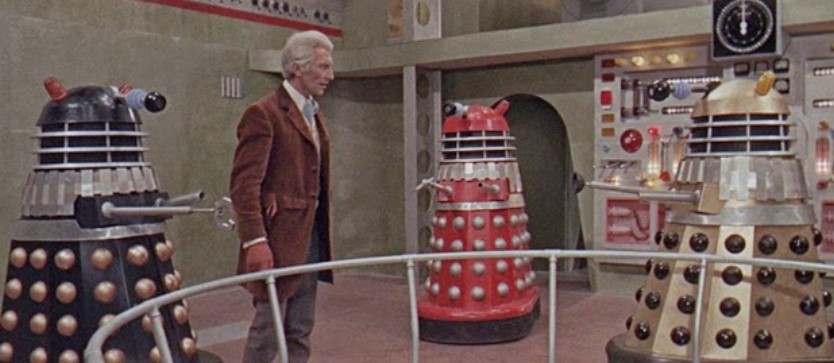
The movie’s strengths are its cast, which is tremendous (Cushing, Cribbins being immensely likeable, Andrew Keir, Philip Madoc doing his best Harry Lime, Ray Brooks), and some of the cinematography (particularly some stylish moments of Cushing looking heroic aboard the Dalek saucer, the entire saucer attack sequence, and the scenes in the Daleks’ Beford HQ). The rebels might look quite well-dressed for desperate survivors, but the sets and locations do a good job of selling a post-war, defeated Britain (much grittier than Technicolor Skaro and its fey Thals).
The script is generally better than Dr. Who and the Daleks’, wisely pairing Tom and Louise (who gets almost as little material as Barbara in the first film), and giving Roberta Tovey the chance to charm Andrew Keir. The main downside is that in condensing a six-part serial to a cool 84 minutes, a lot of connective tissue is sacrificed. The Doctor becomes a rather passive receiver of information before suddenly plucking the solution from the air. I also miss the TV serial’s iconic sequences of the Daleks in deserted London. Ultimately, despite their vast budgetary disparities, The Dalek Invasion of Earth was so influential that the film, however solid, feels inessential. Of the two Amicus films, I much prefer this, while acknowledging it has never made the same impact.
Next Time: The Three Doctors
Next Sideways in Time: An Unearthly Child …
 Next Time...
One comment